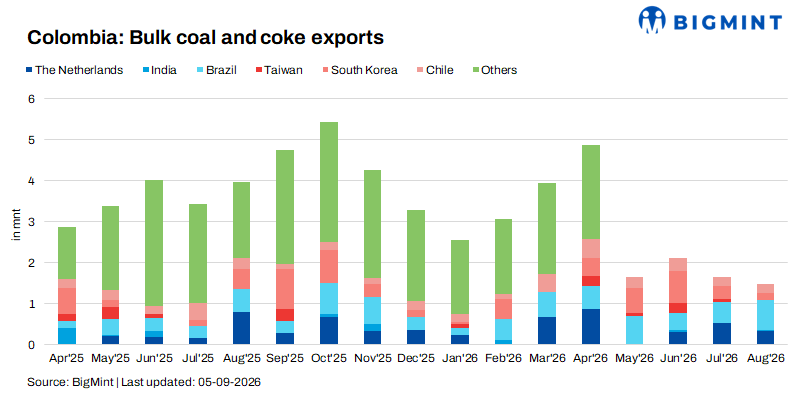
- Aug exports rise 23% y-o-y to highest monthly volume in CY’26
- Atlantic destinations gain as long-haul freight costs rise
Colombia’s coal exports strengthened sharply in August 2026, reaching 4.9 mnt, up around 20% m-o-m and 23% y-o-y, and marking the strongest monthly volume so far this year.
The recovery was overwhelmingly driven by non-coking coal exports, which rose to 4.48 mnt. Yet cumulative exports remained broadly flat, with January-August shipments at 30.64 mnt, around 1% below the same period of 2025.
More significant than the headline increase is the changing destination mix. Colombian coal is being distributed across a broader Atlantic-basin customer base, while shipments to some Asian markets have fallen sharply. At the same time, rising Capesize freight costs are making long-haul movements increasingly expensive.
August marks strongest month of 2026
The trend has improved materially since the weak first quarter. Exports exceeded year-earlier levels in four of the five months from April through August.

Volumes also climbed from 3.33 mnt in May to 4.26 mnt in June, 4.10 mnt in July and 4.90 mnt in August, pointing to stronger second-half momentum.
Thermal coal drives the recovery
Non-coking coal accounted for more than 90% of August exports. Cumulative thermal coal exports reached 27.12 mnt during January-August 2026, slightly above 26.71 mnt in the corresponding period of 2025.

Met coke exports moved in the opposite direction, falling to 2.93 mnt from 3.59 mnt a year earlier.
The improvement is therefore essentially a thermal-coal recovery.
Export geography shifts toward Atlantic markets
Colombia’s thermal coal trade remains highly diversified.

The clearest shift is away from some long-haul Asian destinations.
India received around 2.17 mnt of Colombian non-coking coal in January-August 2025, compared with only around 0.06 mnt in 2026. Taiwan similarly declined from 2.37 mnt to around 0.76 mnt.
At the same time, Brazil rose to 3.14 mnt, Mexico to 2.09 mnt and Turkey to 2.10 mnt, while Morocco, Poland and Guatemala also absorbed meaningful volumes.
This points to a more Atlantic-focused trade pattern.
Freight increasingly matters
The timing of this geographical shift is important because long-haul freight costs have risen sharply.
Capesize markets tightened in early September as South Atlantic charterers rushed to secure vessels, while Brazil-China freights climbed to around $40.10/t, close to a five-year high.
For Colombian thermal coal, indicative freight economics on 3 September showed a large distance penalty:

Freight alone does not explain the fall in Indian and Taiwanese demand, but it strengthens the economics of selling Colombian coal closer to the Atlantic basin.
Europe adds another potential pull
Europe could also become more relevant heading into winter.
CIF ARA 6,000 NAR coal was around $136/t in early September, while European gas prices were elevated and Germany was examining whether around 7 GW of reserve hard-coal capacity could potentially be made available to the wholesale market during periods of high power prices.
Q4 generation costs were projected at around EUR 122/MWh for an older coal plant versus EUR 163/MWh for a standard gas-fired plant, underlining coal’s improved relative economics.
That does not yet translate into a clear surge in Colombian exports to Europe, but it increases the potential for additional Atlantic-basin competition for Colombian tonnes.
Outlook
Colombia’s August performance shows a market recovering strongly from a weak start to the year.
The bigger story, however, is geographical. Brazil, Mexico, Turkey and other Atlantic markets are absorbing more Colombian thermal coal, while India and Taiwan have become much less prominent.
With Capesize freight elevated and European winter fuel risks increasing, this may represent more than monthly volatility.
Colombia’s thermal coal trade appears to be gradually reorienting toward the Atlantic basin, where freight economics and potentially stronger winter demand could provide increasing support through the remainder of 2026.
Leave a Reply