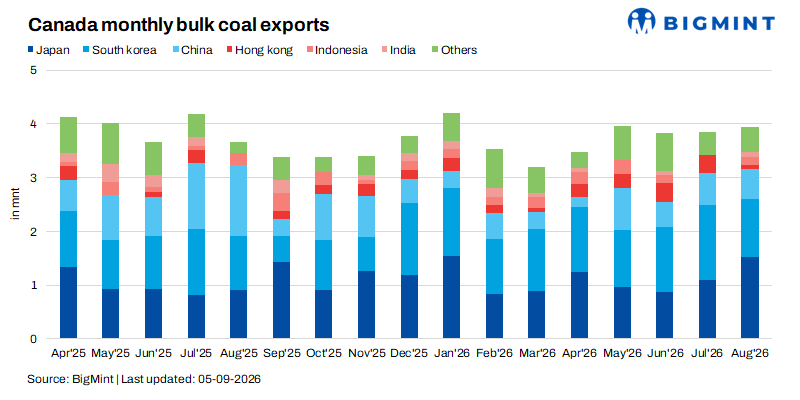
- Japan, South Korea gain as China-bound volumes retreat
- Coking coal exports rise to their highest monthly level of 2026
Canada’s coal exports strengthened to 3.95 mnt in August 2026, up around 8% from 3.66 mnt in August 2025 and marginally above July’s 3.85 mnt.
The headline, however, conceals a sharp divergence between products. Coking coal exports rose to 3.63 mnt, their highest monthly level of 2026, while non-coking coal shipments fell to just 0.32 mnt, the year’s lowest.
The geographical pattern is equally significant. Canada remains overwhelmingly dependent on Asian markets, but the destination mix within Asia is changing: Japan and South Korea have strengthened, while coking coal shipments to China have fallen sharply from 2025 levels.

Canadian exports have shown gradual improvement since March’s 3.20 mnt low, reaching 3.48 mnt in April, 3.96 mnt in May and remaining around 3.8-4.0 mnt during June-August. August was the strongest month since January.
Yet cumulative exports of 29.99 mnt remained around 2% below January-August 2025, indicating that the recent improvement has largely recovered earlier weakness rather than produced significant full-year growth.

The stronger August result was entirely a metallurgical coal story.
Coking coal exports jumped almost 18% m/m and 21% y-o-y to 3.63 mnt, surpassing January’s 3.40 mnt to reach the highest monthly volume of 2026.
Non-coking coal moved sharply in the opposite direction, falling from 0.78 mnt in July to only 0.32 mnt in August. This divergence changed Canada’s export mix substantially: coking coal accounted for around 92% of August shipments, compared with roughly 82% in August 2025.
China loses ground in Canada’s coking coal trade
The more structural change becomes visible when coking coal destinations are compared.

The most striking shift is China.
China received around 7.25 mnt of Canadian coking coal during January-August 2025, making it Canada’s second-largest destination after Japan. In 2026, that volume fell to only 3.42 mnt, a decline of more than half.
Japan moved firmly into first position with 8.87 mnt, while South Korean shipments increased to 4.08 mnt.
Canada has therefore managed to maintain overall coking coal exports relatively well despite losing substantial Chinese demand because other Asian markets have absorbed more tonnes.
Aug shows China recovering, but Japan leads
The August destination pattern is particularly interesting.

A year ago, China was Canada’s largest coking coal destination in August at 1.31 mnt. By August 2026, Chinese shipments had fallen to 0.56 mnt.
Japan simultaneously increased from 0.90 mnt to 1.53 mnt, while South Korea more than doubled from 0.35 mnt to 0.75 mnt.
The August export increase was therefore achieved despite substantially lower Chinese buying, demonstrating how Canada’s metallurgical coal trade has been redirected across Northeast Asia.
Non-coking exports remain concentrated in South Korea
Canada’s smaller non-coking coal business is considerably less diversified.
South Korea received around 5.32 mnt of Canada’s 6.11 mnt non-coking coal exports during January-August 2026, equivalent to roughly 87% of the total.
This concentration also helps explain August’s sharp decline. South Korean non-coking shipments fell to around 0.32 mnt, compared with 0.69 mnt in July and 0.67 mnt in August 2025.
Interestingly, despite August’s weakness, cumulative non-coking coal exports remain substantially higher: 6.11 mnt in January-August 2026 versus 4.90 mnt a year earlier, an increase of roughly 25%.
Canada’s export geography is broadening within Asia
The key signal from Canada’s August data is therefore not simply stronger export volumes.
Canada’s coking coal export engine regained momentum, reaching its highest monthly level of 2026 even as its relationship with its major Asian buyers changed considerably.
China’s sharp retreat has been partly counterbalanced by stronger shipments to Japan, South Korea, Hong Kong and Indonesia, while smaller flows into Europe have also increased. India, by contrast, has become a smaller destination for Canadian coking coal.
This leaves Canada’s export portfolio less dependent on China than it was in 2025, but still heavily dependent on Northeast Asian steelmaking demand.
August’s 3.63 mnt coking coal result suggests that diversification has so far been sufficient to support export volumes. Whether Japan and South Korea continue absorbing larger Canadian tonnages will be critical to determining whether the late-summer momentum can be sustained.
Leave a Reply