- Scrap offers to India rise on firm domestic prices, stronger demand
- Fresh bookings, tight Australian supply support Bangladesh prices
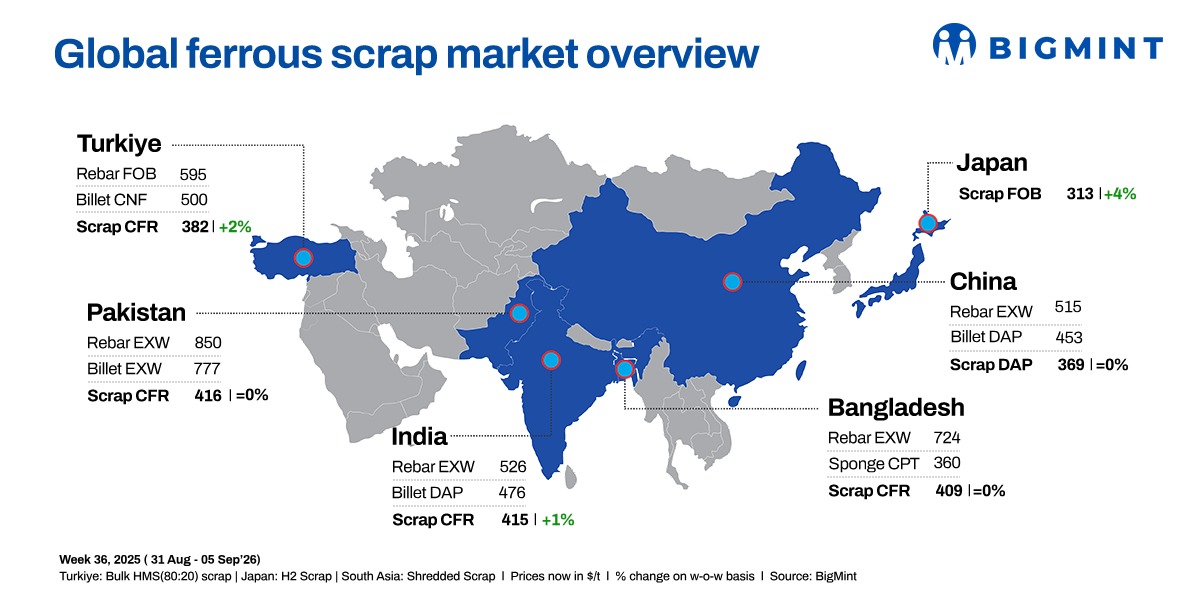
Global ferrous scrap markets showed mixed trends on September 5, with Turkiye and India recording firm prices, while Pakistan remained subdued and Bangladesh stayed elevated. Japan and UAE markets were largely stable amid cautious buying and limited price movements.
Turkiye: Deep-sea imported scrap prices strengthened during the week, rising from $375/t CFR on 31 August to $382/t levels as of 5 September as firm rebar offers, wider scrap-to-rebar spreads and improved mill margins supported buying. Deals included Netherlands HMS 80:20 at $370.5/t CFR and US material at $380/t, while sellers targeted $385-386/t.
Prices stabilised by September 4, with Baltic HMS 80:20 booked at $375/t CFR and EU material reportedly at $371/t. Market participants still expect further gains as mills seek October shipments, although some buyers may pause around $380/t to assess whether higher scrap costs can be passed on through rebar prices.
India: Imported containerised scrap prices firmed throughout the week, supported by rising domestic scrap prices and stronger buying interest as the monsoon season nears its end. HMS 80:20 deals were reported at $365-375/t CFR Mundra, while offers moved above $375/t. UK shredded was offered at $412-420/t CFR India.
However, buyers remained cautious at higher levels, with HMS 80:20 considered workable around $355-365/t. A 10-FCL HMS cargo was booked at $350/t CFR Mundra, while payment terms influenced pricing, with earlier payment attracting discounts of $10-12/t.
Towards the weekend, activity in Chennai remained slow, although sellers maintained firm levels. UK shredded was offered at $412-415/t and HMS at $360-365/t CFR India. Rising freight costs remained a concern, but had yet to fully reflect in scrap prices. Janmashtami festival hampers were also distributed to market participants.
Pakistan: The imported shredded scrap market remained subdued throughout the week, weighed down by monsoon disruptions and limited buying interest. UAE-origin shredded was offered at $420-430/t CFR Qasim, while UK-origin material was around $418-420/t. A UK-origin cargo was booked at $415/t CFR Qasim, but buyers remained reluctant to accept offers above $420/t.
Container shortages, higher freights, and a stronger GBP raised import costs, while cautious buying and the wide bid-offer gap limited fresh business. Prices could rise $5-6/t, potentially reaching $10/t if shortages persist.
Additionally, Pakistan’s ferrous scrap imports rose 11% y-o-y to 1.67 mnt in H1CY26, despite a 26% decline in crude steel output to 1.39 mnt. Imports recovered sharply in June to 0.32 mnt, up 33% m-o-m and 68% y-o-y, offsetting weaker March-April volumes.
Bangladesh: The imported scrap market remained firm through the week, supported by fresh bookings, limited Australian cargo availability and firm local scrap prices at BDT 54,000-55,000/t. Philippines HMS 90:10 traded at $378/t CFR Chattogram, while UK shredded was offered at $410-412/t and HMS 80:20 at $370-375/t. US bulk HMS 80:20 offers held around $390/t, although buying interest remained weak.
Japanese H2 offers remained elevated at $375-380/t CFR Chattogram, with levels above $385/t later heard. However, weak Japanese domestic mill buying and rising freight costs kept buyers cautious, limiting fresh bulk deals.
Japan: H2 export scrap prices remained rose by JPY 500/t at JPY 48,800/t ($312/t) FOB Tokyo Bay.
EVERSTEEL, backed by Mitsui & Co., partnered with recycling firm Kokko to develop AI-based systems for scrap inspection, sales, factory operations and logistics, targeting greater digitalisation and operational efficiency.
UAE: Processed HMS 80:20 was the main exception, rising by AED 11/t ($3/t) week-on-week to AED 1,010-1,020/t DAP, excluding 5% VAT. Other grades remained largely unchanged, with LMS (pure) at AED 780-800/t. UAE steel market faces demand and logistics pressure. Meanwhile, billet availability has tightened across the GCC, creating another supply-side challenge for UAE re-rollers.
Leave a Reply