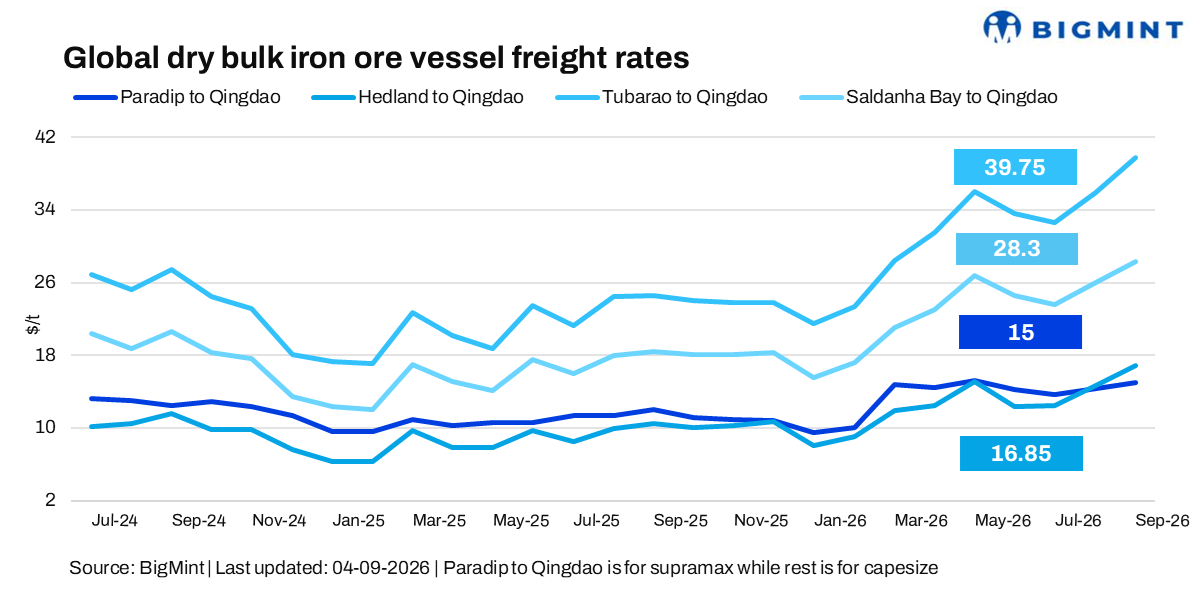
- Capesize rates reach record highs on key Pacific, Atlantic routes
- Weather disruptions, higher bunkers add to voyage costs
Dry bulk iron ore freight rates strengthened sharply across tracked export routes in the week ended 3 September, led by a strong rally in Capesize rates. The Baltic Capesize Index (BCI) rose significantly, supported by firm cargo activity, heavy fixing and tightening vessel availability across major basins.
Capesize rates surged on both Australia-China and Atlantic-China routes, with multiple fixtures pushing market levels higher. Hedland-Qingdao and Tubarao-Qingdao rates reached all-time highs since BigMint began tracking the routes in August 2023, highlighting stronger owner leverage amid limited prompt tonnage and sustained iron ore demand. Saldanha Bay-Qingdao rates also increased, while Paradip-Qingdao Supramax rates posted a modest gain.
A shipbroker said, “The market was “very busy”, with heavy C3 fixing activity and rising FFA rates supporting the strong Capesize market.”
Weather disruptions, longer vessel positioning requirements and firm miner activity further tightened effective tonnage availability. Rising bunker prices also added to voyage costs and supported freight rates. However, cautious Chinese steel demand and mixed mill margins could cap further gains.
Route-wise update

Factors influencing freight rates
- Baltic Dry Index surges w-o-w: The BDI jumped 14.1% (432 points) to 3,488, led by a 20.1% (1,009 points) rise in BCI to 6,042, while BSI gained 1.5% to 1,668. Gains were supported by strong Atlantic-Pacific cargo activity, tighter vessel availability and firm iron ore and coal demand, keeping dry bulk sentiment bullish.
- DCE iron ore futures rebound w-o-w: The benchmark contract rose by RMB 3/tonne (t) to RMB 719.5/t ($107.12/t) from RMB 716.5/t a week earlier. The rebound was supported by lower port arrivals amid typhoon disruptions and a modest recovery in steelmaking demand, although rising coke costs and still-cautious mill buying limited the upside.
- Brent crude futures surge w-o-w: Brent crude futures for the November 2026 contract rose by $6.75/barrel (bbl) (7.6%) w-o-w to $95.15/bbl, from $88.40/bbl. The sharp rebound was driven by renewed US-Iran tensions, heightened Middle East supply risks and disruptions to shipping through the Strait of Hormuz, while potential diplomatic progress and higher Iraqi exports capped some upside.
- Bunker prices rise w-o-w: Singapore VLSFO bunker prices increased by $71/t (9.2%) w-o-w to $843/t, from $772/t. The increase tracked the broader recovery in crude prices, with Middle East supply and shipping disruptions adding upward pressure to marine fuel markets.

Outlook
Dry bulk iron ore freight is likely to remain firm in the near term, particularly across Capesize routes, as strong fixture activity and limited prompt tonnage continue to support rates. Atlantic and Pacific markets could remain volatile amid weather disruptions and changing vessel positioning, while higher bunker costs may provide additional support. However, the sustainability of the rally will depend on Chinese steel demand, mill buying activity and continued miner cargo flow.
Leave a Reply