- Shortage of pellets, coal, sponge iron lifts rebar production costs
- Production cuts, maintenance downtime at mills reduce supply
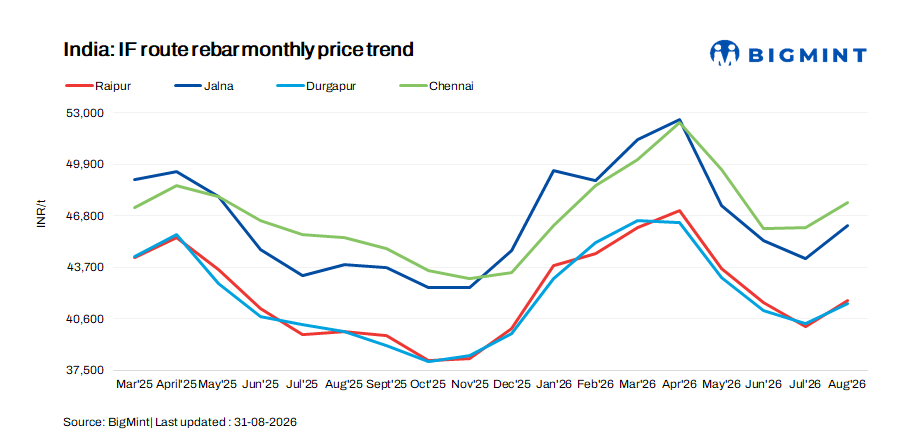
India’s induction furnace (IF)-route rebar prices witnessed a strong recovery across major markets in August, rising by INR 2,700-5,800/t m-o-m. The sharpest increase was recorded in Jalna, where prices surged by INR 5,800/t. The broad-based rally pushed prices across several key markets to four-month highs, marking a sharp turnaround from the lows witnessed in July.
The price recovery was supported by improving market sentiment and a gradual improvement in construction activity as monsoon disruptions remained relatively limited during the month. Buying activity improved across major markets, with traders and end-users stepping up purchases amid expectations of further price increases. Mills also reduced spot discounts as rising production costs provided stronger support to offers.
Mill inventory and order-book visibility varied across regions, with inventories largely at around 6-8 days and order bookings at 5-7 days. However, western markets witnessed significantly stronger booking momentum, with order books extending to around 12-15 days. The increase in primary mill prices also provided support to secondary producers, enabling them to raise offers while maintaining the prevailing price differential.
Region-wise price movements
In the central region, rebar prices rose by INR 5,100-5,500/t in August, driven by a shortage of pellets and coal, which pushed up rebar production costs. Production cuts of up to 65% at several mills, along with shutdowns and maintenance at some plants, further tightened market availability. Demand remained moderate to good, with buying activity improving particularly from the mid-month onward, supporting the upward price movement.
In northern India, rebar prices increased by INR 4,100-5,000/t m-o-m in August, led by Jaipur INR 5,000/t and Muzaffarnagar INR 4,500/t. The rise was driven by higher raw-material costs and tight sponge iron and billet availability, further aggravated by maintenance shutdowns, GST checks, and the Khanauri border strike. Mills operated at around 50-60% capacity, limiting supply and supporting prices. Meanwhile, conversion margins in Mandi improved to INR 5,000-5,500/t, aided by higher rebar realisations.
In the west, IF-route rebar prices surged by INR 3,400-5,800/t in August, led by Jalna at INR 5,800/t, followed by Ahmedabad at INR 4,100/t, and Mumbai at INR 3,400/t. Healthy mill bookings of 12-17 days, easing rainfall and improved retail and project demand supported prices. Tight scrap availability and limited imports pushed billet offers higher, prompting rebar mills to raise offers and protect margins.
In eastern India, rebar prices recovered on the back of higher raw material costs, improved buying activity, and better material movement. Ex-Durgapur prices rose INR 1,200/t m-o-m to INR 41,500/t, while Rourkela Fe 500 increased INR 1,500/t to INR 41,200/t. Sentiment improved from July lows, supported by lower inventories and better demand, although overall consumption remained moderate. Conversion margins stayed negative for most of August, improving toward breakeven by month-end.
In the southern market, rebar prices increased by INR 2,000-2,500/t, driven by higher sponge iron and billet prices and improved finished steel demand. Stronger buying from distributors and end users supported better material movement and higher offers, keeping sentiment firm to positive. Higher rebar realisations largely offset rising billet costs, keeping conversion margins stable to slightly positive.

Raw material price trends
The sharp recovery in rebar prices in August was primarily supported by higher raw material costs. Firm coal and pellet prices, stronger metallics demand, and improved DRI economics against scrap raised production costs and strengthened mills’ pricing power. Tight availability of key inputs further supported the upward trend.
Non-coking coal prices surged to INR 6,900/t in August from INR 5,650/t in July, while met coke prices increased to a monthly average of INR 35,850/t from INR 35,350/t. Pig iron prices also rose by INR 770/t m-o-m to INR 38,600/t, adding to billet production costs.
PELLEX, tracking pellet prices in Raipur, increased by INR 700/t m-o-m to INR 10,400/t, supported by tighter supply, active buying from sponge iron producers, and limited availability of suitable fines. A major pellet producer also remained shut for around 45 days from mid-July, further tightening regional availability.
Melting scrap (HMS 80:20, DAP Mandi Gobindgarh) prices rose by INR 1,800/t m-o-m to a monthly average of INR 36,300/t, with the latest assessment on 29 August at INR 39,400/t.
Limited domestic availability and weak import economics kept scrap prices elevated. Imported HMS traded at an average premium of INR 3,400/t over domestic scrap in Jalna during January-August 2026, versus INR 1,100/t in the year-ago period, discouraging import bookings.
BF rebar sentiment
BF-route rebar prices rose INR 4,200/t m-o-m to INR 55,000/t ex-Mumbai on 27 August, supported by stronger retail and project demand, improved construction activity and higher booking volumes. Prices were also supported by tight rebar availability as several mills remained under maintenance, while some producers paused fresh bookings. Lower distributor inventories and expectations of further price gains encouraged buyers to advance procurement.
Meanwhile, higher coking coal costs added to production expenses, with PHCC prices rising $23/t to $282/t CNF Paradip. Limited supply, firm demand and elevated input costs strengthened producers’ pricing power. Overall, the market remained firm, with supply constraints and healthy demand providing continued support to rebar prices.
Outlook
Rebar prices are expected to remain firm in the near term, supported by healthy mill order books, eased inventory pressure and elevated raw-material costs. Maintenance shutdowns at primary mills and the gradual resumption of project-led and retail demand are likely to keep market sentiment positive. With limited sales pressure and improved ground-level activity, mills are likely to maintain price discipline amid supportive market fundamentals. However, sustaining higher price levels will depend on fresh booking momentum and buyers’ acceptance of elevated offers after recent procurement.
Leave a Reply