- Coal prices rise sharply as rains, power sector demand tighten supply
- Scrap imports decline by 42% y-o-y in Jan-Jul’26 amid elevated costs
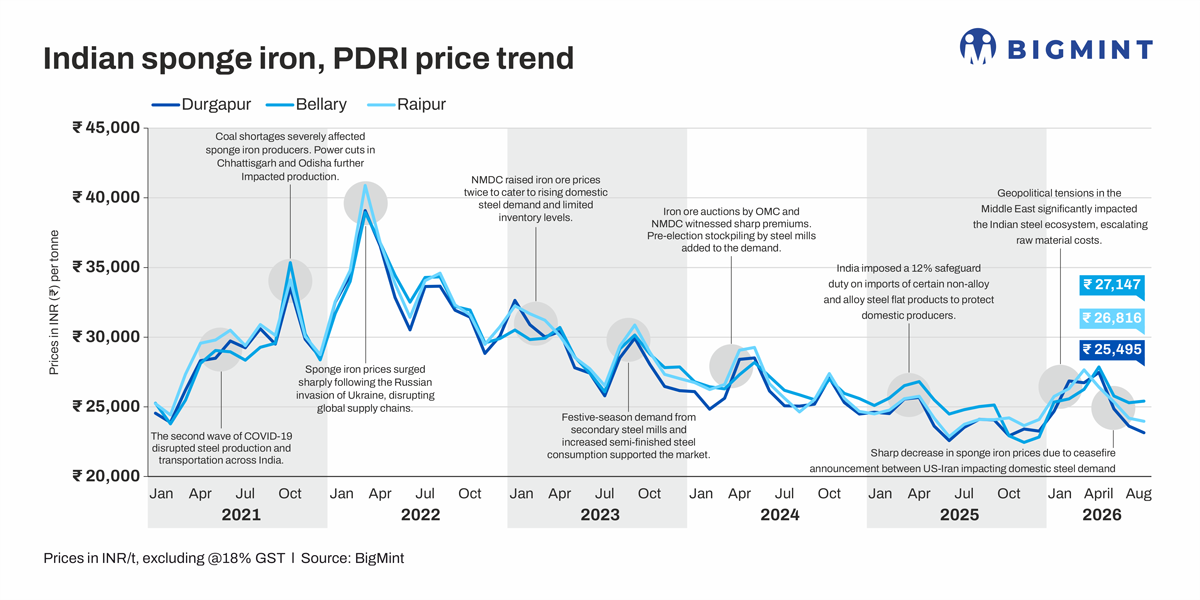
Indian sponge iron prices strengthened sharply in August 2026, with BigMint’s Raipur PDRI benchmark rising by around INR 2,700/t m-o-m to a monthly average of INR 26,700/t compared to INR 24,000/t in July. Prices continued to rally through the month, reaching INR 29,700/t on 29 August, the highest level recorded in the past two years, while the monthly average marks a four-month high, last seen in April 2026.
The sharp recovery from July lows was driven by higher coal and pellet costs, improved metallics demand, and stronger DRI economics against scrap. Tight pellet availability and rising raw material costs also improved producers’ pricing power, supporting the sustained upward momentum in sponge iron prices.
 Coal prices surge on monsoon-related disruptions
Non-coking coal prices (5000 GCV) increased to around INR 6,900/t ex-Bilaspur in August from INR 5,650/t in July, increasing the production costs of sponge iron producers. Heavy rainfall during the monsoon has slowed SECL dispatches and affected the consistency of preferred coal grades, while lower auction frequency across CIL subsidiaries have restricted fresh availability.
Sponge iron producers across major manufacturing clusters have said that while domestic coal is available through auctions and linkages, deliveries have become increasingly unpredictable because railway rake availability has tightened. Meanwhile, most dispatch efforts have been directed towards sustaining thermal generation as electricity demand remains elevated.
Pellet prices increase on tight supply
PELLEX, tracking pellet prices in Raipur, increased by INR 700/t m-o-m to INR 10,400/t, driven by tighter pellet supply, active buying by sponge iron producers, and limited availability of suitable fines. Notably, a major pellet producer kept its production suspended for around 45 days since mid-July.
Rising prices, tighter scrap supply push mills towards sponge iron
Melting scrap (HMS 80:20, DAP Mandi Gobindgarh) prices also rose by INR 1,800/t m-o-m to a monthly average of INR 36,300/t, with the latest assessment on 29 August placing prices at INR 39,400/t, making sponge iron comparatively more economical and strengthening demand from secondary steelmakers.
To illustrate, in Jalna, sponge iron prices (PDRI, DAP) were around INR 2,200/t lower on average than scrap (HMS 80:20, DAP) during April-July. The scrap premium widened from a monthly average of INR 200-250/t in January to INR 2,600-2,700/t by May and INR 3,200/t by June.
However, this gap narrowed to around INR 1,700/t in July, and by the end of August, sponge iron and scrap prices reached parity. In fact, sponge iron prices exceeded scrap by a minor INR 40/t as sponge iron demand remained strong and production costs were elevated.
In recent months, producers in the western and northern belt, traditionally dependent on scrap, have been sourcing DRI due to limited availability of scrap, as imports remain uneconomical. Notably, India’s ferrous scrap imports fell sharply by 42% y-o-y to 2.73 million tonnes (mnt) in January-July 2026, according to BigMint data. Imports dropped to their lowest level in five years, as domestic scrap remained much cheaper.
BigMint notes that the major steelmakers increased the share of sponge iron in their metallic charge to around 30-35% during January-July 2026 from 15-20% previously, while the smaller mills raised DRI usage to 40-45% from around 20-25%. Most of the incremental sponge iron requirement was sourced from West Bengal, Odisha, Chhattisgarh and Karnataka, India’s key DRI-producing states.
Outlook
BigMint expects sponge iron prices to rise further in September, supported by improving finished steel prices and higher coal and pellet costs. Firm raw material replacement values are likely to keep producer offers elevated, while improved steel demand could provide additional support to sponge iron consumption and prices.
However, the resumption of pellet production at a major producer may normalise Raipur’s pellet supply dynamics and soften prices. Similarly, a potential increase in non-coking coal supply, with improved import bookings, may weigh on prices, ultimately capping the support from raw material costs. Steel demand, however, may improve as construction activity resumes while the southwest monsoon recedes.
Leave a Reply