- Chinese supply constraints lift metallurgical coal across Asia
- Coke and PCI follow coking coal sharply higher
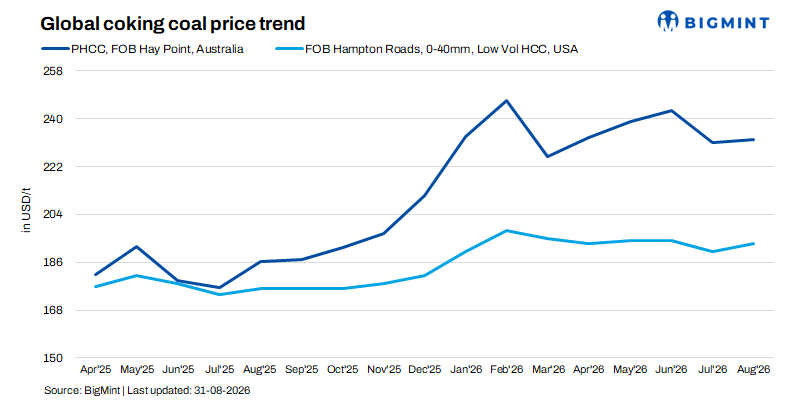
Global metallurgical coal markets strengthened further in late August as supply disruptions in China tightened availability across the steelmaking raw-material chain. Australian premium hard coking coal (PHCC) rose to $265/t FOB Australia on 27 August, Russian low-vol PCI traded at $205/t CFR China, while Indonesian 65/63 CSR metallurgical coke changed hands at $310/t FOB for shipment to India. Domestic blast furnace-grade coke prices in India have also climbed to their highest level in more than two years.
Unlike previous rallies driven primarily by stronger steel demand, the current move reflects tighter raw-material availability. Chinese mine accidents, safety inspections and slower mine restarts have reduced domestic coking coal supply, while weaker Mongolian imports have increased China’s dependence on seaborne cargoes. As procurement shifts towards Australian and Russian material, higher coking coal prices are feeding into PCI, coke and blast-furnace costs across Asia.
Chinese supply disruptions tighten the seaborne market
Chinese domestic coking coal production remained constrained during August following mine accidents, safety inspections and slower mine restarts across Shanxi and other mining regions.
Imports from Mongolia also weakened. Coal haulage through Ganqimaodu averaged 986 trucks/day during 17-23 August, down 7.9% w-o-w, compared with around 1,300 trucks/day in July and roughly 1,400 trucks/day during May-June. Mongolia supplies more than 60% of China’s metallurgical coal imports.
The weaker flows followed a 13.5% m-o-m decline in Mongolian metallurgical coal imports to 6.21 million tonnes in July, while inventories at major Chinese ports fell to around 3.34 million tonnes by 21 August. Lower domestic supply and weaker Mongolian arrivals increased Chinese buying of Australian and Russian cargoes, tightening availability across the seaborne market.
Australian PHCC leads the rally
Australian premium low-vol PHCC was assessed at $265/t FOB on 27 August, after a 75,000-tonne Saraji cargo for 11-20 October loading traded at that level. CFR China reached $283.50/t, while BigMint’s PHCC CFR India index rose $15/t w-o-w to $280/t CNF Paradip.
The forward market remained firm, with Q4 2026 trading around $266/t FOB, Q1 2027 at $267.50/t, and Q2 2027 at $268.80/t.
Buying interest, however, has become more selective. Chinese consumers are showing greater caution towards forward cargoes where November arrival prices offer limited margins against domestic coal, suggesting prompt supply remains tighter than longer-dated availability.
Chinese buying lifts PCI prices
Chinese procurement has also tightened the PCI market. Russian low-vol PCI traded at $205/t CFR China, while Russian mid-vol PCI changed hands at $190/t CFR China. Low-vol PCI CFR China rose $4.5/t in a single day on 27 August, with tradable values ranging between $195-205/t. Australian low-vol PCI was indicated at $185-194/t FOB Australia.
For India, Russian mid-tier PCI was indicated at $181-190/t CFR, with offers extending to $195/t for October shipment, reducing the availability of cargoes that would otherwise be directed towards other Asian buyers.
Higher coal costs lift metallurgical coke prices
Rising coking coal prices are now feeding directly into metallurgical coke.
Chinese coke producers have implemented two rounds of price increases, while the market remains focused on whether a third round can be achieved. Even after the increases, higher coking coal costs have limited margin recovery for coke producers.
On 27 August, Chinese 62/60 CSR wet-quenched coke was indicated at around RMB 1,820/t DDP North China, while dry-quenched material traded near RMB 2,110/t. Export offers for 65/63 CSR coke were around $320-330/t FOB.
Supply tightened further in Indonesia, where a 20,000-tonne cargo of 65/63 CSR coke traded at $310/t FOB for mid-November shipment to India amid limited alternative supply.
Indian blast furnace-grade domestic metallurgical coke has increased to around INR 37,000/t ex-Jajpur, while Indonesian import parity has also moved higher. Higher coking coal costs are increasingly flowing through to coke production costs, raising blast-furnace input costs and adding upward pressure on pig iron and steel prices.
Atlantic cargoes gain competitiveness
The strongest price gains remain concentrated in the Pacific market.
US East Coast low-vol HCC was assessed at $202/t FOB on 27 August, compared with $177.5/t for High Vol A and $163/t for High Vol B. The widening discount to Australian PHCC improves the competitiveness of US, Canadian and other Atlantic-origin cargoes for Indian buyers where blending requirements permit.
Freight continues to influence delivered costs. Australia-to-India Panamax freight stood at around $21.50/t, compared with approximately $50/t from the US East Coast. Even so, sustained Australian prices above $260/t FOB are likely to encourage greater diversification of supply.
Indian buying could return after the monsoon
Indian mills have remained cautious following the recent rally, supported by comfortable inventories and sharply higher replacement costs.
Buying interest is expected to strengthen as the monsoon recedes. Market participants have already reported enquiries for September-loading prime coking coal cargoes, while tighter Indonesian coke availability could encourage mills to increase direct purchases of coking coal.
Any post-monsoon restocking by Indian mills would coincide with continued Chinese procurement, further tightening the seaborne market if supply constraints persist.
Outlook
Chinese domestic supply, Mongolian import flows and Chinese seaborne procurement remain the principal drivers of the metallurgical coal market. Tighter Indonesian coke availability and firmer Russian prices continue to reinforce the current strength across the steelmaking raw-material chain.
A recovery in Mongolian truck movements towards 1,300-1,400 trucks/day, together with a broader restart of Chinese coal mines, would ease some of the prompt tightness in PHCC, PCI and metallurgical coke. If those constraints persist into the fourth quarter, however, Indian post-monsoon buying could coincide with sustained Chinese demand.
Under that scenario, Australian PHCC is likely to remain around the mid-$260s/t FOB, PCI near $200/t CFR China, while imported metallurgical coke remains above $330/t CFR India.
Leave a Reply