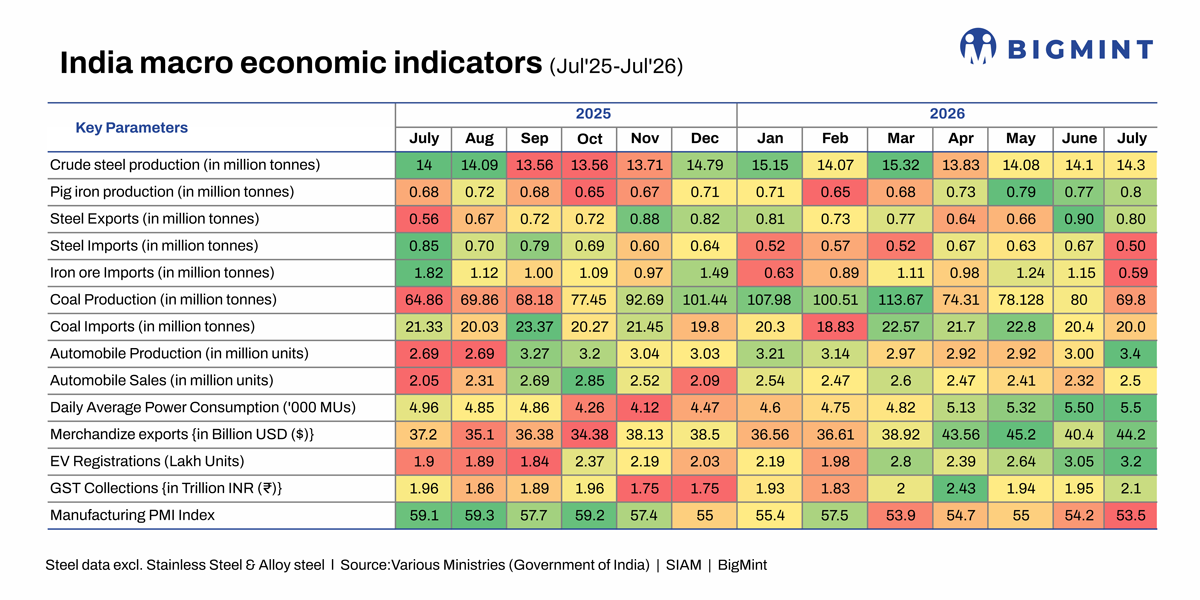
- Steel output, exports, automobile production strengthen
- Coal production, manufacturing PMI and iron ore imports weaken
- Forward-looking indicators point to slower momentum across parts of the economy
Morning Brief: India’s crude steel production rose to 14.3 million tonnes in July from 14.1 million tonnes in June, extending the resilience of investment-led sectors despite softer signals from manufacturing and mining. Merchandise exports climbed to $44.2 billion, automobile production reached a record 3.4 million units, and electric vehicle registrations touched a new high. In contrast, manufacturing PMI eased to its weakest level in recent months, coal production declined sharply and iron ore imports nearly halved.
The divergence is significant for commodity markets because current demand indicators remain supportive while several forward-looking indicators have begun to soften. Steel, automobiles and exports continue to point to healthy industrial activity, but manufacturing sentiment, mining output and raw material procurement warrant closer attention. Whether this reflects seasonal monsoon disruptions or the beginning of broader moderation will become clearer over the coming months.
Steel demand remains supported by manufacturing, exports
Steel and downstream manufacturing continued to underpin industrial activity during July. Crude steel production increased to 14.3 million tonnes, while pig iron output rose to 0.80 million tonnes, the highest monthly level in the current data series.
The external sector also strengthened, with merchandise exports rebounding to $44.2 billion from $40.4 billion in June, supporting export-oriented manufacturing at a time when global trade conditions remain uncertain.
Vehicle production climbed to a record 3.4 million units, while sales improved to 2.5 million units. Electric vehicle registrations reached 3.2 lakh units, extending the structural shift towards cleaner mobility and supporting demand across steel, aluminium, copper and battery supply chains.
Daily average power consumption remained at 5.5 billion units, unchanged from June despite the onset of the monsoon, indicating that electricity demand remained resilient through the month.
Forward indicators point to softer momentum
Several indicators that typically signal future industrial activity weakened during July, with manufacturing PMI easing to 53.5 from 54.2 in June, remaining in expansionary territory but recording its weakest reading in recent months. Coal production declined to 69.8 million tonnes from 80 million tonnes, while coal imports remained broadly stable at 20 million tonnes, compared with 20.4 million tonnes a month earlier.
Raw material procurement also softened. Iron ore imports fell to 0.59 million tonnes from 1.15 million tonnes in June, while finished steel imports declined to 0.50 million tonnes from 0.67 million tonnes, the lowest monthly level in the current data series.
The contrast between resilient steel production and softer mining and procurement indicators suggests that current industrial activity has remained firm even as some leading indicators have begun to moderate.
Domestic demand continues to hold up
GST collections increased to INR 2.10 trillion in July from INR 1.95 trillion in June, pointing to continued economic activity despite the seasonal effects of the monsoon.
Vehicle sales also improved during the month, although manufacturers continued to produce more vehicles than were sold, with output reaching 3.4 million units against sales of 2.5 million units. The gap suggests inventory build-up ahead of the festive season rather than any weakening in production plans.
Outlook
July’s macroeconomic indicators suggest India’s investment cycle continues to underpin demand for industrial commodities. Steel production, pig iron output, exports, automobile manufacturing and electricity consumption remained resilient through the month, indicating that infrastructure, manufacturing and export-oriented sectors continue to support commodity demand.
The softer readings in manufacturing PMI, coal production and iron ore imports are the indicators to watch through the remainder of the monsoon. A recovery in these measures would suggest July largely reflected seasonal disruption.
A further weakening, however, would indicate that the moderation is extending beyond mining into the broader industrial economy. For commodity markets, the balance of evidence continues to favour resilient current demand, while the direction of the leading indicators will determine whether that momentum can be sustained in the months ahead.
Leave a Reply