- Suppliers keep scrap offers firm even as mills buy selectively
- Post-summer rebar demand remains crucial for stronger scrap buying
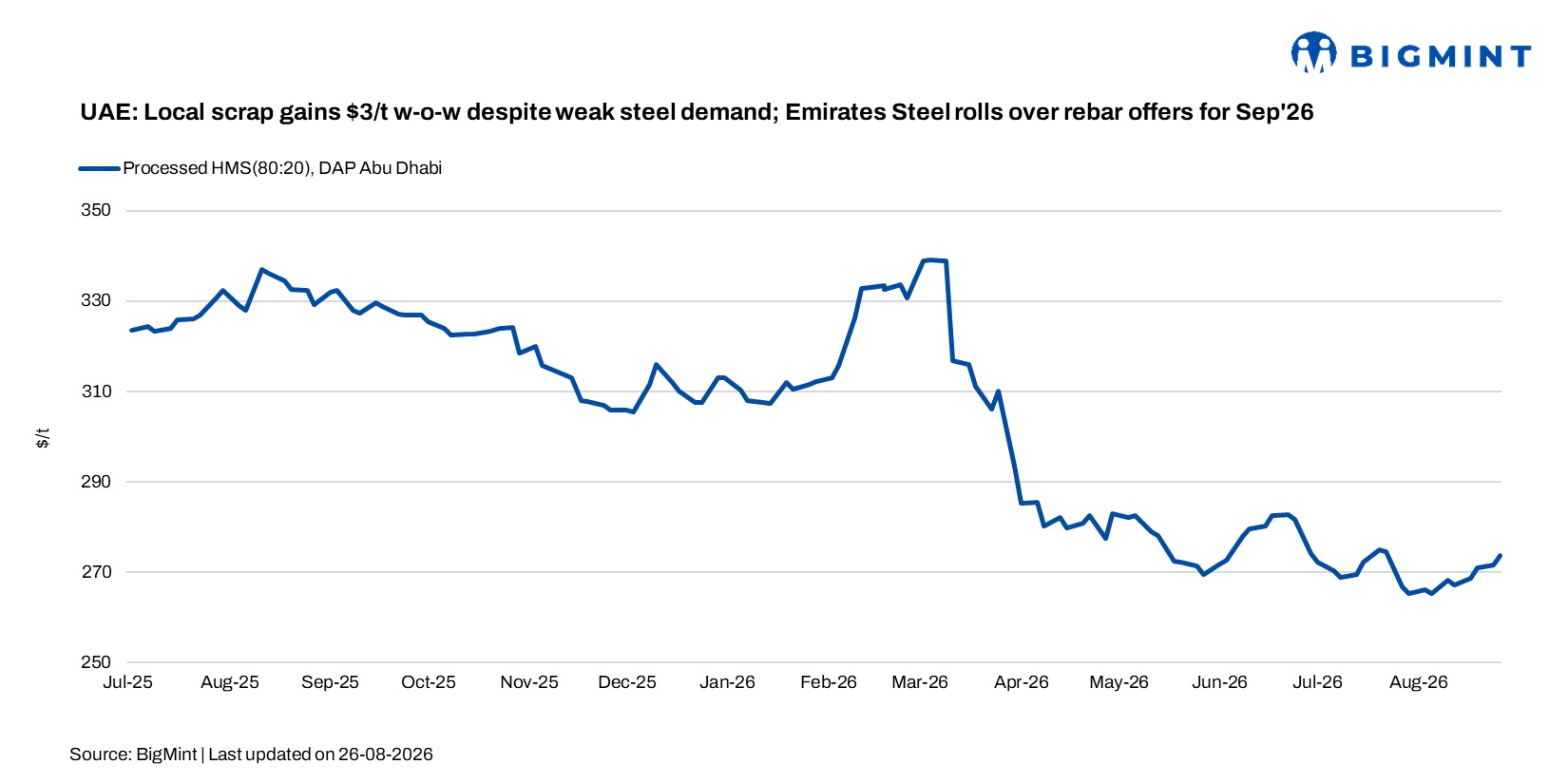
BigMint assessed processed HMS 80:20 at AED 1,006/t ($274/t) DAP Abu Dhabi, up AED 10/t ($3/t) w-o-w. The firmness in local scrap prices was supported by firm replacement economics and steady supplier offers, despite weak underlying steel demand.
According to Dubai-based market participants, the UAE local scrap market remains relatively firm, with processed HMS offers from major steelmakers heard around AED 1,000-1,020/t ($270-275/t). Buying, however, remains largely requirement-based, with mills avoiding aggressive inventory building amid limited visibility on finished-steel orders.
A major Abu Dhabi-based steelmaker indicated domestic processed HMS offers at around AED 1,000-1,010/t ($270-273/t) and shredded at around AED 1,060-1,070/t ($289-291/t). The source said mills are still purchasing mainly against immediate production requirements rather than building inventories, while scrap suppliers remain reluctant to lower offers, keeping the market firm.
PNS was heard at AED 950-960/t ($257-259/t) unprocessed and AED 970-980/t ($262-265/t) processed, while fabrication scrap was around AED 1,020-1,030/t ($275-278/t). End-cuts, mainly rebar, were among the higher-priced grades at AED 1,090-1,110/t ($294-300/t), while LMS remained at the lower end at around AED 780-800/t ($211-216/t).
On the rebar side, Emirates Steel rolled over its September benchmark offer for 12-32 mm at AED 2,921/t ($795/t) exw, unchanged from July and August. The offer remains valid on 90-day LC terms, with an additional AED 92/t ($25/t) surcharge for 8 mm rebar.
August transactions were heard at around AED 2,870-2,890/t ($781-787/t) DAP, below official offers of AED 2,900-2,920/t ($790-798/t). Mills had to offer discounts as buyers resisted higher prices amid weak seasonal demand and limited bookings.
 The September rollover suggests producers are defending benchmark levels while waiting for post-summer construction activity to improve.
Other domestic and regional suppliers are also expected to keep offers broadly stable, although actual transaction prices will depend on booking volumes and buyer acceptance. Strong supplier competition and liquidity constraints are likely to limit significant price increases in the coming weeks.
Regional steel market
The broader GCC steel market remains under pressure. Crude steel production fell nearly 20% y-o-y to around 1.5 mnt in July, while January-July output declined 3% to 11.5 mnt. UAE crude steel production also fell 3% y-o-y to around 2.1-2.2 mnt during the first seven months of 2026.
Saudi Arabia’s scrap market continues to trade above UAE levels. In the western region, premium scrap was around SAR 1,950-1,960/t ($507-511/t), bonus scrap at SAR 1,870-1,880/t ($486-490/t) and mixed resized scrap at SAR 1,800-1,810/t ($468-472/t) and mixed resized at SAR 1,700-1,720/t ($442-450/t), mixed oversized at SAR 1,640-1,650/t ($426-429/t) and light scrap at SAR 1,520-1,530/t ($395-398/t).
In the central region, scrap prices were reported at SAR 1,750-1,800/t ($455-468/t) DAP. In the eastern region, Hadeed’s buying prices were around SAR 2,050-2,070/t ($532-538/t).
Logistics and raw-material supply
The Strait of Hormuz disruption continues to complicate imported raw-material procurement, with restricted vessel movements, longer delivery times and higher freight and insurance costs raising replacement costs for steelmakers.
The impact is also visible in the UAE logistics sector, where logistics and maritime employment declined 3%, compared with a 2% decline across the GCC, as lower freight activity reduced manpower requirements.
For steelmakers, raw-material deliveries are becoming more costly and less predictable, adding pressure while finished-steel demand remains weak. However, the impact is more relevant to imported raw materials and replacement costs than domestic scrap availability.
Outlook
Based on current buying patterns, local scrap prices are likely to remain stable to slightly firm in the coming weeks. Mills are expected to keep purchases requirement-based, while suppliers are likely to hold current offers amid firm replacement costs.
Post-summer rebar demand will be the key driver. Better construction activity and rebar bookings could encourage mills to rebuild scrap inventories, while continued weak demand would keep buying cautious and limit further price gains.
Leave a Reply