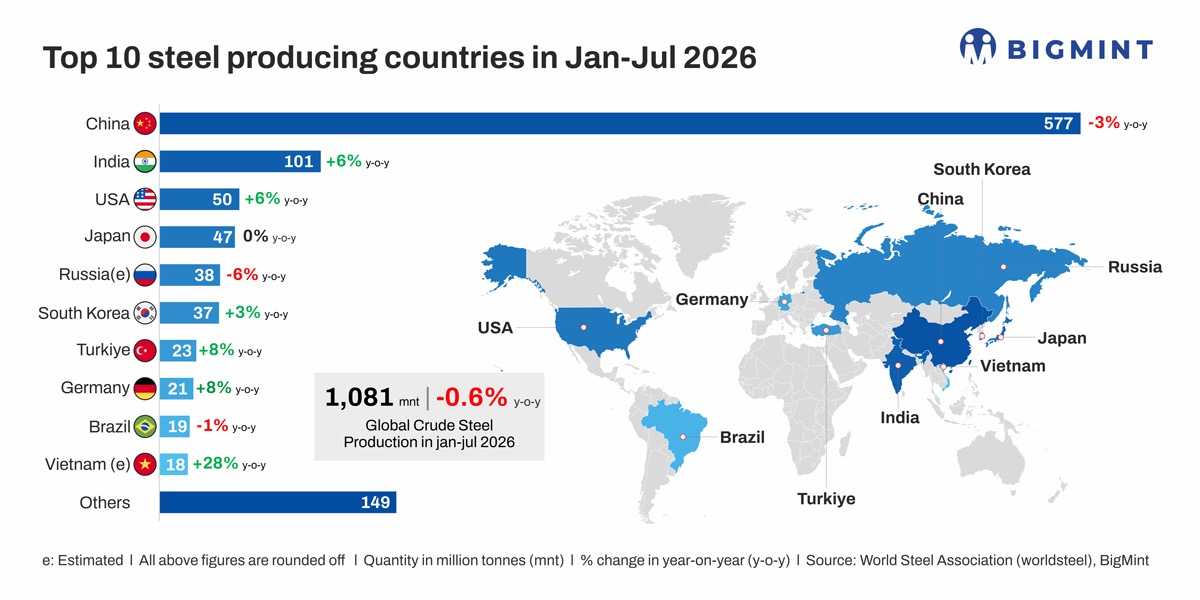
- China remains biggest drag as production declines 3%
- Output from India, US rises 6% amid robust steel demand
- Capacity expansions drive 28% surge in Vietnamese output
Morning Brief: Global crude steel production fell 0.6% y-o-y to 1,081.2 mnt in January-July 2026, extending the decline seen since the start of the year. However, the pace of contraction has eased in recent months. Output fell 0.3% y-o-y in May, rose 1.7% in June, and slipped only 0.3% in July, pointing to a gradual stabilisation in global production.
China remained the largest drag, with output down 3.1% y-o-y. However, stronger production in other parts of Asia and Oceania limited the regional decline to 0.9%. EU-27 production rose 0.4%, driven by a 3.8% increase in July, while North American output climbed up by 5.4%. Middle East production fell 8.1%, although the decline remained well below the sharp contraction seen after the outbreak of the US-Israel-Iran conflict.
Highlights of top 10 producing countries in Jan-Jul’26
China’s crude steel production fell 3.1% y-o-y as weak property activity, subdued manufacturing, and limited infrastructure support weighed on demand. Rising inventories and mounting trade barriers in major export markets added pressure on mills, while Beijing’s focus on curbing overcapacity and its “anti-involution” drive encouraged production discipline. Higher raw material costs since March-April also squeezed mill margins, reducing the incentive to raise output.
India maintained strong growth of 6.1%, although the pace moderated as mills undertook maintenance occasionally and capacity additions slowed somewhat. The medium-term outlook remains positive, supported by rising urbanisation, infrastructure spending, and manufacturing expansion. However, a weaker rupee, higher inflation, and softer macroeconomic conditions linked to the Middle East conflict could weigh on the market eventually in the year.
The US recorded 6% growth during January-July, supported by strong steel demand from manufacturing and data centre construction. According to Japan Metal Daily, US hot-rolled coil (HRC) prices reached the $1,300/t level for the first time in over four years, supported by a 50% additional tariff on steel imports under Section 232 and strong demand from commercial facilities and data centres.
Japan’s crude steel production declined 0.3% y-o-y in January-July, narrowing from a 0.4% decline in the first half. Improving orders from the automotive, industrial machinery, and construction sectors point to a gradual demand recovery. However, high material costs and labour shortages continue to limit the pace of recovery in construction and manufacturing.
Meanwhile, shipbuilding also remains a strong area of demand. Japanese shipbuilders had orders totalling 30.09 million gross tonnes across 628 ships at the end of June, equivalent to about 3.5 years of work.
Russia’s crude steel production declined 6.1% despite a 3.3% increase in July. Western sanctions, weak domestic demand, high interest rates, and a strong rouble continued to weigh on Russian steelmakers. The loss of traditional export markets also compounded weak demand at home, limiting the scope for a sustained recovery in production.
South Korea recorded a modest 2.7% increase. Government measures to support the domestic steel industry, including stricter import controls and a move towards melt-and-pour requirements, are helping protect domestic producers.
Domestic HRC sales benefited from anti-dumping measures on Chinese and Japanese imports, although exports remained under pressure from tighter EU safeguard measures and stronger import restrictions in other markets. South Korea has also announced a $54 billion support programme for its steel industry amid the impact of the Middle East conflict.
Turkiye’s crude steel production rose 7.9% y-o-y, supported by improving domestic demand. In H1, finished steel output increased 5.6% to 21.94 mnt, while domestic consumption rose 6.6% to 19.85 mnt. Exports increased 2.5% to 7.84 mnt, while imports edged up 0.3% to 9.27 mnt.
However, Turkish producers continue to face higher energy costs and the impact of the EU’s Carbon Border Adjustment Mechanism, which could affect competitiveness in European markets.
Germany’s crude steel output increased 8.1%, but the rise largely reflects a low base and inventory replenishment rather than a broad recovery in steel demand. Demand from construction, mechanical engineering, and automotive sectors remained weak, while annual crude steel output is still expected to be around 37 mnt, below the level needed for economically viable capacity utilisation.
Brazil’s output declined 1.2% as heavy imports and weak exports continued to weigh on producers. Brazil has extended its steel import quota regime for another 12 months, with reduced tariffs of 10-16% within quotas and a 25% duty on volumes above the quota.
Vietnam recorded the strongest growth among the major producers, with crude steel output rising 28%. The increase reflects capacity expansion, particularly Hoa Phat Group’s Dung Quat 2 plant, as well as stronger domestic demand. Construction steel remained a key consumption driver, while manufacturing growth has supported higher domestic flat steel supply.
Outlook
Global crude steel production is likely to show a smaller y-o-y decline in the remaining months of 2026 despite a continued downtrend in Chinese production. India, the US, Vietnam, Turkiye, and South Korea are likely to continue driving growth, while output from the EU and Japan is also projected to recover from low levels. Consequently, growth outside China should increasingly offset part of China’s decline.
China will remain the main swing factor. Although weak property demand, high inventories, lower mill profitability, and tighter export conditions are limiting production growth, robust manufacturing exports may incentivise mills to keep production high.
Moreover, the EU’s new, lower steel import quotas could also pose a downside risk for several exporting countries such as India, Japan, South Korea, and Turkiye by reducing their access to a key export market.
Meanwhile, global manufacturing sentiment weakened in August, with the PMI falling to a five-month low of 52.1, as geopolitical and economic uncertainty, tariff concerns, conflicts, and high energy prices weighed on demand and increased risks to factory output.
Overall, the global production decline is likely to narrow further as output stabilises across major markets. However, a sustained return to growth will depend on a firmer recovery in Chinese steel demand, stronger manufacturing activity, and an improvement in global trade flows.
Leave a Reply