- Wheel scrap tightness continues to support premiums
- Domestic tense scrap demand shows improvement
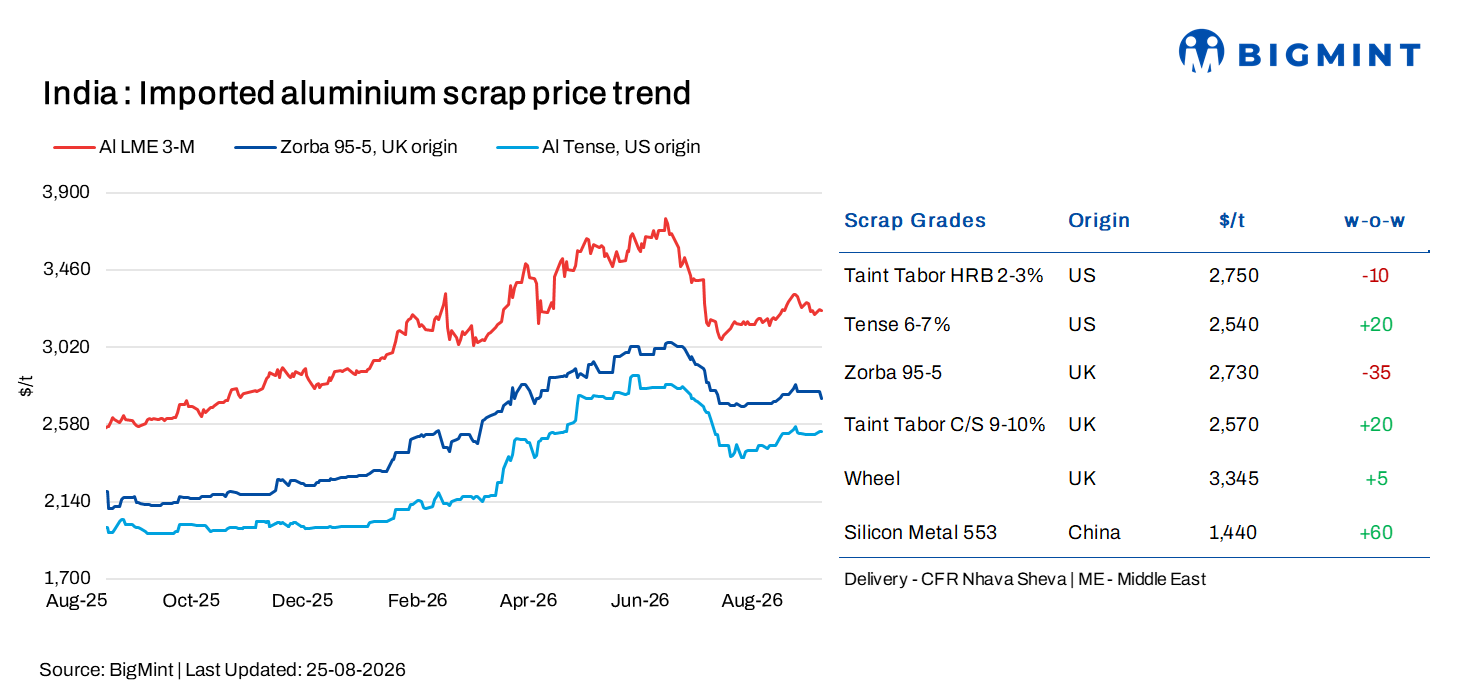
India’s imported aluminium scrap prices displayed a mixed trend w-o-w, amid the decline in LME aluminium prices and varying availability across grades.
According to BigMint’s latest assessment for CFR Nhava Sheva deliveries, US-origin taint tabor HRB 2-3% scrap prices declined by $10/t w-o-w to $2,750/t. Meanwhile, US-origin tense 6-7% scrap prices increased by $20/t w-o-w to $2,540/t, supported by relatively tighter availability.
LME aluminium prices decline 1.1% w-o-w
Three-month aluminium prices on the London Metal Exchange (LME) declined by $37/t, or 1.1% w-o-w, closing at $3,235/t on 24 August, compared with $3,272/t on 17 August. Prices came under pressure amid weak downstream demand, concerns over the pace of China’s seasonal demand recovery, and expectations of rising overseas aluminium production, which outweighed support from relatively low exchange inventories.
Meanwhile, LME aluminium inventories remained unchanged at 246,925 t over the week, limiting fresh supply-side support for prices. The market also remained volatile, with weak demand sentiment and macroeconomic uncertainty keeping aluminium prices largely range-bound.
Market scenario
The global imported aluminium scrap market remained subdued this week, with trading activity largely quiet amid LME aluminium price volatility and uncertainty over price direction. Buyers largely restricted purchases to immediate requirements, while sellers remained cautious in releasing fresh offers. Aluminium wheel scrap availability remained tight globally, supporting premium levels, while EU-origin trading stayed subdued as market participants awaited next month’s decision on the proposed 15% export levy on aluminium scrap.
In India, imported aluminium scrap trading remained particularly quiet over the past few days, with only a few deals reported for HRB Taint Tabor 2-3%, while Tense and Zorba activity was very slow. A trader said buyers remained cautious amid uncertainty over near-term price direction.

Meanwhile, domestic tense scrap prices have started to rise as market activity improves. Demand from end users is expected to strengthen from next month as imported ADC12 inventories decline, prompting buyers to return for fresh alloy supplies and potentially supporting demand for domestic tense scrap.
The trader also highlighted the Pre-Shipment Inspection Certificate (PSIC) requirement as a major concern for the aluminium scrap trade, particularly following a recent sudden notice. Under the revised process, PSIC certificates need to be uploaded on the date of loading and inspection, along with several additional restrictions, making compliance difficult and impractical for market participants.
This has created uncertainty for containers already in transit where certificates have not been uploaded, while the temporary closure of the website for updates has added to the disruption. The trader noted that PSIC-related issues have persisted for around 1.5 months, following the withdrawal of several inspection agencies and the absence of designated agencies in certain countries, further complicating scrap imports.
Outlook
The near-term outlook for India’s imported aluminium scrap market remains cautious amid subdued buying, LME volatility, and ongoing PSIC-related uncertainties. However, improving domestic tense scrap demand and tight wheel scrap availability could provide some support, while the upcoming EU scrap export levy decision remains a key market factor.
Leave a Reply