- U.S.-Canada tariff escalation raises aluminium trade-flow concerns
- Chinese aluminium group considers $2 billion Egypt complex
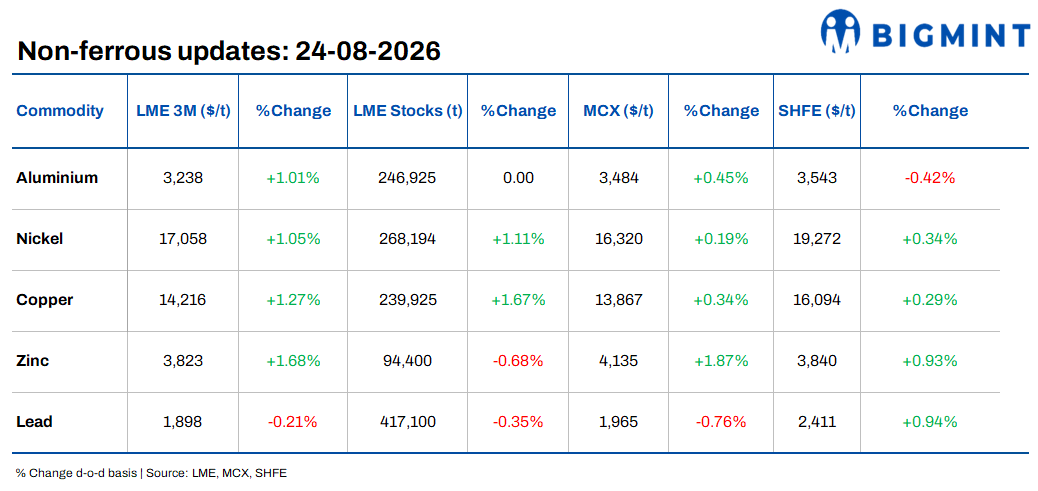
LME base metals traded mixed on 23 August, with four of five metals advancing while lead declined. Zinc recorded the strongest gain, rising 1.68% d-o-d to $3,823/t, followed by copper, up 1.27% to $14,216/t, and nickel, which gained 1.05% to $17,058/t. Aluminium advanced 1.01% to $3,238/t, while lead slipped 0.21% to $1,898/t.
LME inventories recorded mixed trends d-o-d. Copper stocks recorded the steepest rise, up 1.67% to 239,925 t, followed by nickel, which gained 1.11% to 268,194 t. Zinc stocks fell 0.68% to 94,400 t, lead inventories declined 0.35% to 417,100 t, while aluminium stocks were unchanged at 246,925 t.
Domestic market overview
India’s non-ferrous scrap market witnessed higher prices across the reported grades on 23 August. Aluminium tense scrap (loose), ex-Delhi, rose by INR 3,000/t (1.21%) d-o-d to INR 250,000/t, while ex-Chennai prices gained INR 1,000/t (0.41%) to INR 246,000/t.
Meanwhile, copper armature scrap (Cu 99%), ex-Delhi, increased by INR 2,000/t (0.15%) d-o-d to INR 1,302,000/t from INR 1,300,000/t. The move came alongside higher LME copper prices, which advanced 1.27% to $14,216/t.

Other updates
Oil retreats ahead of expected Iran sanctions
Brent crude fell 1.64% to $92.84/bbl, while WTI declined 2.34% to $85.02/bbl on 24 August. Traders took profits ahead of expected new U.S. sanctions on Iran. However, oil prices had gained more than 5% in the previous week.
The earlier rise came amid concerns over shipment disruptions through the Strait of Hormuz. Energy markets remain relevant to aluminium because primary smelting requires high electricity consumption. Therefore, renewed disruptions could increase energy and freight costs. However, the latest oil decline has limited direct impact on aluminium fundamentals.
China’s bauxite imports rise 17.5% in H1 2026
China imported 121 Mt of bauxite in H1 2026, up 17.5% from 103 Mt a year earlier. Lower import prices supported the increase. The average SMM imported bauxite CIF index fell about 26% y-o-y to $66.37/t.
Meanwhile, concerns over a possible cap on Guinean exports encouraged Chinese buying. The trend supports feedstock demand across China’s alumina and aluminium value chain. However, higher imports could also reflect inventory building.
U.S.-Canada tariff escalation raises metals trade risks
The United States imposed 50% tariffs on around $20 billion of Canadian goods after trade talks broke down. Canada plans dollar-for-dollar retaliation from 8 September.
Steel and aluminium tariffs were central to the failed talks. As a result, further escalation could change North American aluminium trade flows and raise regional premiums. It could also encourage greater domestic sourcing in the U.S. Meanwhile, downstream consumers and Canadian producers could face higher pressure.
Chinese aluminium group considers $2 billion Egypt complex
Chinese aluminium producer Henan Zhongfu is considering a $2 billion aluminium complex in Egypt’s Suez Canal Economic Zone. The proposed project would cover more than 1 million sq m and could create over 3,000 jobs.
Plans focus on clean energy and higher-value aluminium products. Its location near the Suez Canal could also improve access to European, African and Middle Eastern markets. However, the project remains at the planning stage. Therefore, it does not represent an immediate change in global aluminium supply.
Leave a Reply