- BF rebar prices rise on tight supplies, mill price hikes
- HRC trade prices edge up on improved downstream buying
- HRC export prices stable amid EU summer slump, weak Vietnam demand
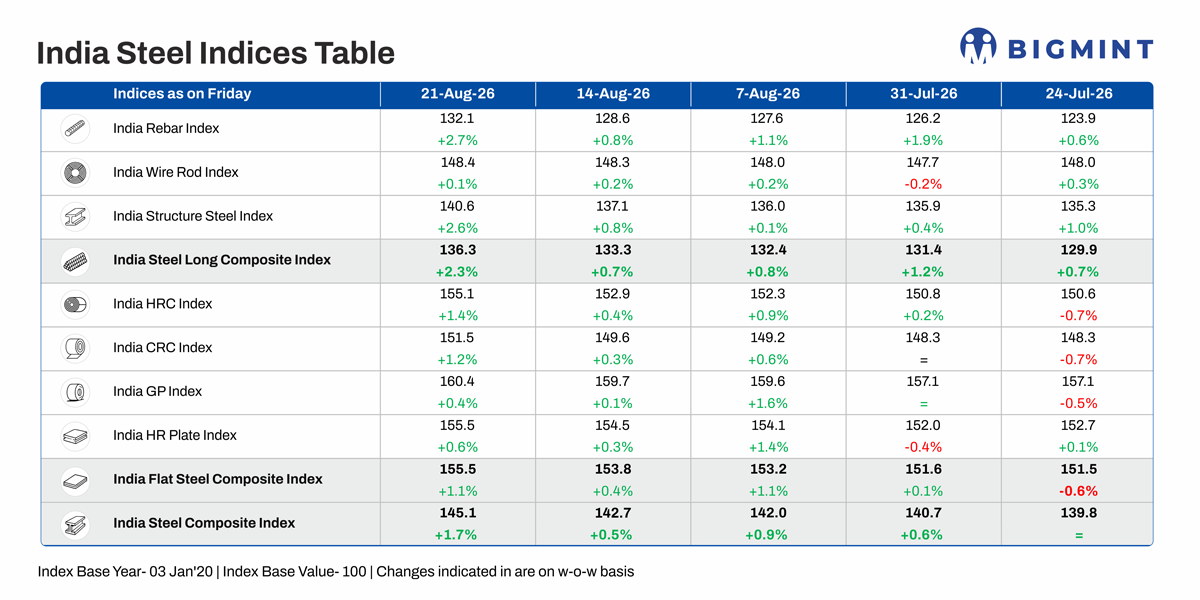
Morning Brief: BigMint’s India steel composite index witnessed the sharpest weekly uptick of 1.7% since early-March, as assessed on 21 August 2026, as domestic steel prices continued on their upward trajectory on improved trade demand and market sentiment as well as tight supplies as some of the major mills were on maintenance shutdown. Some mills also raised prices amid declining inventory levels and with green shoots of demand appearing in the market.

While the flats index rose by 1.1% w-o-w, with prices of all key products rising, the longs composite index surged 2.3% on the week as rebar surged 2.7%.
Highlights of price movements
BF rebar prices surge: BigMint’s benchmark assessment for rebar (IS 1786 Fe 550D, 12-32 mm, BF route) stood at INR 53,900/t on 21 August, up by INR 700/t w-o-w from INR 53,200/t recorded on 14 August. Prices are ex-Mumbai for the distributor-to-dealer segment and exclude 18% GST. This was on account of improving demand, with buying largely driven by retail requirements, while project demand remained supportive.
Some producers reportedly stopped accepting new bookings amid limited availability. While some mills have completed their planned maintenance shutdowns and restarted production, a few mills are still under maintenance, indicating tightening supply conditions towards end-August.
According to sources, major integrated steelmakers increased rebar prices by up to INR 1,000/t ($10/t) for mid-August sales. Market sentiment improved as there is currently no significant inventory pressure on the mills, while most available material is being absorbed by the retail segment. Some producers are expected to divert production towards other steel products, further limiting rebar availability and providing support to prices.
IF rebar prices rise on declining inventory levels: IF-route rebar prices increased by INR 800-2,500/t across markets, as traders actively stocked up material in anticipation of further price increases. The price rise was supported by a sharp rise in sponge iron prices, along with higher iron ore and coal costs, which pushed up input and conversion costs for mills. Mill inventories declined to around eight days, while order booking visibility remained limited to 35 days, indicating continued supply tightness.

HRC trade prices witness uptrend: BigMint’s bi-weekly benchmark assessment for HRC (IS2062, Grade E250, 2.5-8 mm/CTL) in Mumbai increased by INR 700/t ($7/t) to INR 58,800/t ($614/t) w-o-w from INR 58,100/t ($607/t) on 21 August. The assessment for CRC (IS513, Grade O, 0.9 mm/CTL) increased by INR 700/t ($7/t) w-o-w to INR 65,900 ($688/t) from INR 65,200/t ($681/t) on 14 August.
The trade market saw a modest increase in spot prices on improved buying from the value-added and downstream segments, particularly CRC users. Better trade parity following recent mill price adjustments encouraged selective replenishment, while a major domestic mill’s INR 500/t price increase further strengthened spot offers. Another factor behind the price rise was controlled mill dispatches and supply chain constraints resulting in tighter availability of certain grades and thicknesses in some markets.
Mill allocations saw a slight shift towards the automotive or B2B segment, with relatively lower volumes available for the trade market. Overall, controlled dispatches, a more balanced allocation mix, firmer mill price indications and improved trade economics have provided support to spot prices.
HRC export prices stable w-o-w: Indian HRC export offers remained largely stable w-o-w, with prices unchanged to the EU, Middle East and Vietnam. While EU buying remained constrained by fully booked Q4 quotas and summer slowdown, Middle East demand showed some improvement as depleted inventories prompted pipe manufacturers to book material. In Vietnam, however, weak downstream demand continued to limit buying interest.
Bulk HRC imports stood at 118,036 t as of 12 August, with a further 238,539 t expected to arrive by the end of the first week of September. Import volumes are mainly for re-exports of pipes and tubes to the Middle East, thereby hardly affecting domestic trade prices.

Raw material prices remain firm: While BigMint’s flagship Odisha iron ore fines index remained stable w-o-w, higher bids for lumps at OMC’s latest auction on 19 August and tight availability kept market sentiment firm. Sponge iron, pellet and steel semis witnessed a w-o-w surge, while coking coal prices stiffened further on tight premium grade availability and supply constraints in China.
Outlook
BF-rebar prices are expected to remain firm, supported by strong retail buying, limited mill availability, infrastructure demand and elevated raw material costs, especially coking coal and imported South African coal. On the other hand, HRC trade prices may remain supported due to controlled mill dispatches, tighter availability of select grades and continued demand from downstream segments.
Leave a Reply