- Indonesian billet offer increased on strong orders
- Iranian billet prices softened as geopolitical uncertainty weighed on trade
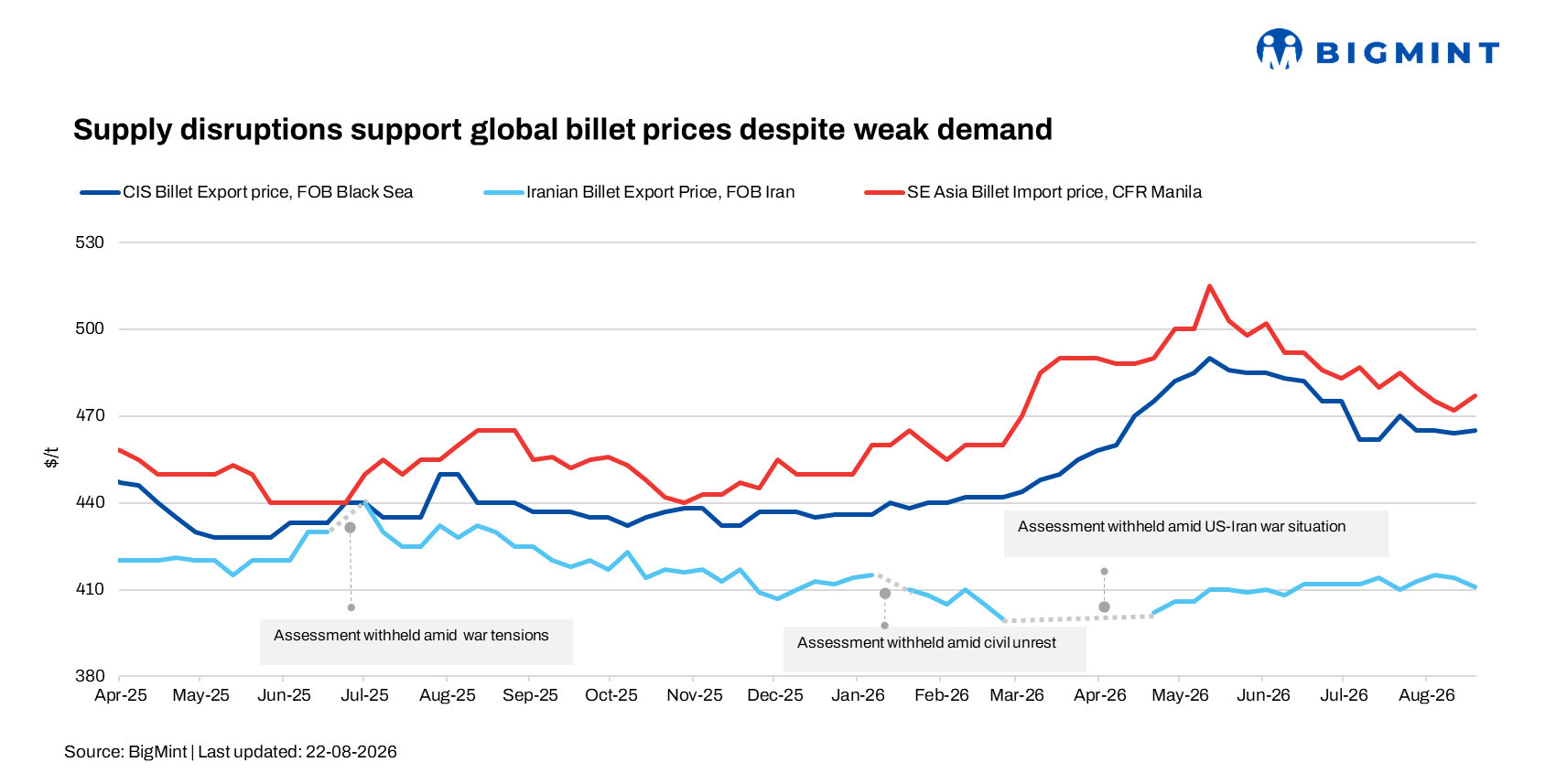
Global billet markets remained mixed during the week, with firmer raw-material costs and supply constraints supporting prices, while weak downstream demanad and cautious buying limited gains. Asian markets edged higher on stronger Chinese domestic prices, whereas CIS trade was disrupted by Black Sea shipping constraints and limited Russian availability. In the Middle East, elevated production costs, geopolitical uncertainty and subdued demand continued to pressure producers and restrict trading activity.
Turkiye’s imported deep-sea scrap market remained broadly stable as mills maintained cautious, need-based buying amid weak finished steel demand. US-origin HMS 80:20 was assessed at around $375/t CFR Turkiye. Limited scrap availability and elevated freight costs supported supplier offers, although buyers resisted higher prices.
Domestic scrap prices remained range-bound, while rebar exports stood at around $585/t FOB, keeping the scrap-to-rebar spread near $205-210/t. Turkish 3sp billet export prices were assessed at around $530/t FOB, down $4/t w-o-w.
Asia billet market
Asian billet markets remained slightly firmer over the past week despite subdued buying interest and weak downstream demand. Chinese exporters largely held offers as higher raw-material costs supported prices. Chinese 3sp billet was heard at $454-455/t FOB for October shipment, with sellers reluctant to reduce prices amid limited activity.
Indonesian suppliers also maintained a firm stance, with a major steel mill raising its base-grade billet offer by $5-7/t to $465-468/t FOB for November shipment, supported by a healthy order book. Around 30,000 t of Indonesian billet was also heard sold to Vietnam at about $458-460/t FOB during the week.
In Southeast Asia, trading remained slow as buyers stayed cautious. 5SP billet offers were generally heard at $475-478/t CFR Manila, while bids remained lower. A 30,000 t Chinese billet cargo was previously booked at $474-476/t CFR Malaysia. Philippines rebar demand remained weak amid heavy rains and flooding, while Thai buyers continued to procure cautiously.
Chinese domestic billet and rebar prices strengthened on improved buying, lower inventories and firmer raw-material costs. Tangshan billet rose RMB 20/t ($3/t) w-o-w to RMB 2,960/t ($440/t), while SHFE October rebar futures increased RMB 24/t ($4/t) to RMB 3,039/t ($452/t). Export billet offers also increased $4-5/t to around $452/t FOB, although uneven demand and a weaker RMB limited buying interest.
Taiwanese mills remained reluctant to purchase imported billet due to weak rebar demand and poor margins. Russian suppliers were largely absent, while logistical constraints in Saudi Arabia and elevated freight costs to East Africa continued to hamper trade.
Overall, Asian billet sentiment remained firm but cautious, with raw-material costs and controlled supply supporting prices, while weak downstream demand limited trading activity.
CIS billet market
The CIS billet market remained subdued and difficult to trade over the past week, with Russian suppliers largely staying out of the export market as Black Sea shipping disruptions continued. Only sporadic offers were heard, with most considered nominal due to limited seaborne availability. Russian billet was estimated at $463-465/t FOB Black Sea, down from $467-468/t a week earlier.
Restrictions on rail shipments to Novorossiysk further complicated exports, while alternative routes through the Baltic ports or Georgia remained uneconomical because of high freight costs. Sellers were therefore reluctant to commit to firm delivery schedules.
A market participant said the key issue is increasingly whether material can be shipped reliably and economically, rather than simply where billet is priced. Russian billet in Turkey was assessed at around $500/t CFR, equivalent to roughly $460-465/t FOB Black Sea.
Limited Russian material was offered to Tunisia at around $505-508/t CFR for 15,000 t, although buyers remained cautious about shipment feasibility. Iranian billet from Oman at around $500/t CFR was considered a more viable alternative.
The supply gap has encouraged Turkish buyers to seek Asian material. Chinese and Indian billet deals were reported at around $495-500/t CFR Marmara, including 50,000 t of open-origin billet purchased by an Aegean region mill and around 50,000 t of Chinese billet bought by another producer. However, CBAM considerations continue to complicate some Indian billet transactions.
Adding to the competitive picture, Indian billet was traded to Turkey last week at around $442-446/t FOB East Coast India, according to a market participant involved in the transaction. The trade provides a competitive Indian export indication against constrained Russian supply, although freight, delivery feasibility and CBAM requirements remain important when comparing origins.
Turkish domestic billet offers also strengthened to around $535-545/t ex-works, supported by limited import availability. Overall, CIS billet sentiment remained weak and uncertain, with Black Sea shipping disruptions, restricted rail access and high alternative freight costs limiting Russian exports. Turkish buyers are increasingly turning to Asian suppliers, while logistics reliability, freight economics and CBAM compliance are becoming decisive factors in billet sourcing.
Middle East billet market
Middle East billet sentiment remained subdued during the week as weak demand, rising production costs and geopolitical uncertainty weighed on trade. In Iran, billet export activity remained limited amid seasonal religious observances, currency depreciation and cautious buying from neighbouring markets. Export prices softened by $5/t w-o-w to $406-412/t FOB, with trader offers around $405-408/t FOB Bandar Abbas and Afghan buyers targeting about $405-406/t FCA. Around 10,000 t was reportedly available at Bandar Abbas.
Despite the quiet market, tender activity increased somewhat, with Arfa Iron and Steel Company offering 15,000-30,000 t of billet to overseas buyers. Iranian producers continued to face pressure from higher gas and energy costs, while concerns over explosives shortages for mining operations added another risk to raw-material supply.
Geopolitical and shipping risks also continued to weigh on Iran’s export outlook. Commercial navigation through the Strait of Hormuz remained constrained, with limited vessel traffic and persistent security concerns keeping shipping activity subdued.
In Bahrain, rebar prices increased to around BHD 270/t ($718/t) exw, from BHD 255-260/t ($678-691/t) earlier in July, mainly due to higher billet and production costs rather than stronger demand. Some delayed billet volumes have arrived, easing supply concerns, but costly feedstock continued to pressure mill margins.
Overall, Middle East billet markets remained under pressure, with weak downstream demand, elevated production costs and shipping uncertainty limiting trading activity and price upside.

Leave a Reply