- Bangladesh market remains subdued amid weak construction
- Weak rebar demand keeps Turkish mills cautious
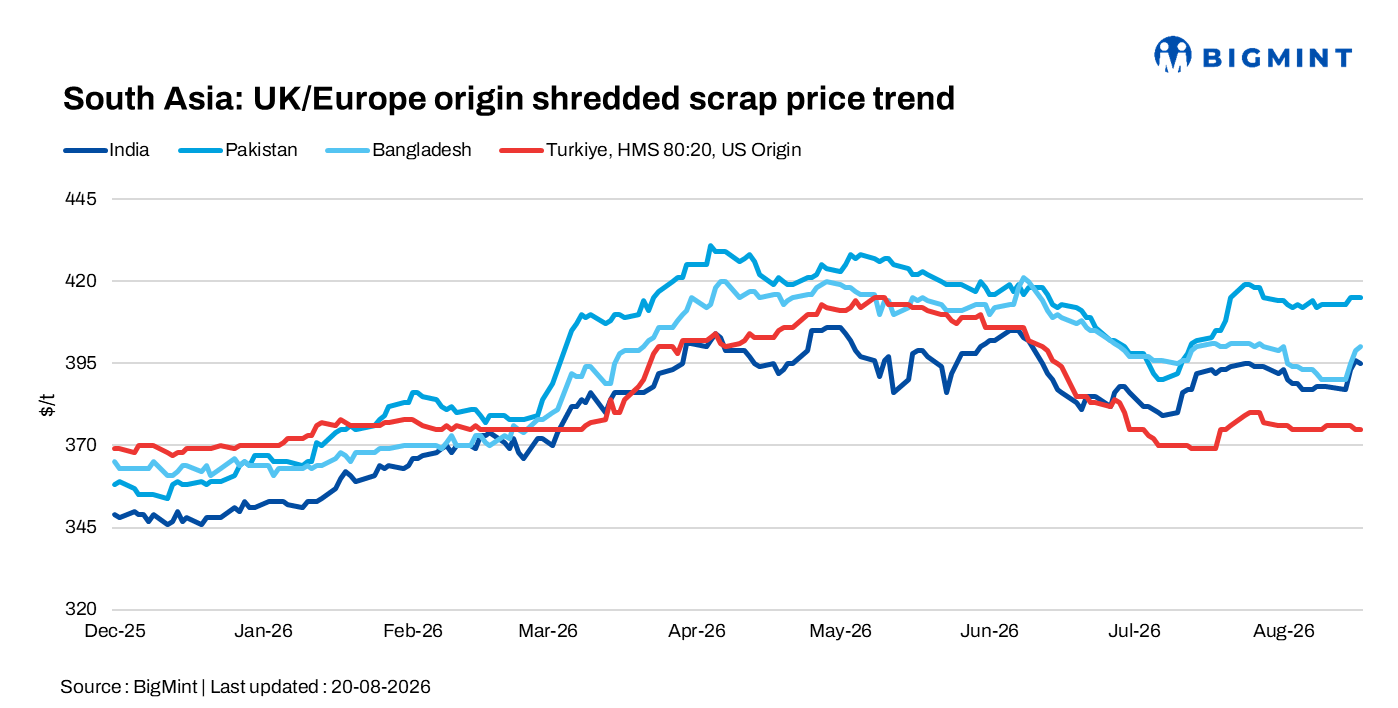
South Asian ferrous scrap markets remained mixed, with firm supplier expectations and limited availability providing support, while weak downstream steel demand, monsoon disruptions and cautious procurement continued to restrict trading activity. Buyers across the region remained focused on workable levels, with freight costs and currency movements adding to import challenges.
India: Imported containerised shredded scrap strengthened alongside firmer domestic steel prices, with offers at $395-400/t CFR India and HMS 80:20 around $340/t CFR. Australia-origin HMS 80:20 was offered at $340-345/t CFR Chennai, while shredded was at $375-380/t. UK shredded was around $365-370/t CFR Vizag, New Zealand MS turnings around $310/t for 1,000 t, and African HMS 80:20 at $335-345/t CFR Nhava Sheva.
Despite firmer offers, import buying remained measured. Weak finished-steel demand, competitive domestic scrap and an unfavourable exchange rate kept buyers from chasing overseas cargoes, with HMS 80:20 bids heard around $310-315/t CFR Nhava Sheva.
A western India-based major steel mill participant noted that overseas sellers have been gradually lowering offers as Indian buyers continue to test workable levels. He said mills remain cautious about building high-cost inventories, given the price risk between scrap procurement and finished-steel sales. Mills are also adjusting their metallic mix based on relative economics, with DRI/pellets gaining preference when more competitive, while lower imported scrap availability has provided greater flexibility.
Logistics is also playing a larger role in import decisions, particularly the availability, cost and suitability of containerised versus bulk cargoes, he added.
Bangladesh: Import activity remained selective despite firm offers. Australia-origin shredded was heard at around $380/t, while UK material was around $390-395/t. However, limited availability of suitable cargoes and strict shipment requirements for origins including Singapore, Hong Kong, Malaysia and Japan continued to constrain imports.
The market remained subdued, with slow construction activity, monsoon disruptions and weak steel demand weighing on buying interest. Deep-sea HMS 80:20 was heard at $370-375/t CFR Chattogram, while shredded was around $390-400/t. Australia-origin HMS workable levels were heard at $370-375/t, with shredded at $395-400/t. Singapore-origin PNS was offered at $410-415/t, while Malaysia-origin PNS was indicated at $405-410/t CFR.
A Dhaka-based participant said buyers were generally avoiding large-volume commitments, keeping import activity subdued.
Pakistan: Buying remained slow as weak steel demand, heavy monsoon rains and comfortable mill inventories reduced urgency. EU/UK shredded was offered at $415-420/t CFR Port Qasim, against bids around $410-412/t. Open-yard material was heard at $415/t, while yard material was around $422-425/t. The wide bid-offer spread continued to restrict bookings, with BigMint assessing shredded at $415/t CFR Port Qasim.
Turkiye: The market showed little movement, with fresh deep-sea bookings largely unchanged. BigMint assessed US HMS 80:20 at $375/t CFR Turkiye on 20 August. European suppliers continued to target around $370/t CFR or higher, supported by limited availability and higher replacement costs.
Freight from New Jersey to Turkiye was around $35-36/t, while low Rhine water levels and disruptions in the Black Sea added further supply-side pressure. However, this was largely offset by limited mill urgency: most August requirements had already been covered, while smaller and mid-sized buyers were primarily looking for late-September cargoes. Weak rebar demand therefore continued to prevent mills from accepting significantly higher scrap prices.

Leave a Reply