- Domestic scrap remains more economically attractive
- Currency weakness further raises landed costs of imports
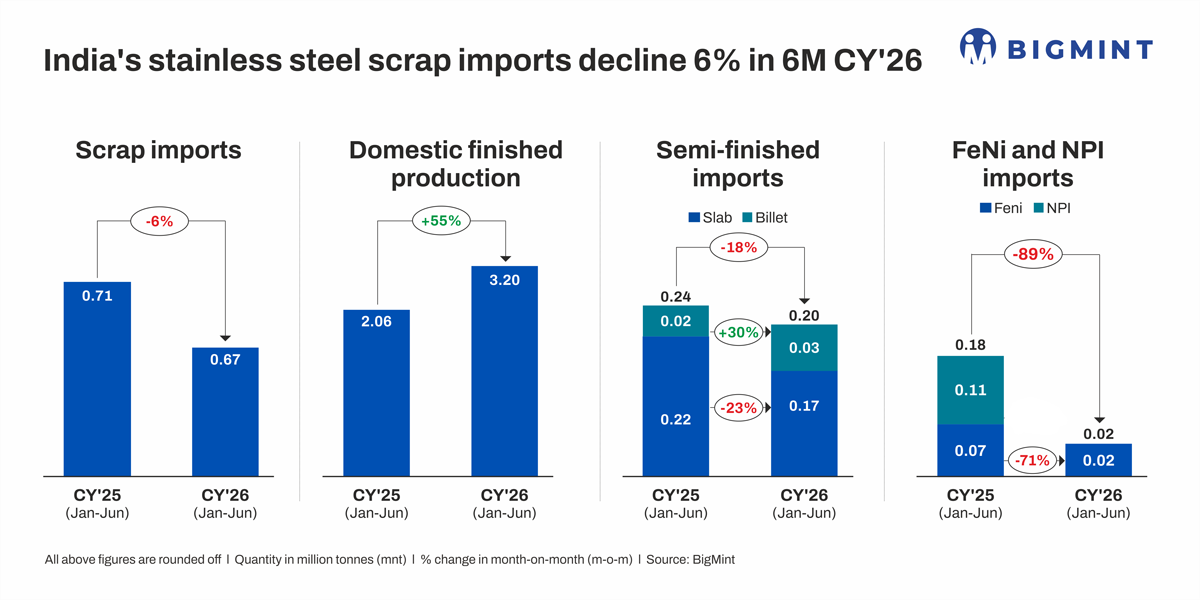
India’s stainless steel scrap imports recorded a measured but consistent decline in the first half of calendar year 2026, falling 6% y-o-y to 0.67 million tonnes (mnt) during January-June 2026 (6MCY’26), compared with 0.71 mnt in the same period of 2025. The pullback was not the result of a single disruptive event but rather the cumulative effect of several converging forces — elevated landed costs, currency headwinds, geopolitical freight disruptions, volatile nickel prices, and a structural preference shift toward domestically available scrap that proved more economical through the period.
Importantly, the decline in scrap imports did not occur in isolation. A simultaneous pullback across multiple imported raw material categories — including stainless slabs and ferro nickel — points to a broader import restraint posture among Indian stainless steel producers, rather than selective substitution of one input for another.
Market sentiment around imported scrap in 6MCY’26 was cautious and price-sensitive. Buyers were not absent from the market but were transacting selectively — covering near-term requirements while avoiding speculative inventory build. The preference for domestic scrap, underpinned by a meaningful landed cost advantage, consistently limited appetite for overseas procurement. Sentiment is likely to remain defensive in the near term unless imported scrap prices correct meaningfully or the INR strengthens sufficiently to narrow the landed cost gap.
Grade-wise imports
Imports were led by 304 grade scrap at 0.26 mnt, up by 1% from last year, while 430 grade imports increased by 14% to 0.068 mnt from 0.060 mnt in H1CY’26. On the other hand, 316 grade declined by 3% at 0.06 mnt from last year’s 0.07 mnt, which led overall drop in imports.

Country-wise imports
The US remained the top supplier, with 0.094 mnt, up by 4% y-o-y from 0.090 mnt. South Korea’s shipments totalled 0.051 mnt down by 6% from last year’s 0.054 mnt, while imports from Turkiye dropped significantly by 16% from 0.031 mnt to 0.023 mnt.
Significant volumes also came from Malaysia, Saudi Arabia, Germany, and the UK, as buyers diversified sourcing.

Elevated landed cost suppress demand
The most direct and quantifiable explanation for the scrap import decline is the significant and sustained landed cost premium of imported material over domestic scrap through 6MCY’26.
Imported 304-grade stainless steel scrap averaged $1,410-1,450/t during 6MCY’26 — approximately $100-130/t higher than year-ago levels. The price escalation reflected a combination of tighter international scrap availability, elevated freight rates on key origin routes, and currency movements that amplified INR-denominated landed costs.

By June 2026, import offers had risen further to $1,540–1,550/t. At the June average exchange rate of INR 94.66/USD, and after adding around INR 3,500/t towards freight, customs duty, port handling and clearance charges, the net-landed cost of imported scrap stood at approximately INR 148,000–149,000/t. This was substantially higher than domestic alternatives, with 304-grade stainless steel scrap trading at around INR 144,000/t. The price differential made domestic procurement more economical and significantly reduced the attractiveness of fresh import bookings during the period.
Import pattern shifts towards finished products
India also recorded significant imports of finished stainless steel products, with HRC imports estimated at around 65,000 t during Jan-Jun 2026, 58% up from 41,000 t in H1CY’25
The trend indicates a gradual shift in import composition towards finished material to meet domestic consumption requirements. Higher finished-product availability through imports may have reduced the requirement for additional domestic melting and scrap-based production for some downstream applications.
Semi-finished imports show mixed trends
A critical question in interpreting the scrap import decline is whether Indian mills were substituting imported semi-finished products (billets and slabs) for scrap-based domestic melting — thereby reducing their scrap requirements. The data provides a nuanced answer.
Billets recorded a 30% y-o-y increase to 0.03 mnt from 0.02 mnt last year, suggesting some downstream processors, particularly re-rollers, found imported billets more economical or operationally convenient than scrap-based melting. Indonesia dominated these shipments, reflecting the growing preference for integrated Indonesian semi-finished supply. However, the absolute incremental volume of only 0.01 mnt is too small to be a material driver of the scrap decline.
Slabs, by contrast, fell 12.5% to 0.175 mnt from 0.20 mnt — actively contradicting the substitution hypothesis at scale. Had mills been broadly replacing scrap with imported semi-finished material, slab imports would be expected to rise, not fall. Their decline instead points to a broad-based import restraint posture across all input categories — mills pulling back on imported inputs simultaneously, rather than selectively substituting.
Ferro nickel imports fall
Ferro nickel imports collapsed 62% y-o-y to just 0.02 mnt in 6MCY’26 — the sharpest contraction across any input category in the period. Industry participants attributed the decline to a combination of elevated Indonesian nickel ore prices, tighter RKAB (Indonesian companies’ work plan and budget) quota approvals, revised HPM (Harga Mineral Acuan) pricing mechanisms, and higher energy costs — all of which significantly eroded the cost competitiveness of imported ferro nickel relative to alternative nickel unit sources.
The market response was clear: as ferro nickel became uneconomical, Indian stainless steel producers increasingly substituted nickel-bearing stainless steel scrap as the preferred nickel unit input in their melting charge mix. This shift toward scrap as a FeNi replacement should, in theory, have increased scrap consumption — and therefore import demand. The fact that scrap imports still declined by 6% despite this substitution dynamic suggests that domestic scrap absorbed the incremental FeNi replacement demand, rather than driving additional import volumes. The FeNi collapse thus reinforced domestic scrap preference rather than creating a new import requirement.
Outlook
India’s stainless steel scrap import market enters H2CY’26 on a cautious footing, with the dominant near-term theme being cost-disciplined, need-based procurement and a structural preference for domestic scrap that is unlikely to reverse without a meaningful correction in international prices or freight conditions. The medium-term picture is more constructive — JSL’s capacity expansion program will drive aggregate scrap demand growth that domestic generation alone cannot fully satisfy, creating a structural floor for import volumes through FY27-29. The long-term case for Indian scrap imports remains intact: India will be a significant and growing scrap importer through the end of the decade, but the pricing, origin mix, and procurement strategy will look materially different from today’s market. Policy developments in Indonesia — from RKAB quota decisions to the planned commodity exchange — will remain the most consequential external variable shaping India’s stainless scrap import economics over the next six months.
Leave a Reply