- EAF electricity emissions remain excluded from crude-steel calculations
- Material losses increase emissions intensity of finished products
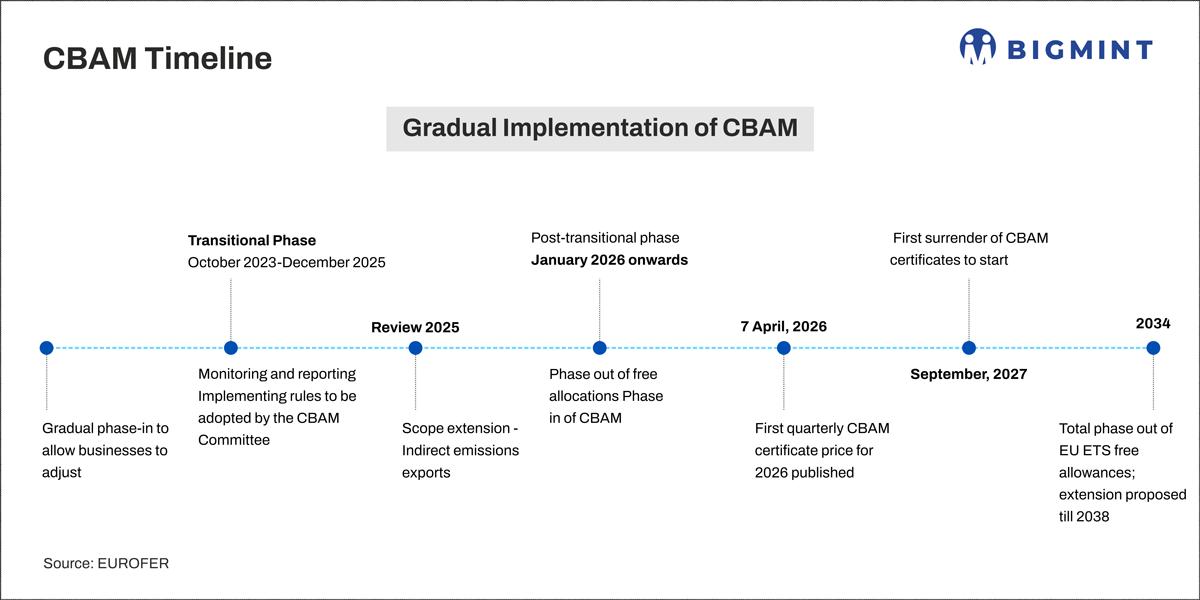
The European Commission (EC) has published sector-specific guidance for iron and steel under the Carbon Border Adjustment Mechanism (CBAM), providing non-EU operators with detailed instructions on calculating, monitoring and reporting embedded emissions during the definitive period beginning in 2026.
Six categories covered under CBAM
The guidance divides iron and steel imports into six main aggregated goods categories: sintered ore, ferro-alloys, pig iron, direct reduced iron (DRI), crude steel, and iron or steel products. The latter covers a broad range of downstream products, including flat steel, bars, rods, wire, sections, tubes, pipes, structural products, tanks, containers and fasteners.
Direct emissions generally apply to steel products
For iron and steel products, only direct emissions are generally included when determining embedded emissions during the definitive period. The main exception is sintered ore classified under CN 2601 12 00, for which electricity-related indirect emissions must also be calculated.
Where sintered ore is subsequently used as a precursor for another steel product, these indirect emissions are carried forward into the embedded emissions of the downstream product.
The EC also clarified that complex steel goods must include emissions embedded in relevant precursors, including sintered ore, pig iron, DRI, ferro-alloys and crude steel. Post-consumer scrap is assigned zero embedded emissions, while the same treatment applies to relevant precursors produced within the EU or in CBAM-exempt countries and territories.
EAF electricity emissions excluded from crude steel
For crude steel produced through electric arc furnaces (EAFs), electricity-related emissions are excluded from definitive-period embedded emissions, despite electricity being the principal energy input for the production route.
Operators must, however, calculate direct emissions arising from fuels, electrodes, carbon-containing materials and other relevant sources.
The guidance also allows operators to combine multiple production stages into a single production process, or “bubble”, under certain conditions. For example, an integrated steel producer may combine sinter, pig iron and crude steel production with downstream operations when internally produced precursors are fully consumed within the installation and are not separately sold or transferred.
Weighted averages apply across production routes
Where the same goods are produced through different production routes at a single installation, specific embedded emissions should generally be calculated using a weighted average.
The same principle applies when precursors are sourced from different installations or production periods, unless sufficient evidence is available to attribute specific batches to individual production processes.
Additional reporting requirements for steel producers
The guidance introduces additional reporting requirements for steel producers. For pig iron and DRI, operators must report information such as the main reducing agent used and the content of certain alloying elements.
For crude steel and finished steel products, reporting requirements include scrap consumption per tonne of product and the proportion of pre-consumer scrap used.
Actual emissions require monitoring and verification
Operators using actual emissions values must maintain an English-language monitoring plan and retain supporting documentation for at least six years.
For externally sourced precursors, actual emissions data can only be used when supported by a verification report from an appropriately accredited verifier. Otherwise, the applicable default values must be used.
CBAM calculation examples
The guidance provides worked examples illustrating how embedded emissions and CBAM certificate requirements are calculated.
For an integrated blast furnace-basic oxygen furnace (BF-BOF) steelworks, the EC calculates specific embedded emissions at 1.567 mt of CO2 per mt of finished steel, including indirect emissions associated with sinter production. For a hypothetical 10,000 mt rail import in 2027, this results in 15,670 mt of embedded emissions and an obligation to surrender 3,690 CBAM certificates after the applicable free-allocation adjustment, before accounting for any eligible carbon price paid in the country of origin.
For stainless steel produced through the EAF/AOD route, finished products have calculated embedded emissions of 1.783 mt of CO2 per mt. A hypothetical 100 mt import of stainless steel pipes in 2027 would result in an obligation to surrender 95.9 CBAM certificates following the free-allocation adjustment and before any deduction for an eligible foreign carbon price.
Material losses can raise embedded emissions
The guidance also covers downstream products such as screws and nuts. Material lost during cutting and machining does not carry over into the final product, meaning such losses can increase embedded emissions per tonne of finished goods.
In the EC’s example, specific embedded emissions reach 2.039 mt of CO2 per mt for carbon steel screws and nuts and 2.371 mt per mt for stainless steel screws and nuts.
Guidance remains explanatory but provides practical clarity
The EC emphasised that the sector-specific guidance is explanatory rather than legally binding, with the applicable EU legislation taking precedence in case of any differences. Nevertheless, the guidance provides greater clarity on emissions calculation, precursor treatment, monitoring and verification requirements, helping non-EU steel producers better understand their obligations under the CBAM definitive period from 2026.
Leave a Reply