- Crude steel production declines as mills respond to weaker construction demand
- Manufacturing remains the largest source of steel demand despite slower investment growth
- Exports continue absorbing surplus production as domestic demand weakens
Morning Brief: China’s steel market became increasingly dependent on manufacturing during the first seven months of 2026 as the property downturn deepened and infrastructure investment weakened further. Crude steel production declined as mills responded to weaker margins and subdued construction demand, while manufacturing-oriented sectors including automobiles, shipbuilding, machinery and electrical equipment continued supporting flat steel consumption. Exports remained an important outlet for surplus production, although rising trade barriers and slowing overseas demand reduced their contribution to market growth.
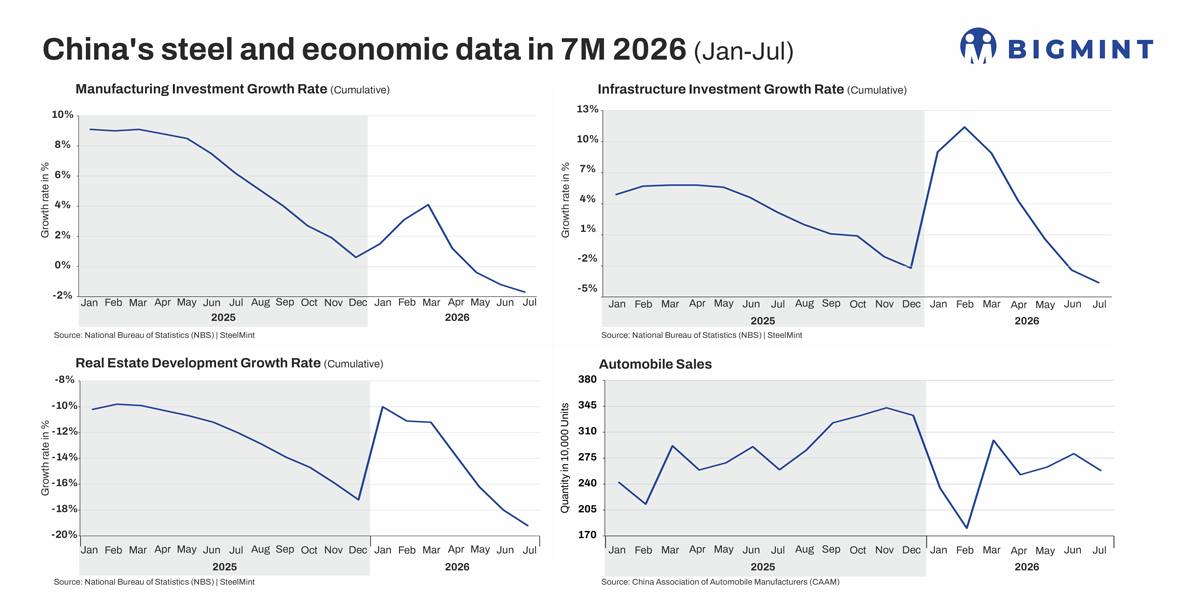
Real estate development investment contracted 19.2% y-o-y during January-July, extending the 18.0% decline recorded during the first half of the year. Infrastructure investment also weakened further, while manufacturing investment remained comparatively stronger despite moderating growth, supported by continued spending on equipment upgrades, advanced manufacturing and strategic industries. The widening divergence between manufacturing and construction continued to reshape China’s steel demand, with flat products outperforming long steel through much of the year.
Steel production slows as margins weaken
Crude steel production declined during January-July as shrinking margins, elevated inventories and weaker construction demand encouraged mills to align output more closely with market conditions. Finished steel prices remained under pressure through June and July, pushing production margins into negative territory.
Losses widened to around RMB 260/t for hot rolled coil (HRC) and RMB 200/t for rebar by the end of July, prompting more producers to advance maintenance schedules and reduce blast furnace utilisation. According to the China Iron and Steel Association, average daily pig iron production at key steel enterprises declined 4.0% m-o-m to 1.82 million tonnes in July, while crude steel production fell 4.9% to 1.97 million tonnes/day and finished steel output dropped 6.7% to 1.93 million tonnes/day.
Combined output of the five major finished steel products declined 2.3% w-o-w to 8.18 million tonnes during July 23-29, while apparent consumption fell 1.5% to 8.12 million tonnes as heavy rainfall, high temperatures and Typhoon Noul disrupted downstream construction activity. Stocks of the five major steel products held by traders across 132 cities consequently increased for a second consecutive week to 19.39 million tonnes by July 30, with rebar inventories rising to 7.94 million tonnes and HRC inventories increasing to 4.76 million tonnes. Inventories tracked across Mysteel’s 35-city survey also rose 1% w-o-w to 11.91 million tonnes.
Lange Steel data showed social steel inventories across 29 major cities increasing 1.7% m-o-m to 11.09 million tonnes at the end of July, remaining 28.9% above year-earlier levels. Building-material inventories rose 2.8% m-o-m to 5.26 million tonnes, compared with a 0.7% increase in flat steel inventories to 5.83 million tonnes.

Manufacturing supports flat steel demand
Equipment manufacturing, shipbuilding, electrical equipment, machinery and new energy industries continued expanding during January-July as policy support remained focused on industrial upgrading and technological transformation. Manufacturing investment moderated during the period but remained stronger than both real estate and infrastructure investment, sustaining demand for flat steel products despite a weaker broader economic environment.
The property sector remained the weakest end-use segment. Declining real estate investment, weaker housing construction and slower infrastructure activity continued to weigh on long steel consumption, while investment in strategic manufacturing sectors increasingly determined the direction of domestic steel demand.
Exports continue balancing domestic market
China exported 64.99 million tonnes (mnt) of finished steel during January-July, down 4.4% y-o-y, an improvement from the 5.6% decline recorded during the first half of the year. July exports stood at 10.12 mnt, down 1.9% m-o-m from 10.32 mnt in June but 2.9% higher than a year earlier, indicating that overseas shipments remained historically high despite weaker external demand.
Trade restrictions continued to limit export growth. Anti-dumping investigations across Europe, Asia and Latin America, together with stricter export regulations and licensing requirements, reduced market access for Chinese steel. Competitive export pricing nevertheless enabled mills to maintain overseas shipments, allowing exports to continue absorbing surplus domestic production as construction demand weakened.
Raw material imports remain resilient
Iron ore imports reached 736.84 mnt during January-July, up 5.9% y-o-y, while July arrivals stood at 108.09 mnt, compared with 112.69 mnt in June. Import volumes remained supported by stable blast furnace utilisation, continued procurement by steelmakers and expectations of additional seaborne supply, despite lower crude steel production during the period.
Coal imports also remained elevated as domestic mine supply continued to recover from earlier safety inspections and production disruptions. Higher imports helped maintain raw material availability for the steel and power sectors even as finished steel production moderated.
Policy support shifts further towards manufacturing
Monetary and fiscal support remained concentrated on equipment upgrades, technological transformation, advanced manufacturing and strategic industries during January-July. Credit conditions improved for manufacturing projects, while policy support for the property sector remained targeted rather than broad-based, extending the divergence between manufacturing and construction activity.
Production of machinery, electrical equipment, shipbuilding and new energy industries continued to expand during the period, supporting demand for flat steel products. At the same time, weaker real estate investment and slower infrastructure activity continued to constrain demand for construction steel, reinforcing the gap between HRC and rebar market fundamentals.
Outlook
Manufacturing is expected to remain the principal source of China’s steel demand through the second half of 2026 as policy support continues to favour industrial upgrading and strategic manufacturing sectors. Property investment is likely to remain under pressure, while infrastructure spending is expected to provide only limited support for construction steel consumption.
Exports are expected to remain an important balancing mechanism for the domestic market despite increasing trade barriers and slower overseas demand. With inventories remaining elevated and mill profitability under pressure, the pace of inventory drawdowns is likely to determine whether current production cuts are sufficient to restore market balance during the remainder of the year.
Leave a Reply