- India’s zinc demand seen outpacing global growth as steel demand expands
- Downstream capacity, supply diversification emerge as key priorities
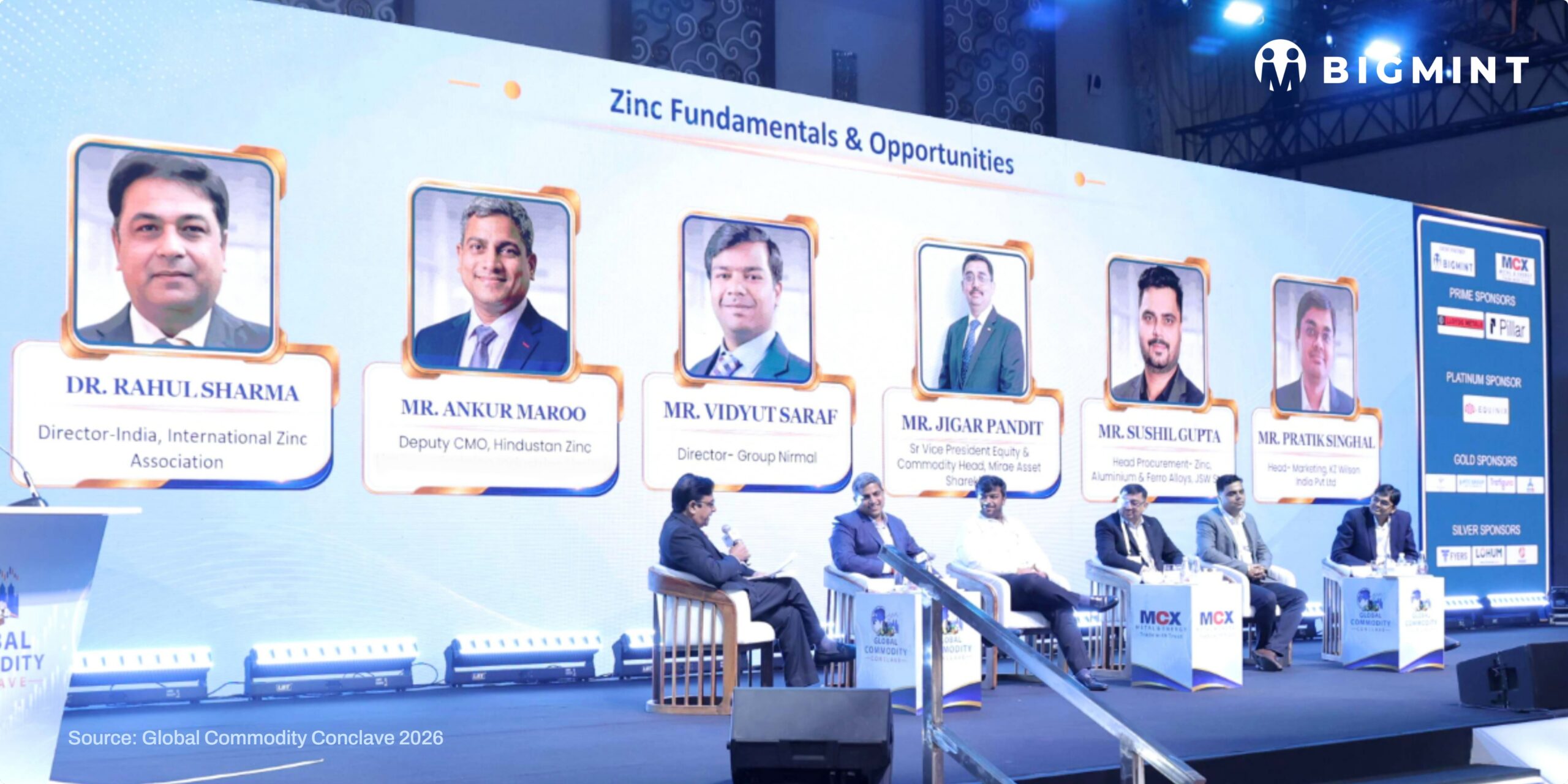
The Global Commodity Conclave (GCC) 2026, hosted by MCX with BigMint as the Event Partner, was held from 12-14 August 2026 at the Jio World Convention Centre, Mumbai. Speaking at the session on zinc fundamentals and opportunities, industry participants said India’s zinc demand has significant room to grow as steel demand expands, galvanising penetration increases, and new applications emerge. The panel also highlighted downstream capacity, supply chain diversification, reserves and policy stability as critical requirements for sustaining this growth.
Galvanising remains key growth opportunity
India consumes around 0.8 mnt of zinc annually, with around 72% going into galvanising, according to the panel discussion. Ankur Maroo, Deputy CMO at Hindustan Zinc, said the primary zinc availability could be captured domestically, while the industry needs to focus more on downstream capacity, logistics and applications.
India’s per capita zinc consumption remains well below the global average, creating scope for higher usage in corrosion protection and infrastructure. Panellists noted that galvanising penetration in India remains low compared with international markets, leaving considerable room for additional zinc demand.
One panellist highlighted the automotive sector, noting that the same vehicle models can have significantly higher galvanised content in overseas markets than in India.
Rising steel demand to lift zinc consumption
India’s steel capacity is currently around 220 mnt and is targeted to reach around 300 mnt by 2030 and 500 mnt by 2047. The expansion is expected to create a larger demand base for zinc, particularly through galvanising in infrastructure, automotive and renewable energy applications.
Participants said the opportunity is not limited to growth in steel volumes. Increasing the proportion of steel that is galvanised could materially expand zinc consumption, particularly as infrastructure development accelerates.
The panel identified infrastructure as a major source of future zinc demand, while automotive and renewable energy were also highlighted as important growth areas.
Automotive moves towards higher zinc coatings
Sushil Gupta, Head Procurement – Zinc, Aluminium & Ferro Alloys, JSW Steel said automotive companies are increasingly targeting coating lives of around 15 years. Demand has consequently moved from G60 towards G90 and G100 coatings, while Galfan is also gaining interest.
The shift could increase zinc consumption per unit of coated steel as manufacturers seek longer coating life and improved corrosion resistance.
Participants said automotive demand is expected to increase, although infrastructure is likely to remain the larger demand driver. Renewable energy infrastructure was also identified as an important additional source of demand, particularly where corrosion protection and longer asset life are required.
Downstream capacity could become bigger constraint
While primary zinc availability was not viewed as an immediate constraint, panellists repeatedly highlighted downstream capacity as a more important issue.
India is broadly self-sufficient in refined zinc, with current domestic production and consumption discussed at around 0.8 mnt. The panel therefore shifted the focus from whether sufficient zinc would be available to whether galvanisers, processors, recyclers and logistics infrastructure would be able to absorb and distribute rising volumes.
Maroo said the industry needs to focus on downstream capacity, logistics, and applications as zinc consumption expands.
Participants also highlighted the need for greater infrastructure for recovering and recycling zinc-bearing residues. Better logistics, recycling facilities and galvanising capacity could become increasingly important as the market grows.
Supply diversification remains risk-management priority
Despite domestic zinc availability, panellists cautioned against relying on a single source for industrial requirements.
A disruption at one producer could affect downstream operations even if national zinc availability remains adequate. Participants therefore called for secondary sourcing options and stronger supply-chain risk management.
One panellist noted that with consumption and production at around 0.8 mnt, any disruption in the supply chain could create a significant operational risk for consumers dependent on a single source.
South Korea was identified as a potentially relevant source for imported material, while China was viewed differently because of its largely closed-loop zinc market. However, Chinese metal could potentially enter international markets when a significant price differential develops between Chinese and global markets.
The discussion therefore suggested that India’s supply security should be viewed not only through the lens of domestic production, but also through access to alternative origins during supply disruptions.
Reserves need to support longer-term growth
Resource security was another key theme. One panellist said current domestic zinc reserves were sufficient for around 15 years and argued that exploration and resource development should target extending this to around 25 years.
This becomes increasingly important as domestic consumption rises. The panel estimated global zinc demand growth at around 0.9%, compared with around 4% for India, indicating that the country is expected to remain a significantly faster-growing market.
Participants said continued investment in exploration and resource development would therefore be required to ensure that domestic production growth remains aligned with consumption over an extended period.
New applications to add to galvanising demand
The panel identified zinc alloys, renewable energy, and zinc-based batteries as emerging demand opportunities.
Alloys were highlighted as particularly promising because advanced zinc-based coatings can improve product life and reduce lifecycle costs. Participants said the industry needs to position galvanising as a value addition rather than simply an additional cost.
Zinc-based batteries were also discussed as an emerging energy-storage application. Panellists viewed these technologies as additional sources of demand alongside traditional galvanising applications.
The discussion also pointed to speciality alloys and newer zinc-coated products as areas where the industry could capture higher-value applications beyond conventional galvanising.
Policy needs to support cost competitiveness
Cost competitiveness emerged as a recurring issue during the discussion. Participants said wider adoption of galvanised steel would depend partly on the overall cost of corrosion protection and the lifecycle economics of infrastructure.
One panellist called for a review of import duties on zinc, arguing that downstream users should retain access to alternative sources even with domestic production available.
Another participant stressed that primary raw materials need to remain cost competitive so that downstream metal industries can compete with Chinese producers.
Policy stability was also identified as important. Participants said abrupt changes in quality-control requirements and implementation procedures could create uncertainty for consumers and disrupt procurement planning.
The panel also encouraged greater use of commodity exchanges and hedging tools to manage metal-price and supply-chain risks. Industry participants said greater awareness of hedging could help companies manage exposure during supply disruptions and price volatility.
Zinc ecosystem needs broader integration
The panel’s key takeaway was that India’s zinc opportunity extends beyond increasing primary production. Stronger galvanising penetration, downstream processing capacity, supply diversification, and recycling infrastructure will be important to support the country’s expanding steel and infrastructure base.
Participants also stressed that industry planning should focus on building a zinc ecosystem capable of supporting demand over several decades, rather than only meeting immediate consumption requirements.
The Global Commodity Conclave (GCC) 2026, hosted by MCX and partnered by BigMint.
Leave a Reply