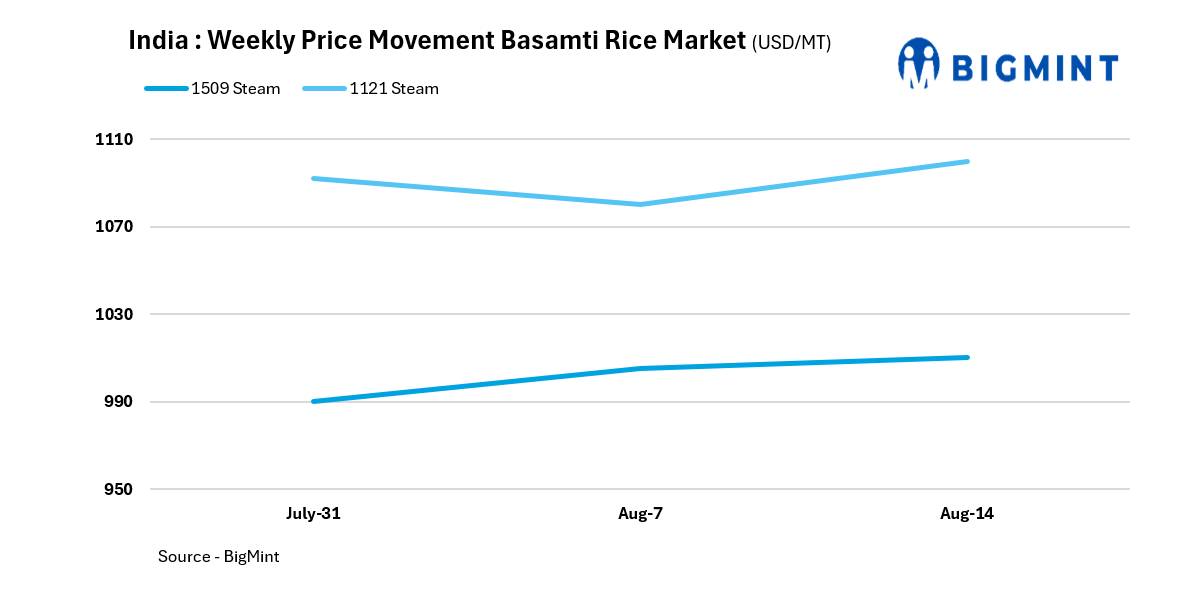
- Basmati prices stayed firm on tight old-crop availability.
- Higher new-crop supply may cap further gains.
India’s basmati rice market remained firm during the week ended August 14, supported by tightening old-crop availability and steady demand for premium varieties. However, the market has yet to enter a strong bullish phase as expectations of higher new-crop acreage and uncertainty over export demand continue to limit aggressive buying. According to BigMint assessments, 1509 Steam increased to around $1,010/MT on August 14 from $990/MT on July 31, while 1121 Steam rose to around $1,100/MT from $1,092/MT during the same period.
Old-crop availability supports prices
Availability of old-crop basmati rice is gradually tightening as the market approaches the new-crop season. This has provided support to prices, particularly for 1121 and 1509 varieties. However, buyers remain selective, with market participants closely monitoring the arrival of new-season paddy. Expectations of higher new-crop acreage could eventually improve availability and cap further price gains. New-crop availability is expected to improve from October, but acreage trends remain mixed. Higher 1509 adoption in parts of Haryana may support output, while lower basmati acreage reported in Punjab could limit the overall production upside
Export demand remains mixed
Export demand for Indian basmati remains firm but selective. Gulf and West Asian markets remain important demand centres, but ongoing geopolitical and logistics disruptions are creating uncertainty around shipment schedules and landed costs. The Indian government has also acknowledged disruption to maritime and air cargo routes through the Middle East, along with higher freight costs, rerouting expenses and war-risk surcharges affecting basmati exporters. Recent congestion at Kandla port, where cargo clearance delays have reportedly extended to 35–40 days, could further pressure shipment timelines and export costs.
Weather remains a key watch factor
Weather will remain an important variable for the upcoming crop. India’s monsoon is expected to weaken across western, central and southern regions over the following two weeks, with rainfall already running below average and El Niño adding to the weather risk. For basmati, the impact will depend more on crop development and weather conditions in the key basmati-growing belt as the new crop progresses. Any deterioration in crop prospects could provide additional support to prices.
Pakistan competition limits upside
Pakistan continues to remain a key competitor in the international basmati market. Competitive Pakistani offers could limit the extent to which Indian exporters can raise prices, particularly in price-sensitive destinations.
Outlook
The Indian basmati market is likely to remain firm in the near term, supported by tightening old-crop stocks and replacement costs. However, expectations of higher new-crop availability and selective export demand could prevent a sharp price rally. Market direction will largely depend on three factors: new-crop crop conditions, Gulf/West Asian demand and freight/logistics costs.
Leave a Reply