- India’s secondary lead network gains strategic importance
- Rising demand could tighten domestic feedstock availability
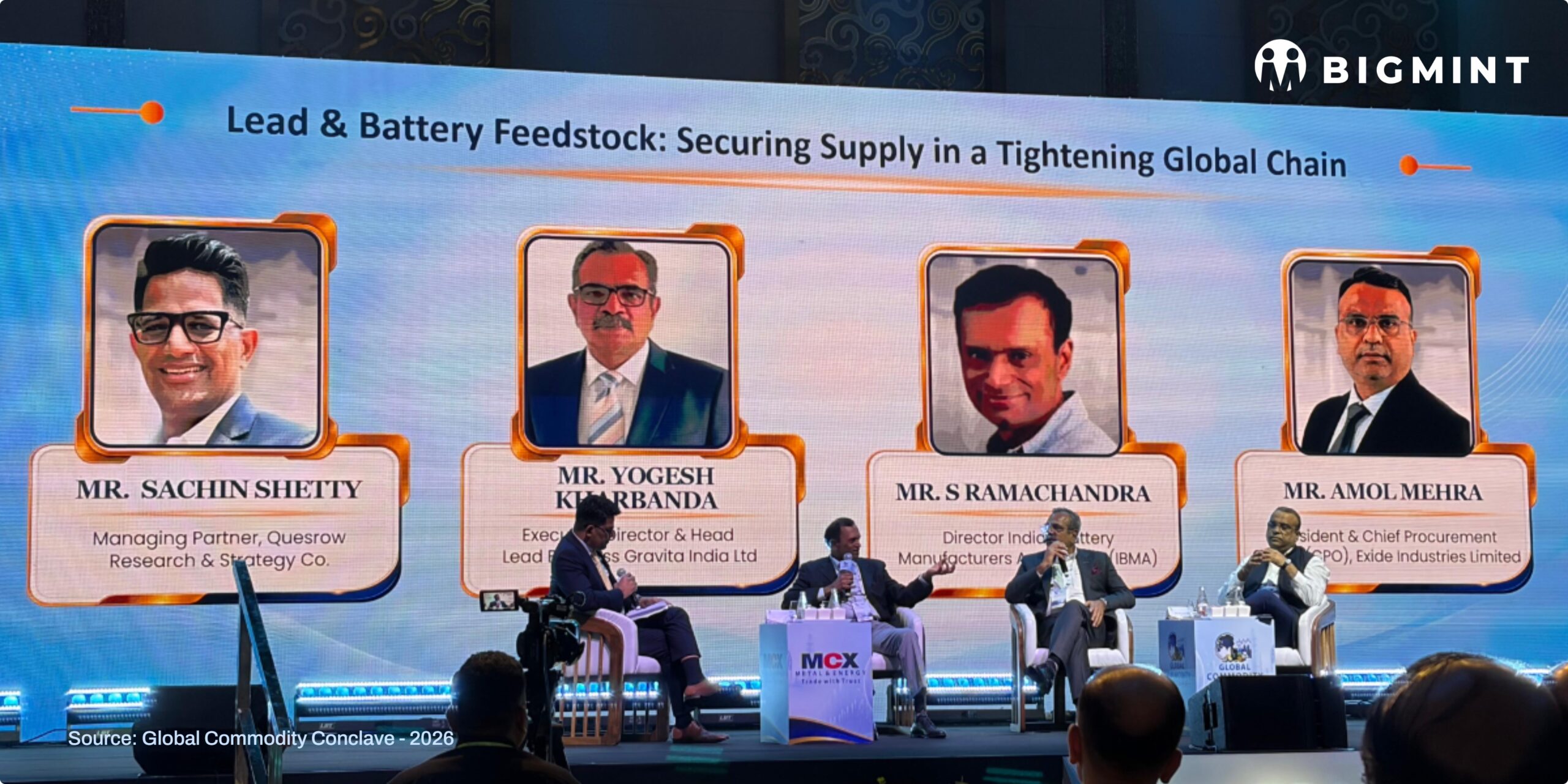
The Global Commodity Conclave (GCC) 2026, hosted by MCX with BigMint as the Event Partner, was held from 12-14 August 2026 at the Jio World Convention Centre, Mumbai. Speaking at the lead and battery feedstock session, panelists highlighted how changing global trade flows, rising battery demand and India’s dependence on recycled lead are reshaping the country’s supply chain. While the global refined lead market remains in slight surplus, securing reliable secondary feedstock is becoming increasingly important as regional arbitrage and demand growth alter material flows.
Trade flows point to a changing global balance
Global refined lead production was estimated at around 13.5 mnt/year, including approximately 4.6 mnt of primary lead. Secondary sources therefore account for around 67% of refined output globally, highlighting the importance of recycling to overall supply.
Against this backdrop, India’s refined lead exports reportedly increased from around 151,000 t in 2022 to nearly 480,000 t in 2025. At the same time, Chinese lead imports rose to around 57,000 t from approximately 500 t a year earlier.
Panelists attributed China’s return to imports largely to arbitrage between domestic Chinese prices and London Metal Exchange prices rather than an immediate physical shortage. With around 9 mnt of refining capacity, China remains the largest refining centre in the global market.
The developments underline a broader shift in which regional availability, pricing differentials and supply-chain economics can influence physical flows even when the global market remains adequately supplied.
India relies heavily on secondary lead
India’s battery industry was estimated to source around 85% of its lead requirements from recycled material, significantly above the global secondary share. Automotive batteries, inverter batteries and e-rickshaws continue to support a sizeable lead-acid ecosystem despite the gradual shift towards lithium-ion technology.
The high recyclability of lead gives India an important structural advantage. Existing batteries effectively represent a future source of feedstock, allowing the industry to operate increasingly as a circular supply chain rather than relying only on primary metal production.
However, stronger battery demand could put greater pressure on this system. Automotive demand was cited as growing by around 20-22% in some segments, while potential additional lead demand of 200,000-300,000 t was discussed over the coming period.
Lead-acid retains applications despite EV transition
The shift towards lithium-ion is accelerating in two-wheelers, four-wheelers and several telecom applications. However, panelists noted that lead-acid batteries are likely to remain relevant in applications where upfront cost is a key consideration.
Automotive auxiliary batteries, e-rickshaws, inverters and uninterruptible power supply systems, rural power applications and some telecom requirements could continue to support lead-acid demand. India’s expanding data-centre infrastructure could also create additional requirements for backup power systems.
Lithium-ion is expected to dominate Battery Energy Storage Systems under the current technology trajectory, particularly because of its cycle life and discharge characteristics. However, the eventual technology mix will depend on battery costs, raw-material availability, policy support, application requirements and recycling economics.
Recycling data remains a major gap
India’s recycling ecosystem provides high collection efficiency but remains difficult to quantify accurately. The panel cited around 650-700 registered lead recyclers, including a figure of 672, with registered capacity estimates ranging from around 3.5 mnt to 4.2 mnt.
At the same time, identifiable capacity among major organised recyclers was suggested to be closer to 700,000 t. The disparity indicates that registered capacity may not represent actual operating capacity across the industry.
The informal collection network further complicates the picture. Panelists suggested that India’s actual lead-acid battery collection rate could be close to 100%, despite a significant share of collection being handled by informal collectors.
The challenge, therefore, is not simply increasing collection. It is improving traceability, environmental compliance, data transparency and integration of the informal network into formal recycling channels.
Recyclers expand their global feedstock reach
Indian recyclers are increasingly participating in international lead trade, responding to arbitrage opportunities and regional supply-demand differences. Material linked to Indian producers was also reported to represent a significant share of lead held in LME warehouses.
Recyclers are simultaneously looking to secure feedstock closer to its source. Africa was cited as an example where companies are establishing collection and processing infrastructure closer to scrap generation rather than relying entirely on material arriving at Indian facilities.
This points towards a more integrated supply model in which recyclers combine domestic collection with international sourcing to improve feedstock security.
Domestic supply security becomes strategic
India’s rising lead exports raise questions about competition between overseas markets and domestic battery manufacturers for recycled material. Panelists did not identify an immediate structural feedstock shortage, but noted that the balance could tighten if battery demand expands by another 200,000-300,000 t without a corresponding increase in collection.
Extended Producer Responsibility could help improve traceability and bring informal collection into the formal ecosystem. However, the efficiency of existing informal networks remains an important consideration, given the high residual value of lead and the resulting incentive to recover used batteries.
India’s lead industry is therefore entering a phase where supply security will depend less on headline refined metal availability and more on the ability to secure, measure and process secondary feedstock efficiently. Strengthening domestic collection, improving recycling data, integrating informal collectors and securing international scrap sources could become increasingly important as battery demand expands and global recyclable-material flows become more competitive.
The Global Commodity Conclave (GCC) 2026, hosted by MCX and partnered by BigMint

Leave a Reply