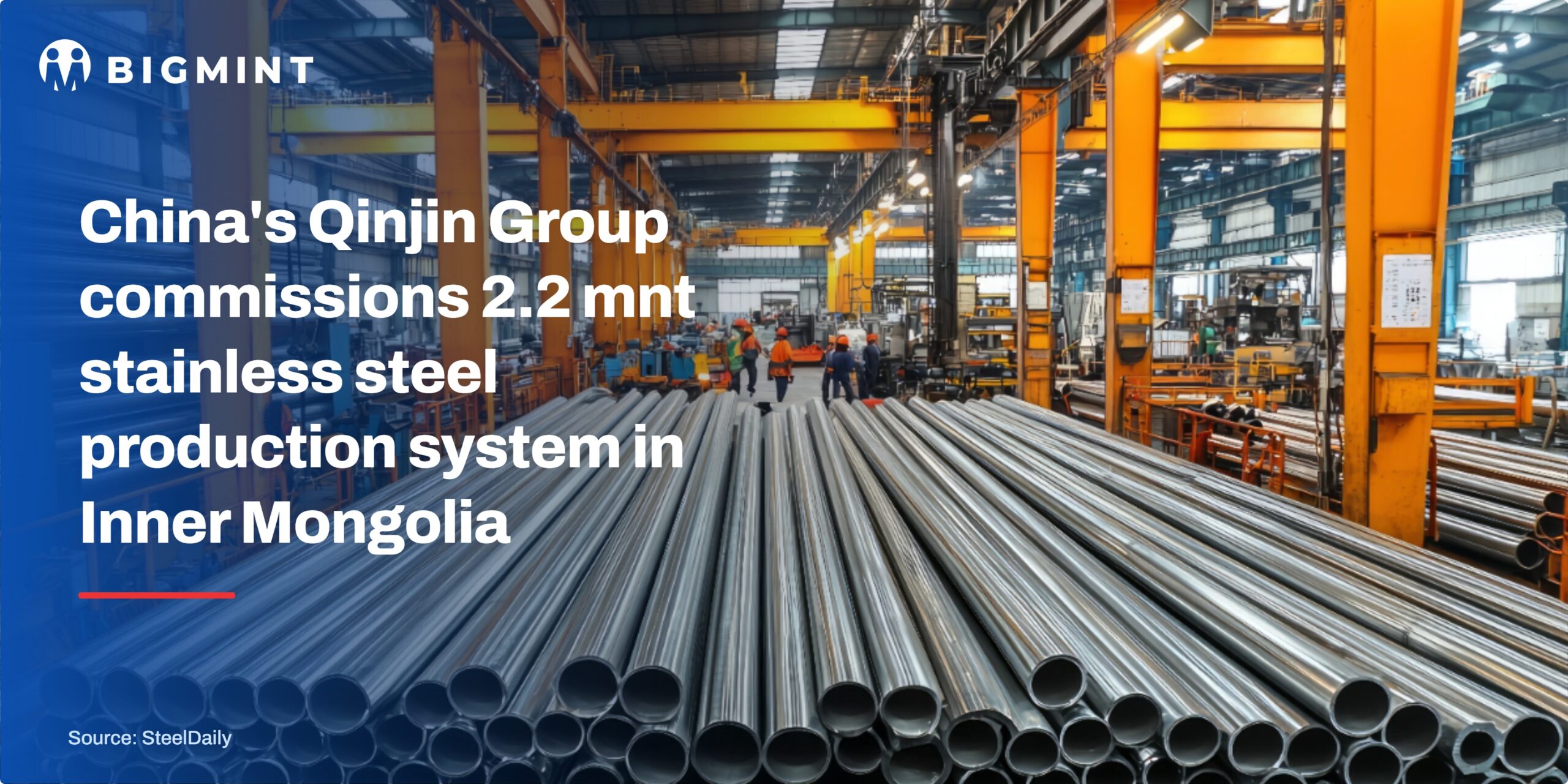
- Qinjin establishes integrated stainless steel production system
- 200 series expected to drive production growth
China’s Qinjin Group has established an integrated stainless steel production system with an annual capacity of 2.2 million tonnes (mn t) in Inner Mongolia, marking the start of full-scale operations. The project integrates ferronickel production, stainless steelmaking, hot rolling, cold rolling and downstream processing, with production primarily targeting China’s domestic market.
Integrated project enters production phase
According to China Metallurgy News, Inner Mongolia Qinjin New Materials Group held a production mobilisation ceremony on 6 August for its integrated green and low-carbon new materials project in Naiman Banner, Tongliao.
The project, backed by Hebei Bishi Group, involves an estimated investment of RMB 21 billion ($2.9 billion) and covers around 10,000 mu. Once fully completed, the facility is expected to produce 2.2 mn t of stainless steel coils annually.
200 series to lead stainless production
The project is expected to focus mainly on 200 series stainless steel, using the RKEF process to produce low-nickel, high-iron ferronickel. The molten ferronickel will then be directly used in stainless steelmaking to produce 200-series hot-rolled coils.
The company claims that the phosphorus content of ferronickel produced through the thermal furnace route is significantly lower than that from the blast furnace route, potentially improving the quality competitiveness of its stainless steel products.
Full production chain strengthens integration
The project is designed to integrate raw material production with ferronickel smelting, stainless steelmaking, hot rolling, pickling, cold rolling and downstream processing.
Phase I includes facilities for silicomanganese, ferronickel, vanadium-titanium alloys and high-carbon ferrochrome. Phase II covers special steelmaking, hot rolling, pickling, cold rolling and renewable energy facilities.
The completed project is expected to generate annual industrial output of more than RMB 70 billion ($9.7 billion) and create around 15,000 jobs.
Renewable energy supports green production
Qinjin is also developing around 400 MW of renewable energy capacity, comprising 250 MW of wind power and 150 MW of solar power, along with a 60 MW energy storage system.
The solar facilities have already been connected to the grid, while wind power capacity is expected to be connected by the end of the year. The company aims to directly use locally generated renewable power across its ferroalloy and stainless steel production processes.
Domestic market remains key target
Given the project’s inland location and distance from major export ports, the stainless steel output is expected to primarily serve China’s domestic market.
The company is also developing downstream industries, including stainless steel cold rolling and steel pipe processing, which could strengthen the regional supply chain.
The project’s location in Inner Mongolia provides access to demand centres across North and Northeast China, while local downstream processing is expected to absorb part of the additional output.
Market impact
The commissioning of Qinjin’s integrated 2.2 mn t/year stainless steel system could increase supply availability in China’s 200-series stainless steel market.
The expansion is particularly significant as the project integrates raw material production with stainless steelmaking and downstream processing, potentially improving cost competitiveness and strengthening Qinjin’s position in the domestic stainless steel market.
With the project targeting mainly domestic consumption, its impact is likely to be felt more strongly across regional supply chains in northern China than in export markets.
Note: This article is published as part of a content exchange agreement between SteelDaily and BigMint.
Leave a Reply