- IOCL raises prices across refineries
- Refinery prices diverge on supply conditions
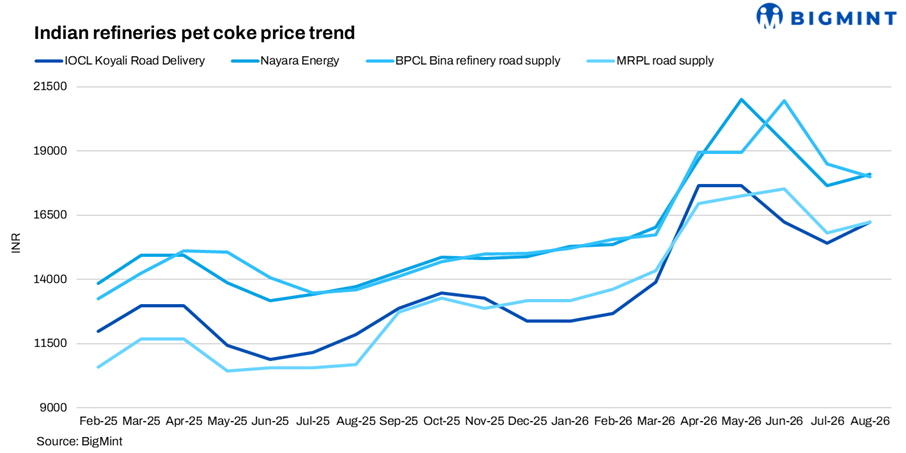
India’s domestic petcoke market reversed its July correction in August, with major refiners raising prices amid renewed strength in international markets, higher freight costs and elevated marine insurance premiums. IOCL led the increase, raising prices by INR 820/t across its four refineries, while Nayara Energy and CPCL increased prices by INR 440/t. MRPL raised prices by INR 800/t, whereas BPCL recorded mixed revisions across its refineries.
IOCL leads August price increase
Indian Oil Corporation (IOCL), the second-largest petcoke producer and a market leader in domestic sales, increased its petcoke prices by INR 820/t across all refineries effective 8 August. Road prices at Koyali increased to INR 16,240/t, Panipat to INR 17,500/t, Paradip to INR 15,250/t, and Haldia to INR 15,370/t.
The increase represented a 4.7-5% m-o-m rise across the refineries. Rake prices remained INR 200/t below road prices at Koyali, Paradip and Haldia, while Panipat has no rake loading facility.
The August increase followed IOCL’s reductions in July, when prices were lowered by INR 800/t at Koyali and Panipat, INR 830/t at Paradip and INR 880/t at Haldia. The reversal indicates that the downward price correction seen in July was short-lived as international market conditions became firmer again.
IOCL’s pricing remained below Nayara Energy across all four refineries. The price differential was INR 2,840/t at Paradip, INR 2,230/t at Koyali, INR 1,850/t at Haldia and INR 590/t at Panipat in August.
The largest differential was recorded at Paradip, although it remained below the INR 4,070/t gap seen in June. Market participants attributed the regional difference partly to local marketing conditions, including road freight costs and supply-demand dynamics.
Global uncertainty supports price reversal
The August increase reflected renewed firmness in international petcoke markets after the correction seen during June and July.
Although an agreement had been reached between the US and Iran, subsequent statements and renewed geopolitical uncertainty have kept market sentiment volatile. Concerns over vessel movements through the Strait of Hormuz have also kept freight costs elevated, while higher marine insurance premiums have added to replacement costs.
These factors have provided support to domestic refinery pricing despite the monsoon and relatively cautious downstream buying.
Nayara Energy increased its August price by INR 440/t to INR 18,090/t, following a sharper INR 1,680/t reduction in July. Its August price remained 31.8% higher y-o-y than INR 13,730/t in August 2025.
CPCL also raised its price by INR 440/t to INR 18,200/t. The refinery’s entire petcoke dispatch is through road, with monthly production and dispatch estimated at around 40,000-45,000 t, mainly serving Tamil Nadu and Andhra Pradesh.
MRPL and BPCL show mixed revisions
MRPL increased its August petcoke price by INR 800/t for both road and rake supplies. The rake price rose to INR 14,690/t, including INR 70/t tarpaulin charges, while the road price increased to INR 16,220/t.
The refinery maintained a INR 2,000/t differential between road and rake prices, excluding tarpaulin charges. However, customers lifting more than 2,500 t/month by road remain eligible for a INR 2,000/t volume discount.
MRPL’s rake price remained INR 3,400/t below Nayara’s August price, although the gap narrowed from INR 3,760/t in July.
BPCL showed a contrasting trend. At Bina, the road price declined INR 500/t to INR 18,000/t, while the rake price remained unchanged at INR 18,000/t. At Kochi, the rail price increased INR 1,000/t to INR 18,000/t.
Bina’s merchant availability remained limited at around 20,000-25,000 t/month, as a significant share of production was consumed internally by its captive power plant. Kochi availability was higher at around 75,000-80,000 t/month.
Overall, August pricing indicates that the domestic petcoke market has shifted back towards firmness after July’s correction. Refinery-specific supply conditions continue to create significant price differences, while freight, insurance costs and geopolitical uncertainty remain key factors supporting replacement costs.
Leave a Reply