- Falling hot metal output, elevated stocks weigh on Chinese imported iron ore
- Indian imported coking coal prices decline as mills hold 1-2 months of stocks
- Chinese, Indian HRC export offers slide as manufacturing demand remains soft
Morning Brief: Global steel and raw material prices declined m-o-m in July, with iron ore, coking coal, scrap, and billet falling to multi-month lows as mills reduced procurement amid soft finished steel demand and comfortable raw material availability.
In China and India, high temperatures and rainy season conditions limited steel consumption and raw material replenishment activity. Meanwhile, scrap and billet also faced pressure from weak demand for Turkish rebar and cautious restocking by mills.
In contrast, hot-rolled coil (HRC) prices softened slightly but remained relatively elevated, tracking Chinese prices. However, weak overseas demand, rising trade barriers, and strong competition kept export offers under pressure.
Notably, the J.P. Morgan Global Manufacturing PMI fell to a four-month low of 52.1 in July, although it remained above the 50-point threshold that signals expansion. The slowdown was uneven, with momentum easing in China and India, while Europe recorded its fastest manufacturing expansion since 2022 and ASEAN rebounded from recent disruptions.
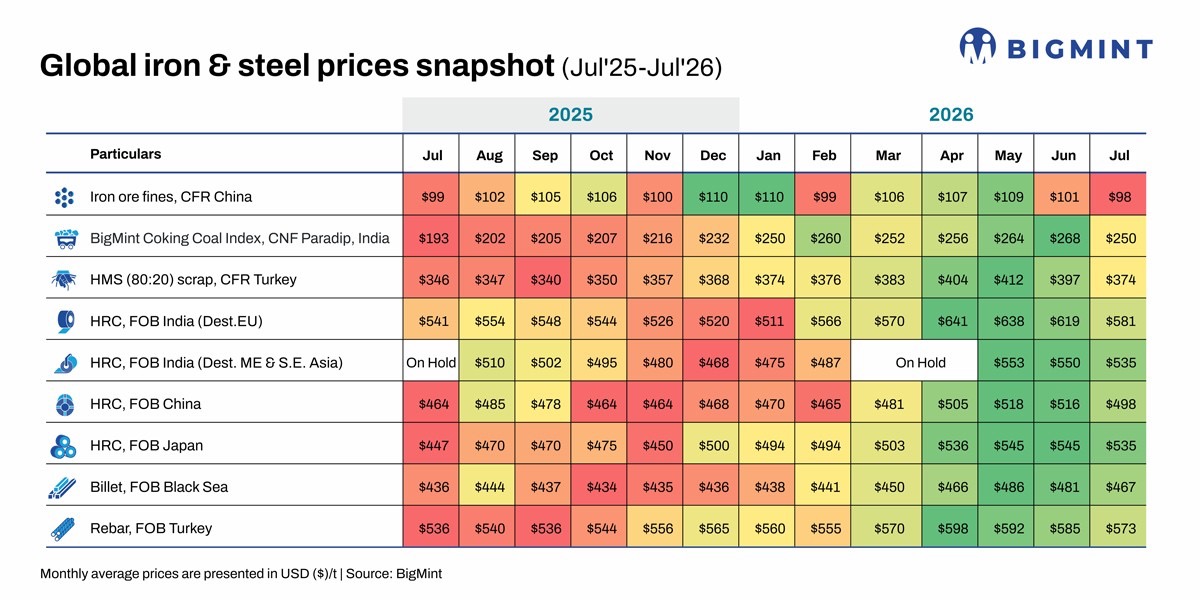
Snapshot of global steel, raw material prices in Jul’26
Chinese imported iron ore: Iron ore prices (Fe 61%) fell 3% m-o-m to a five-month low of $98/tonne (t) CFR China in July, though the decline was considerably smaller than the 7% drop in June.
China’s iron ore imports remained high despite the weaker price trend. Imports reached 108.09 million tonnes (mnt) in July, up 3.3% y-o-y but down 4.1% m-o-m. However, high summer temperatures and seasonal weakness in finished steel demand pressured steel prices, reducing mills’ incentive to procure iron ore aggressively.
Mills also reduced steel production amid narrow profit margins. Average daily hot metal output fell to 2.36 mnt in the week ended 31 July from around 2.43 mnt/day in early July.
Additionally, comfortable supply also exerted downward pressure. Port inventories stood at 165.9 mnt by the month-end, rising sharply by 2.67 mnt w-o-w and halting a four-week destocking trend.
Indian imported coking coal: BigMint’s premium hard coking coal index, CNF Paradip, fell 7% m-o-m to a five-month low of $250/t CNF Paradip in July, driven by weak Indian steel demand and comfortable mill inventories.
Indian mills remained largely absent from the seaborne market as falling finished steel prices and monsoon-related demand weakness reduced the incentive to build inventories. Most integrated steelmakers were estimated to have one to two months of inventory coverage, allowing them to defer fresh purchases and wait for lower prices. Indian met coke prices also softened by 3% m-o-m in eastern India, exerting downward pressure on prices.
Meanwhile, Australian PHCC FOB prices, which had remained firm early in the month on weather disruptions and supply constraints, came under increasing pressure as more August and September cargoes became available. Global market sentiment also turned subdued, as Chinese demand softened and mills proceeded with multiple rounds of coke price cuts.
Turkish imported ferrous scrap: Turkish deep-sea scrap prices fell by around 6% m-o-m to a six-month low of $374/t in July, driven by weak finished steel demand, cautious mill procurement, and a sharp slowdown in deep-sea bookings during the first half of the month. Notably, US-origin HMS 80:20 fell from $380/t CFR to $369/t CFR before recovering to $380/t CFR by month-end. EU-origin HMS 80:20 strengthened to $375-376/t CFR, supported by tighter regional scrap availability.
Weak domestic and export rebar sales, including reduced EU quota availability, kept mills on a hand-to-mouth buying strategy, though higher freights and tighter European scrap availability limited further downside. Prices recovered in the final two weeks as mills replenished inventories and billet prices strengthened, but the rebound remained constrained by weak rebar demand.
Russian billet export offers: Russian/CIS billet export prices fell around 3% m-o-m in July, mainly because weaker Turkish scrap prices and poor finished-steel demand reduced buyers’ workable levels.
Russian offers declined from around $475-478/t FOB Black Sea in early July to $460-465/t by mid-to-late July, as Turkish mills delayed purchases and targeted deeper discounts. Domestic Turkish billet prices also fell to $515-520/t exw, reinforcing pressure on CIS offers.
Chinese material was also offered to Turkiye at roughly $510-520/t CFR, with buyers seeking below $500/t CFR. This gave Turkish buyers an alternative to CIS billet and strengthened their bargaining position.
Seasonal weakness in rebar demand, wide bid-offer gaps, and cautious procurement kept trading thin. The decline was partly limited by tighter Russian availability, higher Black Sea freight, and war risk premiums towards the month-end.
Turkish rebar export offers: Turkish rebar export offers fell 2% m-o-m in July, as mills faced limited bookings and intensified competition from alternative suppliers in Europe, North Africa, and the Middle East. The EU’s revised safeguard quota allocations, effective 1 July, further reduced Turkish mills’ access to their key traditional market, while lower scrap prices reduced cost support.
Notably, Turkish rebar applications exceeded the third-quarter quota of 59,919 t by around 80% within two weeks of implementation of the new import regime. Meanwhile, domestic demand also remained weak, with high interest rates, financing constraints, and seasonal construction slowdown limiting mills’ ability to raise prices.
Chinese HRC export offers: Chinese HRC export offers fell around 3% m-o-m in July to a four-month low of $498/t FOB, mainly due to weak overseas demand, ample export supply, and stronger competition from regional suppliers. With buyers facing more local supply and tighter import restrictions, Chinese exporters reduced prices to retain their competitiveness and secure bookings. Cost support also weakened amid falling iron ore and coke prices.
Indian HRC export offers: Indian HRC export offers to both the EU and the Middle East and Southeast Asia fell m-o-m, but the magnitude differed.
Indian HRC export offers to the EU fell around 6% m-o-m to $581/t FOB main port in July, mainly due to weak buying at the start of the month as buyers assessed the EU’s revised country-specific safeguard quotas. Indian mills reduced offers to stimulate bookings, while subsequent buying was driven mainly by efforts to secure available Q4CY’26 quota rather than stronger underlying demand. The entire Q4 quota was booked during July, bringing fresh EU buying to a halt until the next booking cycle, which is expected to start in October.

Indian HRC export offers to the Middle East and Vietnam fell around 3% m-o-m to $535/t FOB in July. In the Middle East, disruptions along the Strait of Hormuz made buyers cautious about shipment execution, while vessel availability and higher freight costs constrained trade.
Around 50,000 t were booked for August shipment, but this reflected selective buying, with Indian material remaining competitive due to shorter transit times, despite aggressive Chinese offers.
In Vietnam, weak downstream demand and elevated inventories kept buying activity subdued. While enquiries emerged in the second half of July, buyers’ bids remained below Indian mills’ workable levels, resulting in limited or no meaningful bookings.
Outlook
BigMint expects global steel and raw material prices to remain under pressure in August as the steel market remains in its off season across China, India, and Southeast Asia. Chinese iron ore prices are likely to fall as hot metal output will remain subdued and port inventories high. However, expectations of a recovery in steel demand during September, traditionally a peak period in China, could limit the m-o-m drop.
Coking coal is also likely to face pressure as Indian mills carry comfortable inventories and Chinese coke price cuts continue. However, strict safety inspections in China, following another fatal accident in Shanxi in early August, are likely to keep coking coal supply tight, which, along with expectations of improving finished steel demand in September, may support prices. Indian steel prices are also rising, which may prop up offers.
Additionally, tight European scrap availability, logistics disruptions on the Rhine River, August holiday-related collection shortages, and elevated freight costs are expected to keep Turkish imported scrap prices firm. However, weak long steel demand, limited export rebar sales, and cautious mill procurement are likely to prevent any significant increase in import scrap prices unless downstream steel demand improves.
HRC markets are likely to remain firmer than longs and raw materials. Chinese mills are expected to resist steep price cuts while domestic costs remain elevated, but weak overseas demand, trade barriers, and competition from regional suppliers should cap gains.
Leave a Reply