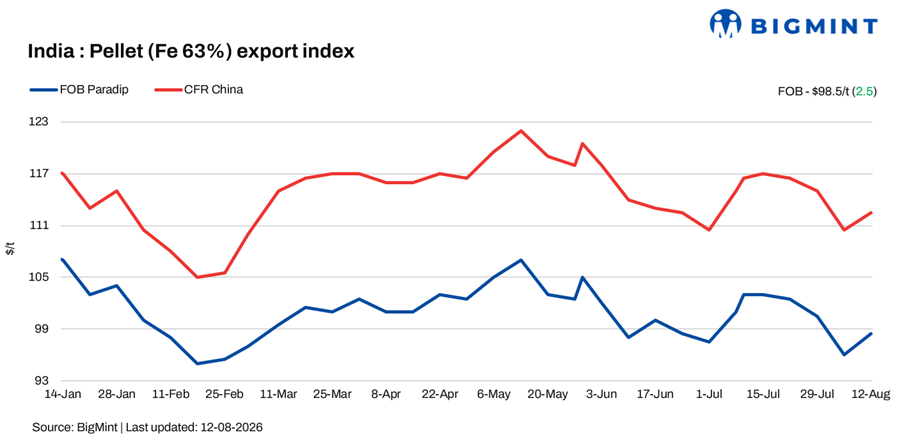
- Index rises amid stronger iron ore benchmarks
- Domestic realisations more attractive than exports
BigMint’s India pellet (Fe 63%, 3-3.5% Al₂O₃) export index increased by $2.5/t w-o-w to $98.5/t FOB east coast on 12 August 2026, supported primarily by a recovery in global iron ore fines prices. The Fe 61% iron ore fines benchmark rose by around $2/t during the assessment period, providing some support to pellet pricing and improving sentiment across the seaborne market.
Despite the index recovery, export trading activity remained subdued, with weak export realisations and limited profitability continuing to discourage fresh bookings. Several pellet producers have adopted a wait-and-watch approach, while others continue to prioritise domestic sales and captive consumption.
Buying interest from China remained limited and selective across pellet grades, while Indian exporters refrained from offering fresh cargoes amid better domestic realisations.
Meanwhile, pellet inventories across 34 major Chinese ports edged down w-o-w to 5.8 mnt, indicating slowdown from procuring material.
Rationale
- Zero (0) confirmed deals from India’s east coast were recorded in this publishing window for T1 trade, and, therefore, this category was allotted 0% weightage for today’s price calculations. Click here for the detailed methodology.
- Eleven (11) bids, offers, and indicative prices were heard, of which eight (8) were considered for the calculation of the index and given the balance 100% weightage.
Market updates
Export trading activity remained subdued during the assessment period despite the recovery in benchmark iron ore prices. Market participants said export economics continued to remain unattractive, with domestic realisations reportedly around INR 800/t higher than export returns.
Several pellet producers that were previously active in the export market have reduced their participation, with domestic commitments and captive consumption taking priority. Pending order books have further restricted merchant availability for overseas sales.
A market participant said, “Most producers already have sufficient domestic commitments. At current export prices, there is little incentive to divert material overseas, so fresh export availability remains limited.”
An eastern India-based seller said early orders remained pending, while many sellers were already booked for the month, reducing the urgency to sell and clear inventories.
The bid-offer gap also continued to restrict fresh business. Chinese buyers were heard targeting around $110-112/t CFR China, while Indian producers indicated that at least $118-122/t CFR China would be required to achieve workable margins. The wide gap has kept negotiations largely inactive despite the recent improvement in iron ore prices.
Producers are likely to continue prioritising domestic sales and captive consumption, keeping export availability restricted.
Domestic vs export market
The pellet export realisation was recorded for Fe 63% at INR 7,200-7,250/t ($75-76/t), gaining up by INR 250/t this week while domestic realisation (Fe 62.5%) held steady w-o-w at INR 8,050/t ($85/t) exw.

Factors impacting pellet exports:
Chinese iron ore fines prices rebound by $3/t w-o-w: The benchmark iron ore fines Fe 61% index bounced back, climbing by $3/t w-o-w to $96/dmt CFR China on 11 August. Additional support stemmed from concerns over potential disruptions to Australian iron ore exports after unions representing workers at BHP’s Port Hedland operations announced a two-day protected industrial action. The recovery was supported by reports that CMRG advised some Chinese steel mills to suspend negotiations with Australian miners for September-loading cargoes until annual contract talks are concluded.
DCE iron ore futures firms w-o-w: Iron ore futures on the Dalian Commodity Exchange (DCE) for the September 2026 contract settled at RMB 722.5/t ($107/t) on 5 Aug, up by RMB 23/t ($3-4/t) w-o-w.
Outlook
BigMint expects the pellet export market to remain subdued in the near term. While firmer iron ore benchmarks may provide some support to prices, weak export economics, limited Chinese buying interest and a wide bid-offer gap are likely to constrain fresh trade. A meaningful recovery in international pellet prices would be required to make exports more competitive with the domestic market.

Leave a Reply