- Mills’ production cuts offer limited support to prices
- Coke price cuts continue amid softer mill profitability
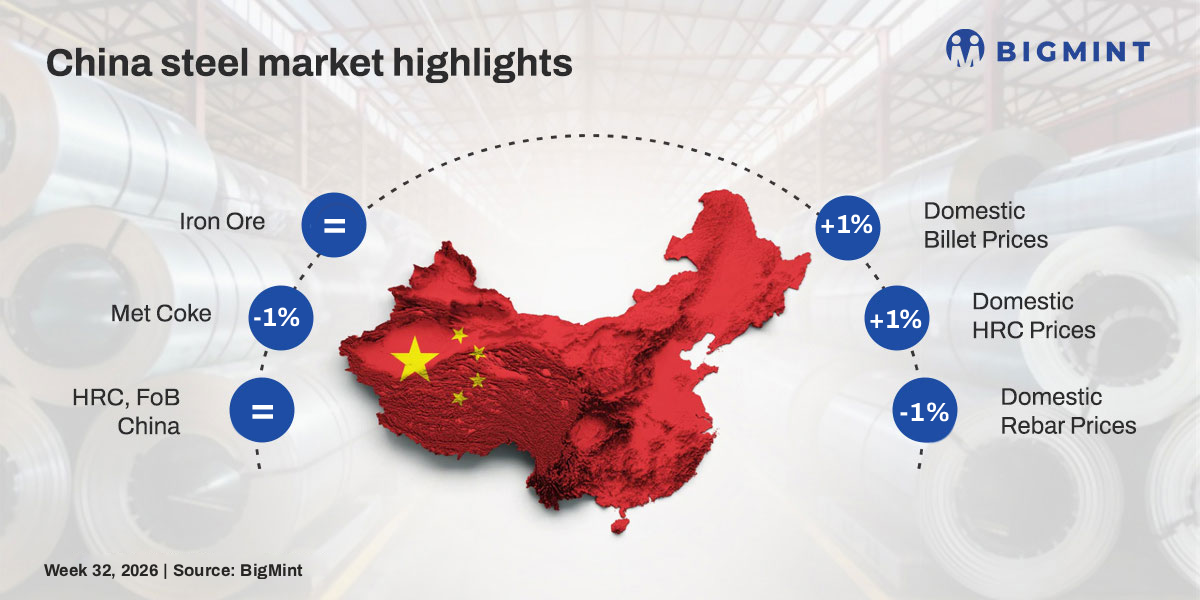
Steel prices in China showed a mixed trend during the week ended 7 August, with rebar prices declining while HRC and billet prices edged up. Raw material markets were largely stable, with iron ore prices remaining range-bound, while coke prices weakened following another round of cuts by major steel mills.
The market continued to face weak seasonal demand, elevated inventories, and subdued downstream activity. However, production cuts, maintenance at steel mills, and relatively firm raw material costs provided some support to prices.
Steel inventories in late-July
The China Iron and Steel Association (CISA) reported that total steel inventories at key CISA-affiliated mills stood at around 16.28 million tonnes (mnt) during end-July (21-31 July 2026), down 1.85 mnt, or 10.2%, from 18.13 mnt in mid-July.
However, inventories were up 1.5 mnt, or 10.1%, y-o-y from 14.78 mnt recorded during the same period last year. M-o-m, inventory levels remained broadly unchanged.
Steel price trend
Rebar prices decline w-o-w: China’s domestic rebar prices fell by RMB 20/tonne (t) ($3/t) w-o-w to around RMB 3,130/t ($464/t) on 7 August from RMB 3,150/t ($467/t) a week earlier. However, SHFE rebar futures (October 2026 contract) increased by RMB 22/t ($3/t) to RMB 3,010/t ($446/t) from RMB 2,988/t ($443/t).
Chinese rebar prices declined during the week amid weak off-season demand and continued inventory accumulation. Downstream construction and manufacturing activity remained subdued, while steel mills faced pressure from high inventories and weak finished steel shipments. Narrowing profit margins prompted mills to increase production cuts and maintenance, including reduced operating hours at electric arc furnace mills and blast furnace maintenance. However, despite the supply-side adjustments, weak market transactions and sluggish demand continued to weigh on prices.
Domestic HRC prices rise: China’s domestic hot-rolled coil (HRC) prices increased by RMB 40/t ($6/t) w-o-w to around RMB 3,100/t ($459/t) on 7 August, compared with RMB 3,060/t ($453/t) a week earlier. Furthermore, SHFE HRC futures (October 2026 contract) were up by RMB 36/t ($5/t) to RMB 3,242/t ($480/t) from RMB 3,206/t ($475/t) in the previous week.
China’s domestic HRC prices increased during the week, supported by firmer trader offers and a moderate release of downstream demand following the recent price rebound. However, buying remained cautious, with limited willingness to chase higher prices.
Although supply pressure persisted and the overall supply-demand balance remained weak, prices hovered near production costs, which led producers to maintain firm offers. This helped prices gain modestly, while the lack of stronger demand kept the market range-bound.
Meanwhile, a market participant said, “Prices are fluctuating within a normal range, but the continued decline is becoming excessive. If the downward pressure persists, mills may start restricting production.”
Chinese HRC export offers remained stable in the week, with offers around $495/t FOB Rizhao.
A market participant said, “Weather conditions at Chinese ports have been extremely poor, with our vessels also facing delays of more than 10-15 days. Loading operations were halted due to strong winds and adverse weather, while port authorities temporarily suspended vessel berthing.”

Raw materials front
Iron ore spot prices steady w-o-w: Iron ore fines benchmark prices for Fe 61% remained largely stable w-o-w at $95/dmt CFR China on 7 August. Physical buying activity remained slow. Mills are waiting for further clarity over prices amid supply bottlenecks due to the port strike and the dispute between CMRG and a major miner.
a) Spot pellet premium stable w-o-w: The spot pellet premium for Fe 65% grade pellet remained steady at $23.7/t CFR China on 5 August.
b) Spot lump premium rose w-o-w: The spot lump premium edged up w-o-w to $0.2405/t CFR China on 7 August.
Coke market weakens as steel mills announce third coke price cut: China’s coke markets remained largely stable w-o-w, although sentiment weakened after major steel mills initiated a third round of coke price reductions of RMB 50-55/t ($ 7-8/t).
Despite tight coking coal supply caused by stringent mine safety inspections and temporary production suspensions, weak steel profitability, lower pig iron output, and maintenance-related production cuts curtailed procurement activity. Loss-making coke producers reduced output, while higher inventories at coke plants, weaker port prices, and softer freight rates highlighted sluggish downstream demand, keeping the near-term market under pressure.
In the seaborne market, Australian premium hard coking coal (PHCC) prices declined further by $4/t w-o-w to $214/t FOB, pressured by subdued steel demand and cautious spot buying. Reflecting the softer global coking coal market, BigMint’s premium hard coking coal (PHCC) index was assessed at $234/t CNF Paradip, India, on 07 August 2026, down by $7/t w-o-w. A drop in export offers and expectations of price drops held back Indian mills from actively bidding for coking coal cargoes this week.
Billet prices edge up w-o-w on cost support despite weak demand: Chinese billet prices increased modestly during the week ended 7 August, supported by firmer raw material costs, improving market sentiment, and speculative buying at relatively low price levels. However, persistently weak seasonal steel demand, rising inventories, and subdued export activity continued to cap further gains.
BigMint assessed domestic billet at RMB 2,940/t ($436/t) on 7 August, up RMB 20/t ($4/t) w-o-w from RMB 2,920/t ($432/t) on 31 July.
In the export market, Chinese billet offers declined to around $450/t FOB from $454/t FOB a week earlier as exporters continued to adjust prices to improve competitiveness. Although domestic sentiment improved, overseas buying remained cautious, limiting export transactions despite some suppliers raising bids by around $5/t later in the week.
Outlook
Based on supply-demand dynamics, production costs, and macroeconomic factors, China’s steel market is expected to remain under pressure in August 2026.
The market is awaiting a meaningful recovery in domestic demand, while supply growth is gradually weakening. Market transactions remain stable with a slight improvement, but cost support is also weakening. As a result, domestic steel prices are expected to maintain a weak and volatile trend next week.
The key focus will remain on downstream demand and the production status of steel mills. Accordingly, the domestic construction steel market is expected to fluctuate within a narrow range.
Leave a Reply