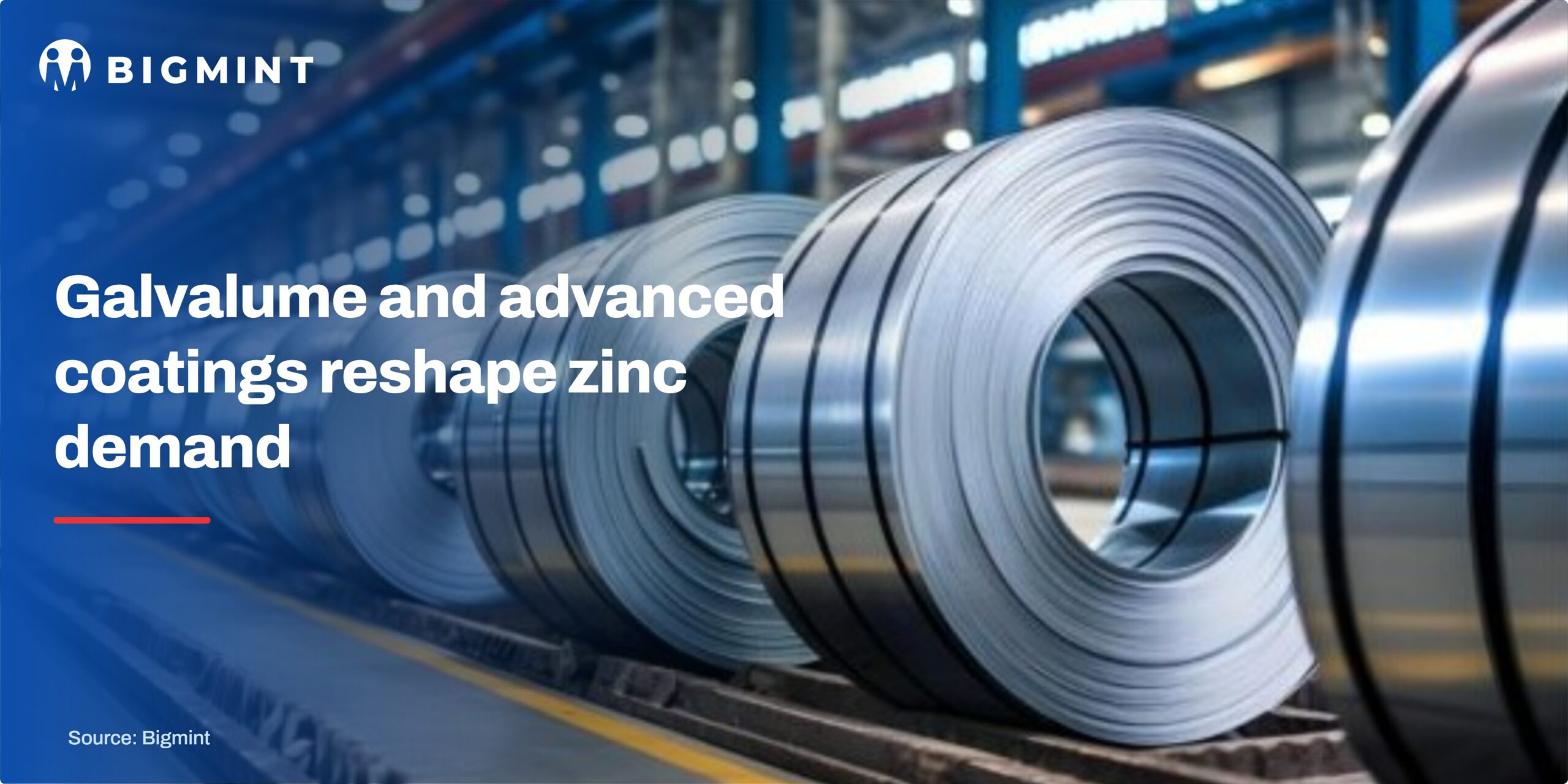
- Galvalume adoption rises across roofing and solar applications
- Advanced alloy coatings reduce zinc intensity while improving durability
India’s galvanising industry, which accounts for around 70% of the country’s annual refined zinc demand of nearly 1 million tonnes (mnt), is witnessing a gradual shift towards advanced zinc-based coating technologies. While conventional hot-dip galvanising (HDG) continues to dominate the domestic market, the growing adoption of Galvalume (55% aluminium, 43.5% zinc and 1.5% silicon) in roofing, pre-engineered buildings (PEBs) and solar structures, alongside the gradual emergence of zinc-aluminium-magnesium (ZAM) coatings, is changing zinc consumption patterns. These coatings require less zinc than conventional galvanising by replacing part of the zinc layer with aluminium and other alloying elements.
Galvanising remains the largest end-use segment for zinc in India, driven by demand from transmission towers, railways, highways, industrial buildings, roofing and automotive applications. Conventional HDG coatings typically use around 275 g/m² of zinc, whereas ZAM-coated steel can provide comparable corrosion protection with coating weights of 90-180 g/m², depending on the application. Galvalume offers higher corrosion resistance and better heat reflectivity, making it increasingly preferred for roofing, industrial buildings and outdoor applications where service life is a key consideration.
Unlike ZAM, which remains at an early stage of commercial adoption in India, Galvalume has gained significant traction over the past few years. Rising investments in industrial sheds, warehouses, commercial buildings and utility-scale solar projects have increased its consumption. Market participants expect solar installations to become one of the fastest-growing end-use segments, while automotive manufacturers are evaluating alloy-coated steels for body panels and structural components to improve corrosion performance.
Industry interactions indicate that galvanising activity remains stable despite the gradual shift towards alloy-coated products. One integrated steel producer stated that its galvanising and Galvalume operations consume around 10,000 t/month of zinc, while aluminium consumption for alloy-coated products is estimated at 10,000-11,000 t/month. The producer manufactures around 50,000 t/year of Galvalume, reflecting the increasing share of aluminium-zinc coatings in its coated steel portfolio. Market participants also noted that primary zinc continues to be procured mainly through annual contracts, while aluminium purchases increasingly combine primary and secondary material depending on product specifications.
The wider use of Galvalume and the gradual adoption of ZAM are reducing zinc consumption per tonne of coated steel rather than replacing zinc altogether. As coating weights decline, future zinc demand will increasingly depend on growth in coated steel production instead of higher zinc application rates. The shift also indicates a gradual change in raw material consumption, with aluminium accounting for a larger share of corrosion-protection coatings while zinc continues to provide the primary sacrificial protection layer.
Conventional HDG is expected to remain the dominant coating technology across infrastructure and general engineering applications because of its established processing base and lower cost. However, the increasing use of Galvalume in roofing, industrial construction and solar projects indicates that growth in coated steel demand is gradually shifting towards alloy-coated products with lower zinc intensity.
This article has been curated by BigMint as part of the Global Commodity Conclave (GCC) 2026 knowledge series, highlighting the evolving trends shaping India’s galvanising and coated steel industry.
Continue the discussion at GCC 2026
The changing dynamics of zinc consumption, the growing adoption of Galvalume and advanced alloy coatings, and emerging opportunities across infrastructure, roofing and solar applications will be explored during the “Zinc outlook: Demand strength & emerging opportunities” session at the Global Commodity Conclave (GCC) 2026, hosted by MCX with BigMint as the Event Partner, from 12-14 August 2026 at the Jio World Convention Centre, Mumbai. Join industry leaders and market participants as they discuss the key demand drivers, evolving coating technologies and the long-term outlook for zinc and the broader non-ferrous metals sector.

Leave a Reply