- Costly inland logistics keep DRC concentrate exports limited
- Kamoa-Kakula has secured multiple export exemptions since 2021
The Democratic Republic of Congo (DRC) has imposed an immediate ban on exports of copper and cobalt concentrates, reinforcing its long-term strategy to expand domestic mineral processing and capture greater value from its vast mineral resources. While the announcement sparked a sharp rally in global copper prices, market analysts believe the immediate impact on physical copper supply is likely to be limited, as the majority of the country’s copper is already processed domestically before export.
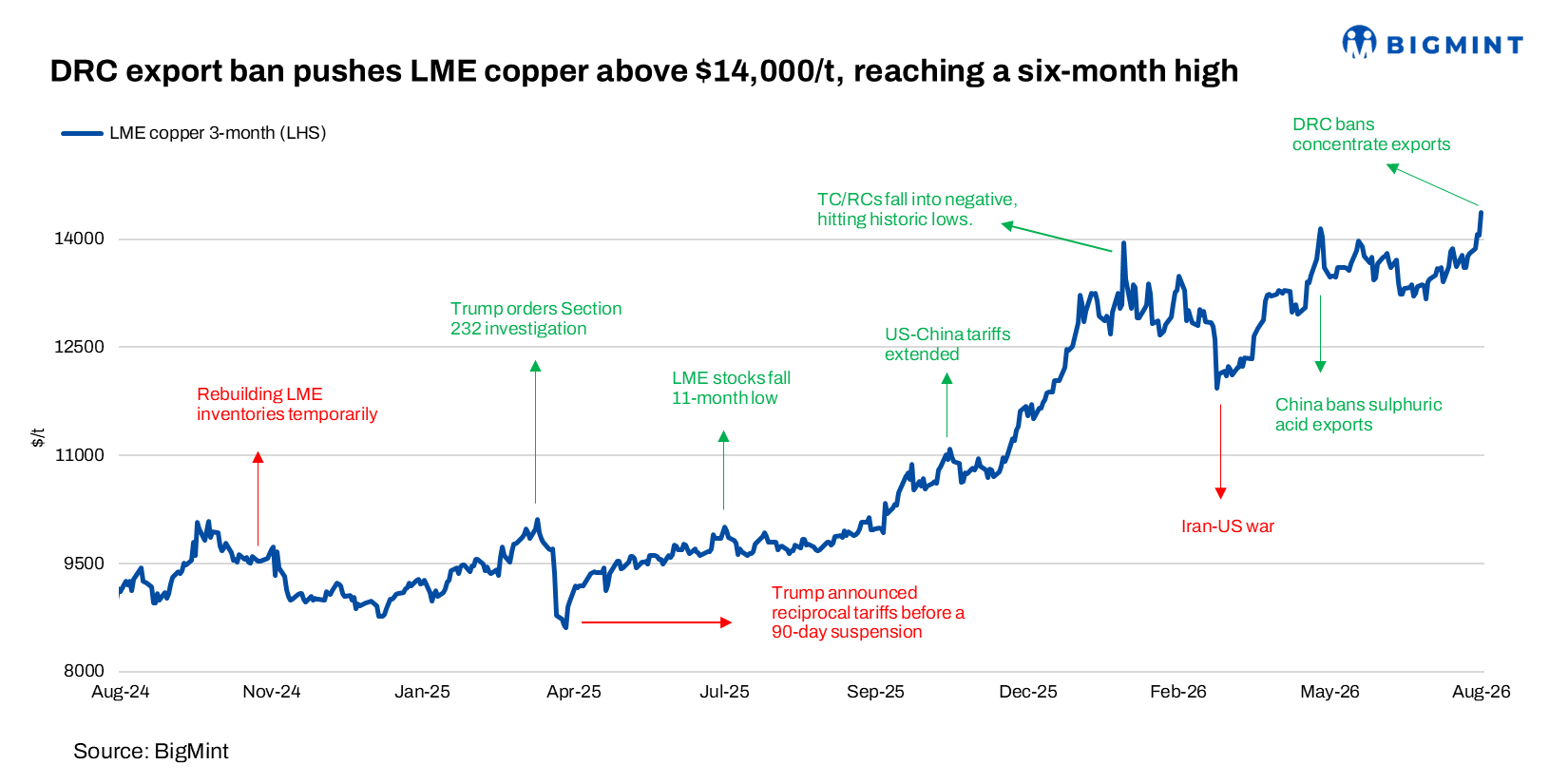
The announcement immediately lifted sentiment across the copper market, with LME three-month copper prices rising nearly 1.8% to $14,370/t, the highest level since late January this year.
The rally was largely driven by concerns over tightening concentrate availability, adding to an already constrained global concentrate market where treatment and refining charges (TC/RCs) remain near historic lows.
The order allows one-year export waivers under strategic circumstances, although the government has not specified the eligibility criteria. The policy replaces the 2023 export framework and introduces a broader mineral export regime, along with a taxation system for economically significant mining by-products after a three-month transition period.
DRC’s copper industry already heavily integrated
Although the DRC is the world’s second-largest mined copper producer, its export profile differs from many other copper-producing countries. A significant share of production comes from SX-EW (solvent extraction-electrowinning) operations, which produce refined cathodes directly rather than copper concentrates.
The country’s flagship Kamoa-Kakula operation has also significantly reduced dependence on concentrate exports following the commissioning of its on-site smelter in late 2025. Instead of exporting concentrates, the operation now converts most of its output into 99.7%-pure copper anodes within the DRC, adding greater value before shipment.
Notably, the 500,000 t/year Kamoa-Kakula smelter is currently operating at around 60% of its capacity due to limited concentrate availability, indicating that much of the mine’s concentrate is already being absorbed domestically rather than entering the export market.
This explains why relatively little copper concentrate currently leaves the country despite Congo’s massive mine production.
Minimal impact expected on refined copper availability
The latest export restriction is unlikely to materially affect global refined copper supply in the near term.
Official data show that during Q1 2026, the DRC exported around 696,725 t of refined copper cathodes, compared with only 53,926 t of copper concentrates, containing approximately 18,863 t of copper metal. This indicates that concentrate exports represent only a small portion of the country’s overall copper exports.
According to Ivanhoe Mines, Kamoa-Kakula has received multiple export exemptions since production began in 2021, while most of its concentrate is currently processed either at its own smelter or the nearby Lualaba Copper Smelter.
Market analyst estimates that the DRC’s net copper concentrate balance is effectively zero in 2026, implying that nearly all concentrate produced is already consumed domestically. While the concentrate surplus is expected to gradually increase from 2027 onward, suggesting some export potential in future years, the current ban has little immediate effect on physical concentrate flows.
Additionally, transporting copper concentrate from the DRC is both costly and logistically challenging, as most mining operations are located deep inland, far from seaports. Consequently, further domestic processing has long been a more economical option than exporting concentrates over long distances.
Indian investment reinforces DRC’s copper processing ambitions
Earlier this year, India’s Lloyds Metals & Energy Ltd. (LMEL) commenced commercial production of copper cathodes from its 12,000 tpa copper processing plant in the Katanga Copper Belt on 16 March 2026. Additionally expands its presence through the acquisition of the Chemaf Group.
Chemaf currently operates the Etoile processing plant with a capacity of 20,000 tpa of copper cathodes, while its Mutoshi expansion project is expected to raise copper production capacity to 70,000 tpa. Combined with Lloyds’ existing operations, the group aims to build a 100,000 tpa copper production platform in the DRC.
Long-term implications outweigh immediate disruption
While the immediate market impact appears limited, the policy could become increasingly significant over the medium to long term. As new mining projects come online and concentrate production rises, export restrictions could require additional investments in domestic smelting capacity or influence future mine development strategies.
The announcement also reinforces the DRC’s broader resource-nationalism agenda, following previous concentrate export restrictions introduced in 2013, 2019 and 2023, all aimed at promoting local beneficiation.
Conclusion
The latest export ban is unlikely to significantly disrupt refined copper availability in the short term, given the DRC’s existing downstream processing capacity and the limited volume of concentrate exports. However, the announcement has injected fresh bullish sentiment into the copper market at a time when concentrate supplies remain structurally tight and global inventories continue to decline.
Going forward, market attention will shift towards the implementation of the policy, the granting of export waivers to major producers, and the pace of new smelting capacity additions. While today’s price rally appears largely sentiment-driven, the policy could become a more meaningful supply-side factor if the DRC’s concentrate surplus expands over the remainder of the decade.

Leave a Reply