- Comfortable supply, lower seaborne prices weigh on index
- Domestic market remains more attractive than exports
India’s low-grade iron ore fines (Fe 57%) export market remained under pressure in the week ended 6 August 2026, as declining seaborne iron ore prices, weak Chinese steel margins, and ample raw material availability kept buyer interest subdued. Most participants adopted a wait-and-watch approach, expecting further price corrections, while spot trading activity remained largely absent.
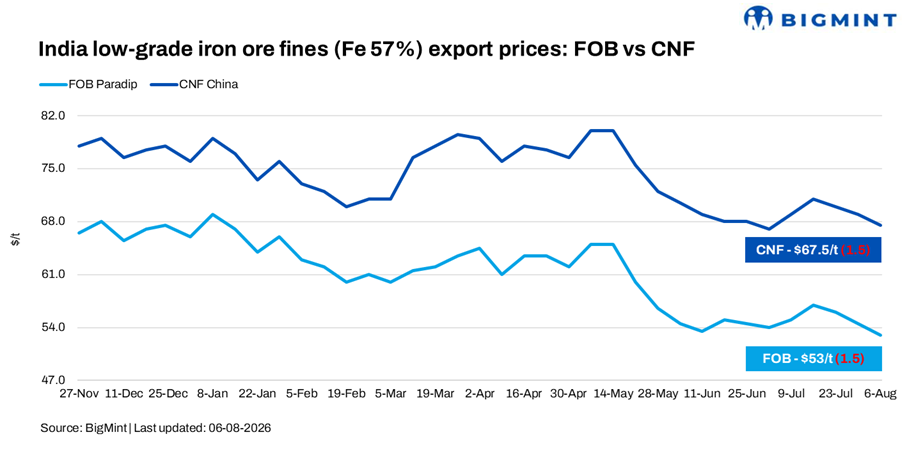
Reflecting the weaker market, BigMint’s bi-weekly Indian low-grade iron ore fines (Fe 57%) export index declined by $1.5/tonne (t) w-o-w to $53/t FOB east coast (equivalent to $67.5/t CFR China) on 6 August 2026. No fresh export deals were reported during the assessment period, with buyers remaining on the sidelines and sellers showing limited urgency to conclude business at prevailing price levels.
A trader said, “Export demand has weakened due to subdued buying from China. Steel mills have already built sufficient raw material inventories to sustain operations, reducing the need for fresh imports. Coupled with the monsoon season, this has further dampened export activity.”
Rationale
- No confirmed deals for Fe 57% fines were reported during the current publishing window. Consequently, T1 trades were assigned a 0% weightage in the index calculation. For the detailed methodology, click here.
- BigMint received 16 indicative price inputs during the assessment period, of which 12 qualified as T2 inputs and were assigned the remaining 100% weightage for the index calculation.
Market scenario
Market participants said export negotiations remained limited during the assessment period as buyers and sellers failed to align on workable price levels. Buyers largely preferred to stay on the sidelines amid expectations of further weakness in benchmark iron ore prices, while Indian suppliers refrained from aggressively lowering offers due to comparatively better domestic realisations.
Traders noted that Chinese steel mills continued to procure only on a need-based basis, supported by comfortable raw material inventories and sufficient seaborne supply. Consequently, fresh enquiries remained sporadic and most negotiations failed to translate into concluded deals.
Another trader noted, “Indian low-grade iron ore fines are currently trading at a discount of around 21-22% to benchmark prices, reflecting weak demand and continued pressure on export realisations.”
Domestic vs export market
The gap between domestic and export realisations widened to INR 700/t this week as export prices weakened while domestic prices remained stable. Export realisations for Fe 57% fines declined by INR 200/t ($2/t) w-o-w to INR 2,600/t ($27.3/t), whereas domestic realisations held steady at INR 3,300/t ($34.7/t) exw, making the domestic market more attractive for producers.
Why are Indian low-grade export prices under pressure?
- Chinese iron ore fines prices ease w-o-w: The benchmark iron ore fines (Fe 61%) index declined by $3/dmt w-o-w to $94/dmt CFR China on 5 August 2026. Seaborne iron ore prices remained under pressure as subdued spot buying, comfortable port inventories, and ample availability of medium-grade fines outweighed support from higher freight and energy costs. Weak steel mill margins and cautious procurement by Chinese buyers further limited any meaningful price recovery.
- DCE iron ore futures soften marginally w-o-w: Iron ore futures for the September 2026 contract on the Dalian Commodity Exchange (DCE) settled at RMB 719/t ($106.5/t) on 5 August, easing marginally by RMB 0.5/t ($0.1/t) w-o-w. The limited movement reflected cautious market sentiment, with traders balancing expectations of stable near-term steel production against persistent concerns over weak downstream demand and ample iron ore supply.
Outlook
India’s low-grade iron ore fines export market is expected to remain subdued in the near term, with spot trading likely to stay limited unless buying interest from China improves. Producers are expected to continue prioritising domestic sales, where returns remain more attractive than exports, limiting the availability of fresh export offers.
Any sustained recovery in export prices will depend on a rebound in seaborne iron ore benchmarks and stronger procurement by Chinese steel mills. Until then, export activity is likely to remain driven by selective enquiries rather than broad-based spot demand.

Leave a Reply