- Scrap premium over sponge iron widens to nearly INR 3,300/t in Jun’26 from INR 200/t in Jan
- Growing steel output lifts consumption of both metallics despite changing procurement trends
India’s secondary steel sector is increasingly recalibrating its metallic mix, with sponge iron (DRI) gaining ground over ferrous scrap as widening price differentials and changing procurement economics reshape raw material sourcing. While ferrous scrap remains central to India’s long-term decarbonisation ambitions and circular steel economy, elevated scrap prices have encouraged induction furnace (IF) mills to increase DRI consumption to protect steelmaking margins without compromising production.
Steel capacity expansion lifts metallic demand
India’s metallic demand continues to grow alongside expanding steel capacity. According to BigMint estimates, ferrous scrap consumption is projected to increase from 33 million tonnes (mnt) in FY’25 to 38 mnt in FY’26 and 44 mnt in FY’27. Sponge iron demand is also expected to rise from 44 mnt to 48 mnt and 51 mnt, respectively.
As a result, total metallic demand is projected to increase from 77 mnt to 95 mnt over the same period. While sponge iron is expected to remain India’s dominant metallic, scrap’s share is projected to increase from around 43% in FY’25 to nearly 46% by FY’27, reflecting the growing contribution of recycling to the country’s steelmaking mix.
Widening price spread favours sponge iron
The key shift in procurement during H1CY’26 was driven by changing relative economics.
Between January and June 2026, HMS (80:20) DAP Jalna prices increased by around INR 2,400-2,500/tonne (t) (7%), rising from INR 33,300/t to INR 35,800/t. In contrast, Raipur-origin sponge iron (DAP Jalna) declined by around INR 600/t (2%), from INR 33,100/t to INR 32,500/t.

Consequently, the premium of ferrous scrap over sponge iron widened sharply from around INR 200/t in January to nearly INR 3,200/t in June, making DRI a significantly more cost-effective metallic for secondary steelmakers.
Regional mills increase DRI consumption
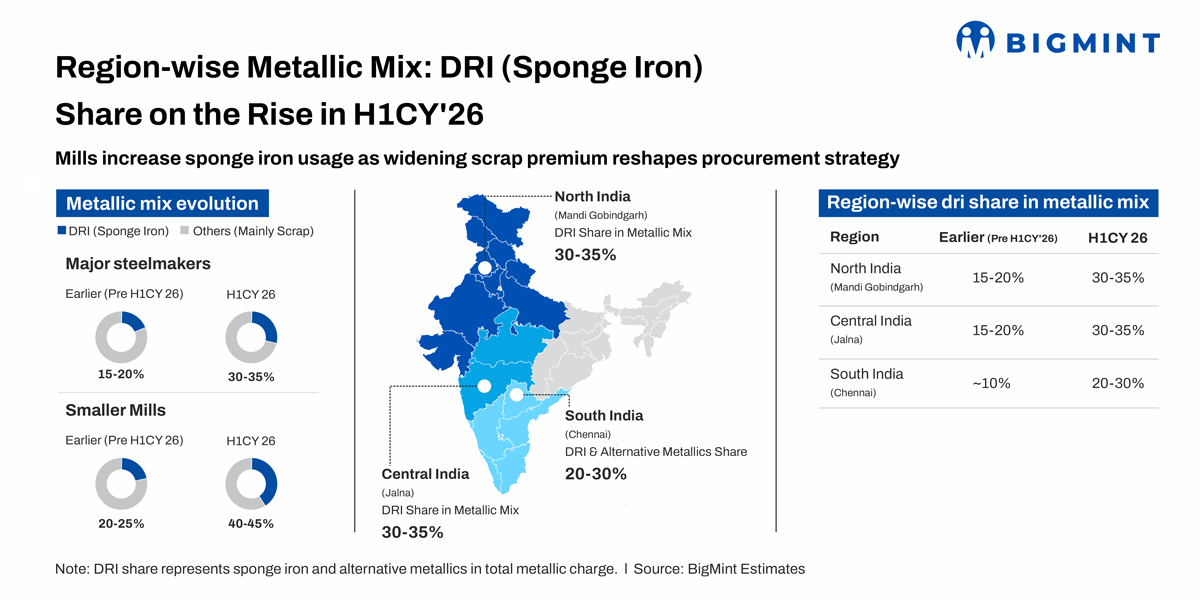
The widening cost advantage prompted mills across key scrap-based steelmaking clusters, including Jalna, Mandi Gobindgarh and Chennai, to optimise their metallic mix.
BigMint estimates that major steelmakers increased the share of sponge iron in their metallic charge to around 30-35% during H1CY’26 from 15-20% previously, while smaller mills raised DRI usage to 40-45% from around 20-25%. Most of the incremental sponge iron requirement was sourced from West Bengal, Odisha, Chhattisgarh and Karnataka, India’s key DRI-producing states.

The shift was particularly evident in southern India, where imported scrap became increasingly uncompetitive. During Q1CY’26, the INR 1,000-1,500/t price gap between imported melting scrap and sponge iron, coupled with better domestic availability, encouraged mills to substitute part of their scrap requirement with DRI without materially affecting production efficiency.
A Chennai-based steel mill source said: “South Indian mills have increased the use of sponge iron and alternative metallics from around 10% earlier to nearly 20-30%, while imported scrap remains largely unviable under current market conditions.”
Higher DRI usage supports steel production
Despite lower imported scrap inflows, India’s evolving metallic mix continued to support higher steel output.
Crude steel production increased to around 87 mnt during H1CY’26 from 81 mnt a year earlier. Among the three primary steelmaking routes, scrap-based crude steel production recorded the strongest growth, increasing 14% y-o-y to 21 mnt, followed by sponge iron-based production, which rose 7% to 25 mnt, while hot metal-based production increased 4% to 42 mnt.
The data suggests that Indian steelmakers are increasingly optimising the proportion of scrap and DRI in their metallic mix rather than substituting one metallic entirely with the other.
Outlook
BigMint expects the scrap-DRI price spread to narrow gradually as domestic scrap availability improves and supply-side pressures ease. However, sponge iron is likely to retain a cost advantage over the coming months, encouraging mills to maintain a relatively higher DRI share in their metallic mix.
Over the medium term, expanding steel capacity, rising domestic scrap generation and increasing emphasis on recycling are expected to support higher consumption of both ferrous scrap and sponge iron. Procurement decisions will increasingly depend on relative raw material prices, regional availability, freight costs and steelmaking margins, reinforcing the complementary role of both metallics in India’s evolving steel industry.
Leave a Reply