- Ongoing labour negotiations at Hedland weigh on Australian exports
- Healthy Vale loading programmes support Brazilian shipments
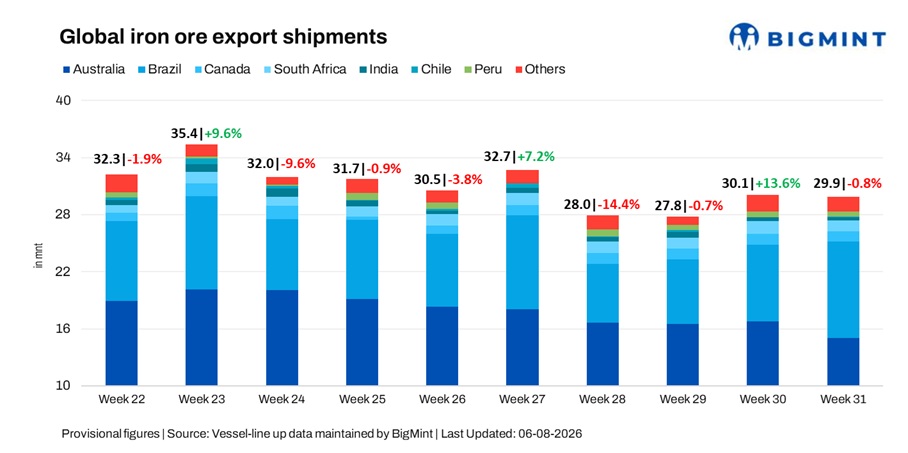
Global seaborne iron ore exports edged down by 0.8% w-o-w to 29.9 million tonnes (mnt) in the week ended 31 July, remaining broadly stable as stronger shipments from Brazil, Guinea, and Chile largely offset softer cargoes from Australia and several Atlantic Basin exporters.
Brazil posted the strongest w-o-w gain among major exporters, supported by healthy Vale loading programmes, while Guinea recorded a sharp rise as Simandou’s ongoing ramp-up continued to boost cargo availability. In contrast, exports from Australia, South Africa, India, Canada, and Peru moderated amid lighter loading programmes, leaner vessel schedules, and selective export activity. Liberia, Sierra Leone, Mauritania, Norway, and Sweden also registered lower shipments during the assessment week.
Country-wise exports

Port & shipper-wise trends
- Australia: Port Hedland handled 8.46 mnt, followed by Port Walcott (3.16 mnt) and Dampier (2.97 mnt). Rio Tinto led shipments at 6.14 mnt, followed by BHP (5.58 mnt) and FMG (2.46 mnt). China remained the leading destination at 12.50 mnt, followed by Japan (0.82 mnt) and South Korea (0.78 mnt).
- Brazil: Ponta da Madeira handled 3.89 mnt, followed by Itaguai (2.45 mnt) and Tubarao (2.09 mnt). CSN led shipments at 4.55 mnt, closely followed by Vale (4.54 mnt). China remained the dominant destination, receiving 5.85 mnt.
- Canada: Sept-Iles handled 0.64 mnt, followed by Port Cartier (0.34 mnt). Guinea & Nimba Mines led shipments at 0.35 mnt, narrowly ahead of ArcelorMittal (0.34 mnt) and IOC (0.29 mnt). China was the leading destination at 0.18 mnt, followed by South Korea (0.14 mnt).
- South Africa: Saldanha handled 1.16 mnt during the week. China remained the leading destination, receiving 0.61 mnt.
- India: Paradip handled 0.19 mnt, followed by Kakinada (0.12 mnt). Lloyds Metals & Energy led shipments at 0.12 mnt, while China remained the key destination at 0.06 mnt.
- Chile: Caldera handled 0.05 mnt, with Japan receiving the entire cargo volume.
- Peru: San Nicolas handled 0.51 mnt, followed by Matarani (0.03 mnt). Shougang Hierro shipped 0.51 mnt. China remained the leading destination at 0.34 mnt, followed by South Korea (0.17 mnt).
- Guinea: Morebaya handled 0.70 mnt, with China accounting for the entire cargo volume.
- Liberia: Buchanan handled 0.22 mnt, remaining the country’s sole iron ore export terminal during the week. France and Spain each received 0.11 mnt.
- Mauritania: Nouadhibou handled 0.18 mnt, remaining the country’s sole iron ore export terminal during the assessment week.
- Sierra Leone: Freetown handled 0.18 mnt, remaining the country’s only iron ore export terminal during the week.
- Norway: Mo i Rana handled 0.03 mnt during the assessment week.
- Sweden: Narvik handled 0.17 mnt, followed by Lulea (0.03 mnt). Germany was the leading destination at 0.17 mnt, followed by Denmark (0.03 mnt.
Freight market remains mixed as Capesize weakens, Supramax holds firm
The dry bulk freight market remained mixed during the week, with Capesize rates continuing to soften amid subdued Pacific chartering activity, easing iron ore fixture volumes, and ample vessel availability. In contrast, the Supramax segment remained comparatively resilient, supported by healthy minor bulk cargo demand and balanced tonnage across key trading regions.
While Atlantic cargoes continued to provide some underlying support, slower iron ore enquiries from the Pacific weighed on overall sentiment. Elevated bunker prices also encouraged owners to maintain freight expectations, preventing a sharper correction across the dry bulk market.
Outlook
Global iron ore exports are expected to remain broadly stable in the near term, supported by steady loading programmes in Brazil and continued ramp-up of Guinea’s Simandou operations. However, shipment activity from Australia and other major exporters will be closely watched amid evolving loading schedules and vessel availability. Freight rates are likely to remain mixed, with Capesize tracking Pacific iron ore demand, while Supramax stays firm on healthy minor bulk trade and balanced vessel supply.

Leave a Reply