- Trade slows as buyers remain hesitant at higher prices
- Higher raw material costs push sellers to keep offers firm
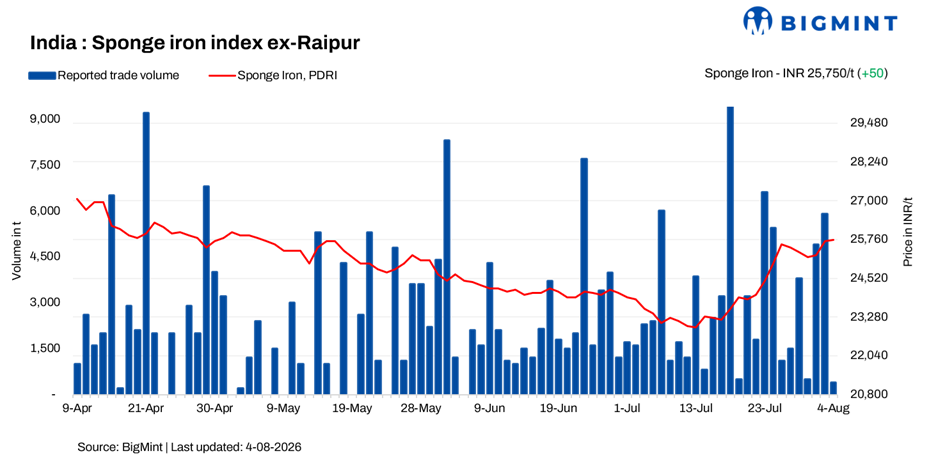
Indian sponge iron prices increased by around INR 50-200/t d-o-d on 4 August 2026 following stronger trading activity in the previous session. In the Raipur market, sponge iron was assessed at approximately INR 25,750/t, up by INR 50/t. The price increase was primarily supported by healthy buying interest witnessed a day earlier, which encouraged suppliers to raise their offers.
Despite the firmer price trend, trading activity remained subdued during today’s session. Many buyers were reluctant to accept the revised offer levels, as several had already secured sufficient material in earlier trades. Consequently, market activity was largely limited to enquiries and need-based purchases, while bulk transactions remained scarce. Buyers largely maintained a wait-and-watch approach amid the higher offer levels.
According to a sponge iron seller from the Durgapur market, “Producers continue to face significant margin pressure due to elevated domestic coal prices and limited domestic coal availability. As a result, imported coal suppliers have become more active in the market, and the use of imported coal is expected to increase further in the near term. In addition, pellet prices have also strengthened in recent days, adding to raw material costs and further squeezing producers’ margins.”
Overall, sellers continued to maintain firm offers, supported by rising input costs and the previous session’s stronger trading activity. However, cautious buyer participation limited fresh deals during the day. BigMint recorded sponge iron trade volumes of around 10,000 t, lower than the previous trading session, reflecting softer market activity.
Going forward, the sustainability of the recent price increase will depend on the emergence of fresh demand and buyers’ willingness to transact at the current higher price levels.
Rationale
Prices have been derived based on transactions, offers, bids, and indicative price data sets. Transactions are considered as T1 and given a weightage of 50%, whereas other data sets are considered as T2 and given a weightage of the balance 50%.
Click here for detailed methodology


Leave a Reply