- Elevated prices, supply disruptions limit Indian petcoke imports
- Higher domestic coal, imported fuel costs pressure cement producers’ margins
Indian cement manufacturers have increasingly shifted towards domestic and imported thermal coal after a sharp decline in petcoke imports disrupted fuel availability during recent months. The change in fuel sourcing has strengthened demand in Coal India Limited’s (CIL) non-coking coal e-auctions while increasing fuel costs for cement producers already facing pressure from higher imported energy prices and freight costs.
Lower pet coke availability changes fuel mix
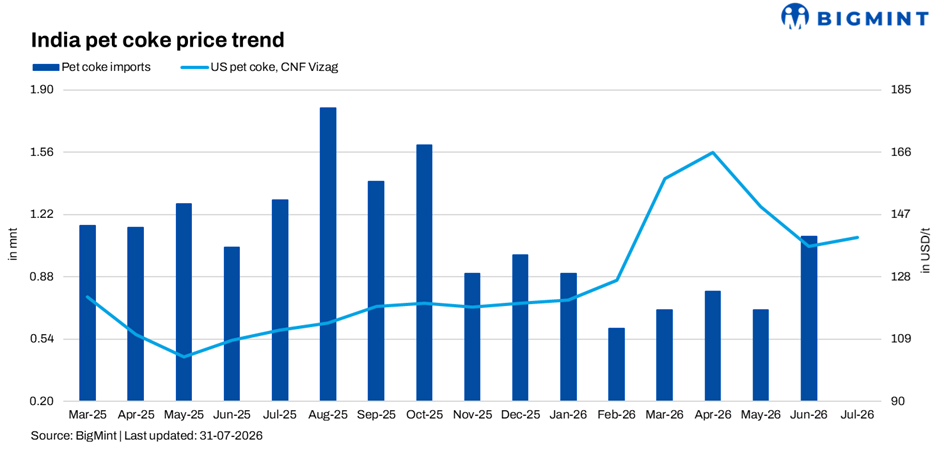
BigMint data shows that India’s petcoke imports declined sharply between October 2025 and February 2026, falling from around 1.6 million tonnes (mnt) in October 2025 to nearly 0.60 mnt in February 2026. Although imports recovered during the March-June period, volumes remained below the levels seen during the second half of 2025.
At the same time, US-origin petcoke prices remained elevated at around $130-140/t CNF Vizag, increasing procurement costs. Supply disruptions linked to geopolitical tensions in West Asia also delayed contracted cargoes, forcing several cement companies to diversify their fuel basket to ensure uninterrupted kiln operations.
The shift has already been reflected in Q1FY’27 results. Shree Cement reduced petcoke usage in its fuel mix to 9% from 54% a year earlier, while coal usage increased to 74% from 26%. Other cement manufacturers also reported higher dependence on thermal coal after disruptions in imported fuel supplies.
CIL e-auctions witness stronger buying by cement producers
As cement companies increased domestic coal purchases, participation in CIL’s e-auctions remained healthy during June and July. ECL auction data showed strong bidding across multiple auction rounds, particularly for G5 to G10 grade non-coking coal, which is widely used in cement kilns. Among these, G6, G7, and G8 grades attracted the highest interest due to their suitable calorific value and operational efficiency. Some manufacturers also procured G11-G13 grades for blending based on plant requirements.
Cement companies became more active in e-auctions to secure fuel supplies after lower petcoke availability. However, demand from sponge iron producers, captive power plants, and other industrial consumers also supported auction participation, keeping premiums firm.
Several cement companies have increased purchases through CIL e-auctions, mainly for G6 to G8 grades, to maintain clinker production while imported pet coke supplies remain uncertain.
Higher fuel costs increase production costs
The increased use of domestic coal has raised production costs for cement manufacturers. Unlike long-term fuel linkages, e-auction coal is procured at market-driven premiums, increasing the overall fuel bill. Rising domestic coal prices, higher imported petcoke prices, and elevated freight costs have together put pressure on operating margins during Q1FY’27.
The impact has already been reflected in company results. Shree Cement reported a rise in blended fuel costs after replacing imported pet coke with higher-cost thermal coal, while operational EBITDA per tonne declined to INR 1,111 from INR 1,339 a year earlier. Birla Corporation reported a 5% y-o-y increase in power and fuel costs, resulting in a 6% decline in EBITDA per tonne to INR 675/t. Sagar Cements also indicated that fuel costs are expected to increase by around INR 50/t during FY’27, with overall production costs rising by nearly INR 100/t because of higher imported fuel and domestic coal prices.
Outlook
Thermal coal demand from the cement sector is expected to remain firm in the coming months as cement producers continue diversifying their fuel mix and maintaining adequate inventories. While petcoke imports have started recovering, companies are likely to continue sourcing domestic coal through e-auctions to ensure supply security. As long as domestic coal prices, auction premiums, and imported fuel costs remain elevated, cement production costs are expected to stay under pressure through Q2FY’27.
Leave a Reply