- Steel inventories climb despite production cuts as demand slows
- Iron ore prices drop $3/t amid weak buying, abundant supply
Chinese steel prices fell in the week ended 1 August 2026 as seasonal weakness in downstream demand, rising inventories, and softer raw material costs continued to weigh on market sentiment.
Steel price trends
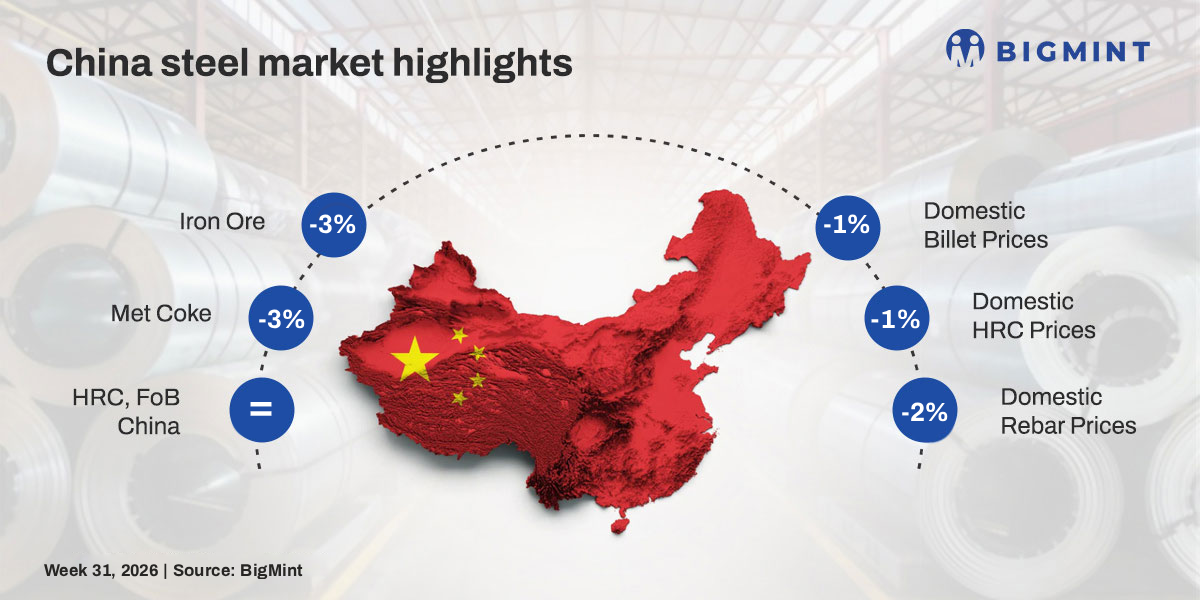
Rebar prices decline w-o-w: China’s domestic rebar prices fell by RMB 60/tonne (t) ($9/t) w-o-w to around RMB 3,150/t ($466/t) on 31 July from RMB 3,210/t ($475/t) a week earlier. Similarly, SHFE rebar futures (October 2026 contract) declined by RMB 76/t ($11/t) to RMB 3,010/t ($446/t) from RMB 3,086/t ($457/t).
The construction steel market remained under pressure due to seasonally weak demand and continued margin stress for steelmakers. In response, several mills scheduled blast furnace maintenance to reduce supply and lower production costs, increasing maintenance capacity compared with the previous week.
Despite these measures, demand remained subdued, keeping market sentiment cautious. With mills continuing to face profitability challenges, some producers are considering additional output cuts or adjustments to their raw material mix. In the near term, rebar prices are expected to remain largely stable, with market direction largely dependent on mill production changes and overall sentiment.
Domestic HRC prices weakened: China’s domestic hot-rolled coil (HRC) prices declined by RMB 40/t ($6/t) w-o-w to around RMB 3,060/t ($453/t) on 31 July, compared with RMB 3,100/t ($459/t) a week earlier. Furthermore, SHFE HRC futures (October 2026 contract) fell by RMB 77/t ($11/t) to RMB 3,221/t ($477/t) from RMB 3,298/t ($488/t) in the previous week.
The domestic HRC market remained under pressure during the week as weak seasonal demand outweighed a marginal decline in production caused by maintenance at some steel mills. Despite the production cuts, inventories continued to build, highlighting persistent supply-side pressure and an imbalance between supply and demand.
On the demand side, high temperatures and typhoons disrupted downstream manufacturing activity across several regions. Procurement remained largely limited to immediate requirements, resulting in subdued trading activity and offering little support to prices.
China’s official manufacturing PMI fell to 49.0 in July, remaining below the 50-point expansion threshold and signalling continued contraction in industrial activity.
HRC export offers stable despite headwinds: Chinese HRC export offers remained stable at around $495/t FOB Rizhao during the week. However, exports continue to face mounting challenges as trade barriers and geopolitical uncertainties increasingly constrain overseas shipments.
Steel inventories rise 8% in mid-Jul’26
The China Iron and Steel Association (CISA) reported that total steel inventories at key CISA-affiliated industries stood at around 18.13 million tonnes (mnt) during mid-July (11-20 July 2026), marking an increase of 1.36 mnt or 8.1% from 16.77 mnt in early-July.
Moreover, inventory levels rose by 230,000 t or 1.3% m-o-m from 17.90 mnt recorded in the same period last month. Furthermore, inventories increased by 2.47 mnt or 15.8% y-o-y from 15.66 mnt recorded in mid-July 2025.
The rise in inventories was largely driven by weak downstream consumption. Heavy rainfall in southern China, high temperatures in the north, and typhoon-related disruptions disrupted outdoor construction activity. At the same time, subdued real estate activity and delays in infrastructure project execution further slowed demand, particularly for construction steel.
Raw material prices
Iron ore spot prices decline w-o-w: Benchmark iron ore fines prices (Fe 61%) dropped by $3/t w-o-w to $95/dmt CFR China on 31 July. Seaborne iron ore prices eased as weak spot buying and abundant medium-grade fines supply outweighed support from higher freight and energy costs.
Market sentiment remained subdued amid concerns that fresh US trade restrictions could dampen overseas demand for Chinese steel and manufactured goods, adding to uncertainty over iron ore consumption. At the same time, seasonal weakness in steel demand and maintenance-related production cuts at Chinese mills reduced iron ore procurement, keeping spot buying subdued.
a) Spot pellet premium remains stable w-o-w: The spot pellet premium for Fe 65% grade pellets remained steady w-o-w at $23.7/t CFR China on 29 July.
b) Spot lump premium rises w-o-w: The spot lump premium edged up w-o-w to $0.2385/t CFR China on 31 July.
Coking coal, met coke markets remain under pressure: China’s domestic coking coal and coke markets remained under pressure, as the second round of coke price reductions of RMB 50-55/t ($7-8/t) was implemented, while select coking coal grades declined by RMB 10-30/t ($ 1-4/t). Although stricter mine safety inspections and production suspensions due to licence expiries tightened raw coal supply, cautious procurement by coking plants and steel mills, rising coke inventories, weak steel prices, and increased blast furnace maintenance continued to weigh on overall market sentiment.
In the seaborne market, Australian premium hard coking coal (PHCC) prices declined by $5/t w-o-w to $217/t FOB, pressured by subdued steel demand, ample supply availability, and cautious spot buying from key importers. Reflecting the softer global coking coal market, BigMint’s PHCC index fell by $2/t w-o-w to $241/t CNF Paradip, India, as Indian buyers held back from purchases in anticipation of further price drops.

Billet prices decline w-o-w on limited demand: Chinese billet prices softened during the week ended 31 July as weak seasonal steel demand, easing raw material costs, and sluggish export activity continued to pressure the market. BigMint assessed domestic billet at RMB 2,920/t ($432/t) on 31 July, down RMB 40/t ($5/t) w-o-w from RMB 2,960/t ($437/t) on 24 July.
Mills reduced billet base prices by RMB 10-30/t ($1-4/t) during the week to stimulate sales, although spot trading remained limited amid high summer temperatures.
In the export market, Chinese billet offers declined to around $454/t FOB from $460/t FOB a week earlier as weak overseas demand and cautious mill pricing kept trading activity subdued.
Outlook
China’s steel market is expected to remain weak in August, with seasonal factors continuing to suppress demand. Steel consumption from the manufacturing sector may see a modest recovery, but performance will remain uneven across industries. HRC is likely to face greater pressure as traditional manufacturing demand remains subdued during the seasonal off-season.
On the supply side, widespread losses across steel mills and weak end-user demand are expected to limit capacity utilisation. As a result, steel output is likely to contract marginally in August, easing supply pressure to some extent and preventing a sharper decline in steel prices. However, unless demand improves meaningfully, the market is expected to remain under pressure in the near term.
Leave a Reply