- Fed holds rates; easing inflation supports base metals
- Tsingshan’s nickel export suspension supports sentiment
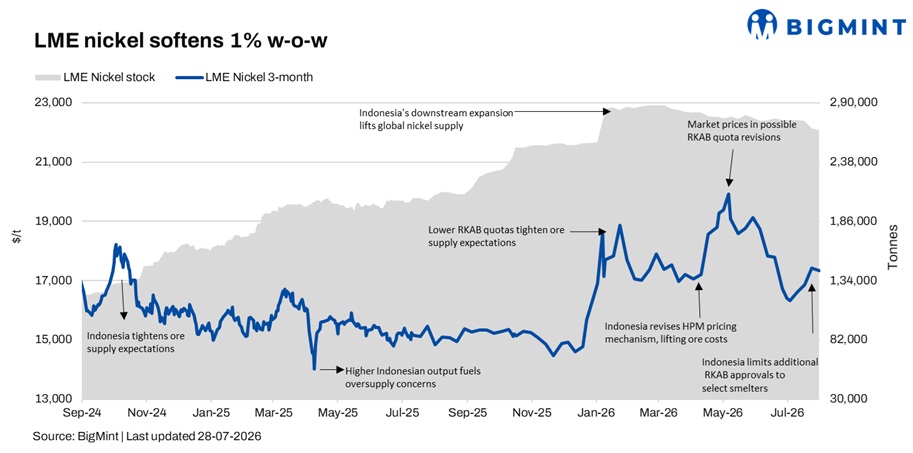
London Metal Exchange (LME) three-month nickel prices declined by 1% during the week ended 31 July 2026, settling at $17,335/t compared with $17,430/t a week earlier. Meanwhile, LME nickel inventories remained largely stable at 266,172 t, continuing to signal ample physical availability despite steady warehouse withdrawals during July.
Macro sentiment offsets weaker price trend
Broader macro sentiment remained supportive for nickel after the US Federal Reserve kept its benchmark interest rate unchanged at 3.50-3.75%, in line with market expectations. Softer-than-expected US inflation data strengthened expectations of monetary easing later this year, improving sentiment across the base metals complex.
Although LME nickel prices eased w-o-w, inventory drawdowns of more than 8,000 t during July and ongoing uncertainty surrounding Indonesia miners’ RKAB (annual work plan and budget) quota approvals helped limit downside.
Despite the supportive macro backdrop, LME nickel prices declined 1% w-o-w as persistent concerns over abundant global supply continued to weigh on market sentiment. Expectations of higher Indonesian mine output following supplementary RKAB approvals, elevated LME inventories and subdued stainless steel demand in China limited buying interest. As a result, positive macro signals were insufficient to offset cautious physical market activity and profit-taking after recent gains.
Tsingshan export suspension supports nickel sentiment
Market sentiment also received support after reports that Tsingshan Holding Group temporarily suspended exports of selected nickel products, including mixed hydroxide precipitate (MHP), from its Indonesian operations while awaiting clarity on the country’s new mineral inspection procedures.
The suspension is understood to be linked to regulatory inspections rather than production disruptions. Nevertheless, the move has raised concerns over the near-term availability of battery-grade nickel intermediates. Prolonged export delays could tighten intermediate nickel supply and lend further support to global nickel prices.
Canada Nickel advances Crawford project
In North America, Canada Nickel secured a positive Decision Statement from Canada’s Minister of Environment, Climate Change and Nature for its Crawford nickel project in northeastern Ontario. The approval marks the first mining project cleared under Canada’s amended Impact Assessment Act since 2019.
The company will now proceed with detailed engineering, financing, and remaining regulatory approvals ahead of a targeted construction decision in 2027. Once operational, Crawford is also expected to become North America’s only primary chromium source, strengthening the region’s critical minerals supply chain.
Greenpeace raises concerns over Raja Ampat mining
Separately, environmental group Greenpeace alleged that nickel mining activities continue in Indonesia’s UNESCO-listed Raja Ampat despite last year’s public protests and government action against several mining projects.
According to Greenpeace, three nickel mining licence applications are still under review in environmentally sensitive areas, while PT Gag Nikel, a subsidiary of state-owned Antam, continues operations despite an earlier environmental audit highlighting biodiversity and sedimentation risks. Antam denied any environmental violations, stating that its operations are located outside the Raja Ampat Geopark and that the audit only recommended operational improvements. Indonesian authorities are currently reviewing Greenpeace’s findings.
Outlook
LME nickel is expected to remain largely stable in the near term as supportive macroeconomic sentiment and regulatory uncertainty in Indonesia are balanced against elevated exchange inventories and cautious physical demand. Market participants will continue to monitor developments related to Indonesia’s RKAB approvals, mineral export inspections, inventory trends, and global monetary policy for further price direction.
Leave a Reply