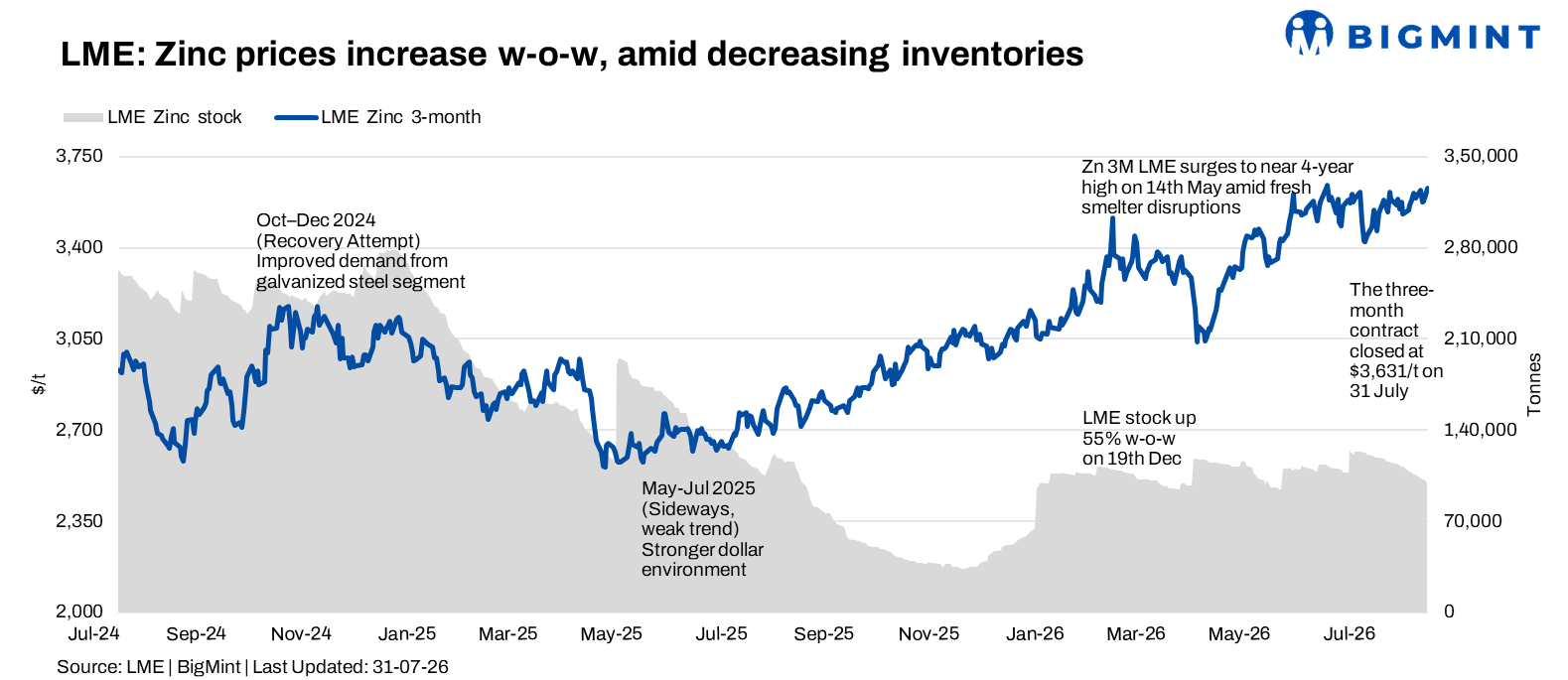
- Concerns over tightening Chinese supply and declining exchange stocks support prices
- MCX gains amid short covering, while SHFE remains range-bound
London Metal Exchange (LME) zinc prices rose by over 2% during the week ended 31 July 2026, supported by a continued drawdown in exchange inventories, expectations of lower mine and smelter output in China, and signs of improving manufacturing activity. The market also drew support from a sharp narrowing in the global zinc surplus, reinforcing expectations of tighter supply-demand fundamentals in the near term.
LME zinc cash settlement prices increased by 2.1% week on week to settle at $3,710.5/t on 31 July, compared with $3,633/t on 24 July. The three-month contract followed a similar trajectory, rising from $3,592/t to $3,631/t during the same period. Meanwhile, LME inventories continued their downward trend, falling by 6,000 t over the week from 105,800 t to 99,800 t, marking the first time in several months that exchange stocks have slipped below the 100,000-t threshold. The continued premium of cash prices over the three-month contract underscored tight nearby availability and lent further support to market sentiment.
Supply concerns outweigh higher Chinese production
Market sentiment strengthened after a zinc mine in southwest China announced production adjustments that are expected to reduce zinc concentrate output by around 1,000 t in August. In addition, a major smelter in central China is scheduled to undergo routine maintenance next month, potentially impacting another 1,000-1,500 t of refined production. These developments heightened concerns over concentrate availability and provided fresh momentum to zinc prices.
The International Lead and Zinc Study Group (ILZSG) reported that the global zinc surplus narrowed sharply to 8,700 t in May, down from 43,400 t in April, suggesting that market balances are tightening despite higher production levels in China. Refined zinc output in China rose by 10% year on year to 641,000 t in May, while zinc metal production increased by 9.4%. However, inventories in warehouses monitored by the Shanghai Futures Exchange (SHFE) declined by 0.8%, indicating resilient downstream demand.
Production updates from major miners also pointed to tighter concentrate supplies. Glencore’s own-sourced zinc output fell by 21% year on year to 365,600 t in the first half of 2026, while Boliden’s zinc concentrate production declined by 16.8% quarter on quarter to 74,200 t. MMG reported a marginal decline in second-quarter output, further supporting the narrative of tightening mine supply outside China.
MCX outperforms as SHFE lags
On the domestic front, MCX zinc futures tracked the gains in international prices, with the July contract settling at INR 390,750/t on 31 July, up 1.8% from INR 383,900/t a week earlier. The contract touched a weekly high of INR 401,100/t before easing towards expiry.
However, open interest dropped sharply from 1,361 lots on 27 July to just 62 lots on 31 July, indicating that the rally was driven largely by short covering and position unwinding rather than aggressive fresh buying.
In contrast, SHFE zinc remained relatively subdued. Prices edged down from $3,716/t on 27 July to $3,701/t on 31 July, highlighting the divergence between overseas and Chinese markets. While tightening LME inventories and supply-side disruptions supported international prices, concerns over the pace of demand recovery in China kept gains on the Shanghai exchange in check.
Outlook
BigMint expects LME zinc prices to remain supported over the next one to two weeks, with exchange inventories continuing to trend lower and Chinese mine and smelter disruptions likely to keep concentrate availability tight. The fall in LME stocks below 100,000 t is expected to provide a psychological boost to market sentiment, while the narrowing global surplus could further underpin prices.
However, the sharp rally over the past fortnight and the significant decline in MCX open interest suggest that bouts of profit-booking cannot be ruled out, particularly if fresh buying interest fades at higher levels.
In the near term, support is seen at $3,650-3,680/t, while resistance is expected around $3,750-3,800/t. Inventory movements, developments in China’s physical market and the cash-to-three-month spread will remain the key indicators to watch over the coming weeks.

Leave a Reply