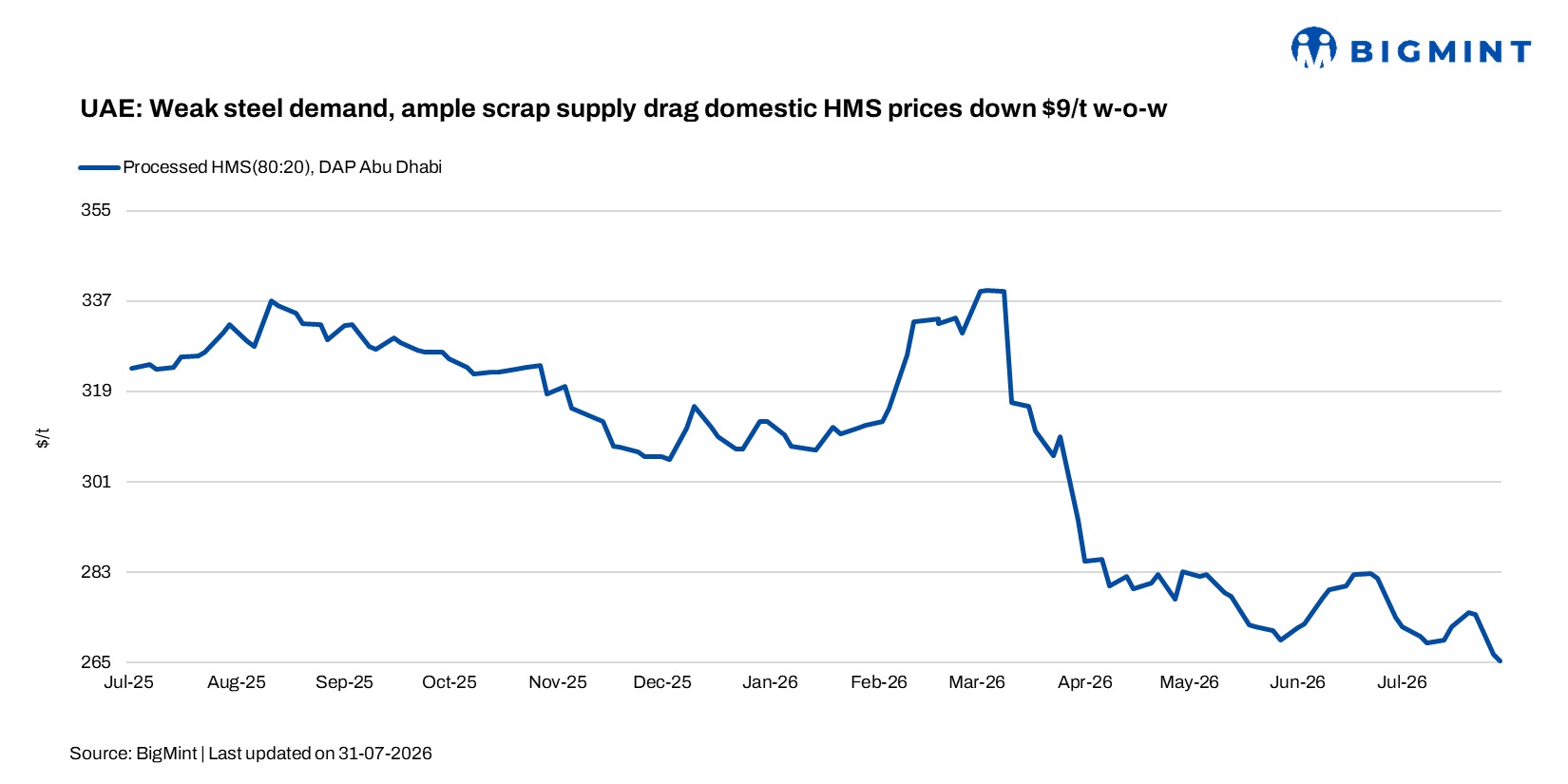
- Processed HMS 80:20 falls to lowest level since assessment launch
- Need-based mill buying limits recovery despite regular mill bookings
UAE domestic processed scrap prices extended their decline in the week ending 31 July, pressured by subdued steel demand and abundant local scrap availability following the ferrous scrap export ban. Although major steelmakers continued to procure material for ongoing production, purchases remained largely need-based, limiting any meaningful recovery in prices.
According to BigMint’s assessment, processed HMS 80:20 was assessed at AED 975/t ($265/t) DAP Abu Dhabi, down AED 34/t ($9/t) w-o-w, while market offers were heard at AED 960-980/t ($261-267/t) DAP. The assessment fell to its lowest level since its launch on 11 October 2023, reflecting a persistent supply overhang and cautious procurement by steelmakers amid weak downstream demand.
A Dubai-based trader said buying indications from major mills were currently heard at AED 940-950/t ($256-259/t) DAP for processed HMS 80:20, while inquiries for shredded scrap were around AED 1,020-1,030/t ($278-281/t) DAP. “Mills are active, but they are negotiating aggressively and buying only for immediate production requirements,” the trader said.
Meanwhile, a UAE-based scrap yard owner said the export ban has kept material readily available in the domestic market, intensifying competition among suppliers. “Large mills continue to place regular orders, but comfortable inventory levels mean there is no urgency to buy additional volumes. Sellers are therefore having to accept lower prices to secure business,” the source said.
Steel market update
Despite the decline in domestic scrap prices, UAE rebar producers have largely maintained their August offers, supported by high billet costs and elevated freight expenses. Market participants said disruptions to shipping through the Strait of Hormuz have increased raw material procurement costs, leaving mills with little room to reduce finished steel prices without affecting margins.
Current rebar offers are heard in the range of AED 2,890-2,930/t ($787-798/t), with producers continuing to defend these levels even as market activity remains subdued. However, demand from the construction sector has slowed significantly due to the peak summer season, resulting in fewer new orders and lower steel consumption.
Buyers are therefore limiting purchases to immediate project requirements instead of building inventories, keeping trading activity muted. Traders noted that while mills are holding firm on prices, selling material at these levels has become increasingly difficult as end-users remain cautious and resist higher prices. This has put additional pressure on distributors’ margins and widened the gap between mills’ pricing expectations and market realities.
Morocco has imposed definitive anti-dumping duties on galvanised wire imports (HS Code 7217.20.99.00) from Egypt and the UAE for a period of five years, after concluding that dumped imports had caused material injury to the domestic industry by adversely affecting production, profitability and market conditions.
According to a 28 July 2026 notice issued by the Ministry of Industry and Trade, the investigation found that imports from both countries were being sold at unfairly low prices, prompting the imposition of a 46% duty on Egyptian material and duties ranging from 18.44% to 52.71% on UAE-origin imports, depending on the producer. The investigation was initiated on 13 March 2025 following a petition filed by domestic producers Somatref, Sicotrem, Galvafil and Sodafer, which together represent Morocco’s entire galvanised wire manufacturing industry.
Prior to the final determination, the government had imposed provisional anti-dumping duties of 25.74-50.67% on Egyptian imports and 23.13-52.71% on material from the UAE.
Outlook: Market participants believe a meaningful improvement in steel demand–and consequently scrap buying–is likely only after construction activity gathers pace following the summer slowdown. Until then, cautious procurement and comfortable raw material availability are expected to keep the domestic scrap market under pressure.

Leave a Reply