- EU buyers continue negotiations; fresh bookings yet to materialise
- Geopolitical tensions continue to constrain trade flows to Middle East
Indian HRC export activity remained weak during the assessment week ended 28 July, with no major fresh bookings reported across key export destinations; however, negotiations remained ongoing. Export offers to the EU remained unchanged w-o-w as buyers continued to assess the availability of the remaining tariff-free quota volumes and awaited greater clarity on CBAM verification requirements before concluding purchases. Meanwhile, export offers to the Middle East declined as escalating geopolitical tensions disrupted trade flows and weighed on buying activity. In Southeast Asia, lower offers to Vietnam reflected weak regional demand, with buyers remaining unwilling to purchase at prevailing offer levels.
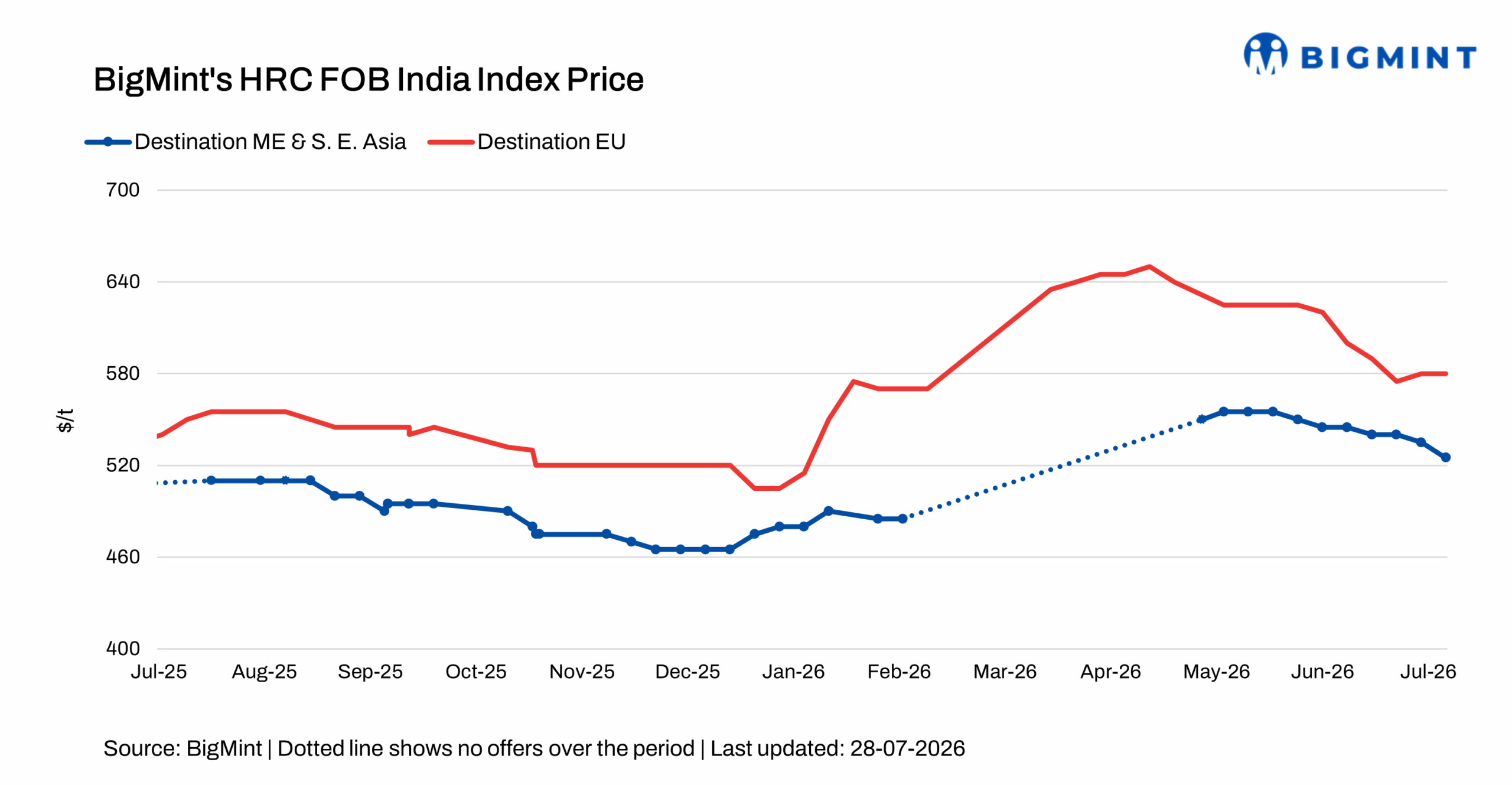
HRC export offers to EU remain unchanged w-o-w: The Indian HRC export index to the EU remained unchanged w-o-w at around $580/t FOB, as buyers continued to assess the availability of the remaining tariff-free quota volumes and the implications of CBAM-related compliance costs before concluding purchases, despite ongoing negotiations with suppliers. As a result, discussions remained active during the assessment week but did not materialise into fresh bookings, with selective transactions expected in the coming week.
An EU-based source indicated, “Many buyers are still awaiting the European Commission’s confirmation of third-party CBAM verification bodies, expected in September, before making procurement decisions, as they seek greater clarity on the CBAM verification process.”
Another regional source stated, “Domestic HRC offers across Europe remained broadly stable during the week, as subdued trading activity continued to weigh on the market. Although domestic mills are attempting to raise offer prices, weak underlying demand has limited the extent to which these increases can be passed through, as buyers remain resistant to higher offers and continue to negotiate at lower price levels.”
HRC export offers to Middle East, Southeast Asia decline w-o-w: The Indian HRC export index to the Middle East and Southeast Asia declined by $10/t w-o-w to around $525/t FOB from $535/t a week earlier, driven by lower offers to both the Middle East and Vietnam.
Indian HRC export offers to the Middle East fell by $10/t w-o-w to around $520/t FOB from $530/t in the previous week, with freight to Jeddah estimated at approximately $60/t. In contrast, Chinese HRC export offers to the region remained unchanged w-o-w at around $560/t CFR Jeddah.
A Middle East-based source stated, “Escalating tensions across the region over the past two weeks have significantly disrupted steel trade. Heightened security risks along key shipping routes, particularly the Strait of Hormuz, have made vessel owners increasingly reluctant to deploy vessels, with new vessel nominations being withheld until voyage safety can be assured. The resulting disruption to maritime logistics has stalled buying activity, with no fresh bookings reported during the week.”
Similarly, Indian HRC export offers to Vietnam declined by $5/t w-o-w to around $515/t CFR Ho Chi Minh City from $520/t CFR in the previous week. A major Indian steel exporter stated, “Vietnamese buyers remained unwilling to purchase at prevailing offer levels due to weak regional demand. However, negotiations continued and could materialise into bookings if some price concessions are offered .”
Outlook
Indian HRC export activity is expected to show mixed trends across key export destinations in the coming week. While underlying demand in the EU remains weak, selective bookings may emerge amid ongoing negotiations as importers seek to utilise the remaining tariff-free quota volumes. In contrast, exports to the Middle East are likely to remain under pressure until shipping conditions stabilise. Meanwhile, bookings in the Vietnamese market could materialise if suppliers offer further price concessions, as buyers continue to seek lower prices amid weak downstream demand.
Leave a Reply