- Steel exports rise 27% in H1 CY’26 as mills redirect shipments beyond Europe
- Semi-finished exports to the EU to rise as quotas hurt finished steel trade
- Indian producers expand focus on Southeast Asia, UAE, Africa
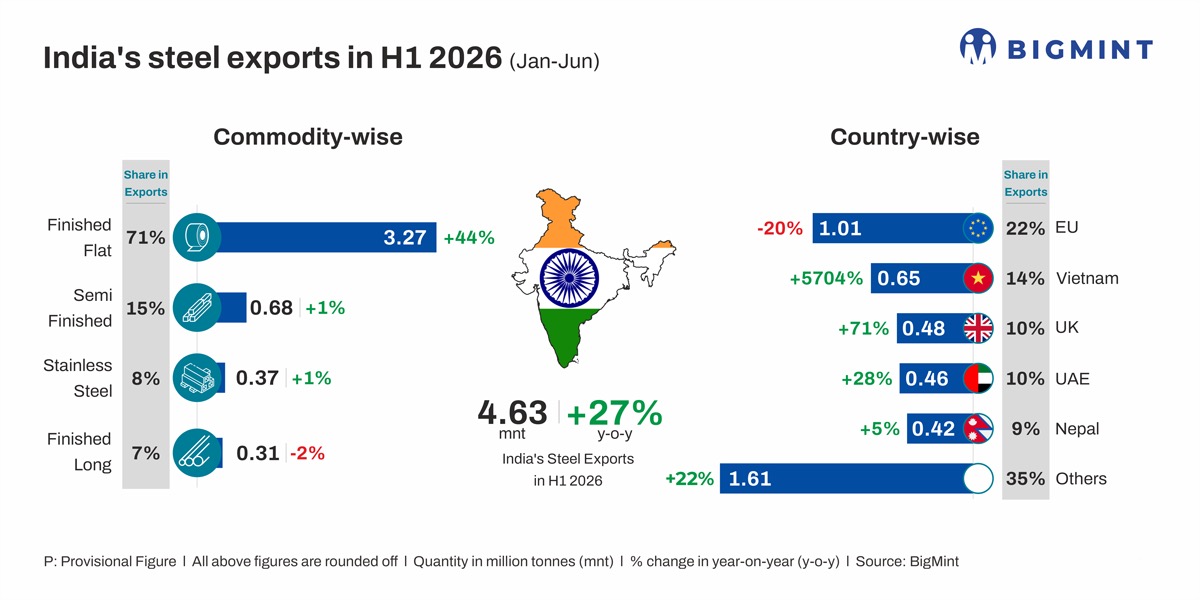
Morning Brief: India’s steel exports increased 27% year-on-year (y-o-y) to 4.63 million tonnes (mnt) during H1 CY’26, compared with 3.64 mnt a year earlier, as higher shipments to Vietnam, the UK and the UAE more than offset weaker exports to the European Union (EU). Exports to the EU declined to 1.01 mnt from 1.26 mnt, while Vietnam emerged as one of India’s fastest-growing export destinations, with shipments rising to 0.65 mnt from 0.01 mnt in H1 CY’25.
The first-half trade pattern is expected to shape India’s export strategy over the coming months. Market participants expect finished steel exports to Europe to remain under pressure following the implementation of tighter safeguard measures, while exports of semi-finished steel, particularly slabs, are expected to increase as they remain outside the scope of the EU’s revised tariff-rate quota (TRQ) regime. At the same time, Indian mills are increasingly positioning Southeast Asia, the Middle East and Africa as priority export markets as trade barriers in the EU and the US continue to reshape global steel flows.
Europe shifts towards semi-finished steel exports
The European Commission’s revised safeguard measures, effective from 1 July 2026, are expected to alter the composition of India’s steel exports to the region rather than eliminate them. Finished steel shipments are likely to remain under pressure because of lower tariff-free quotas, higher out-of-quota duties and the additional compliance costs associated with the Carbon Border Adjustment Mechanism (CBAM). By contrast, market participants expect exports of semi-finished steel, particularly slabs, to increase as these products remain outside the revised TRQ framework.
The announcement has also removed much of the uncertainty that weighed on trade during the first half of the year. European buyers had delayed forward bookings while awaiting clarity on revised quota allocations, but bookings have resumed following the European Commission’s confirmation of the new safeguard measures, with market sentiment improving despite continued concerns over CBAM compliance costs and subdued manufacturing activity.
Indian mills broaden export markets
The changing trade environment is also accelerating a broader shift in export strategy. Indian mills are increasingly looking beyond their traditional markets as higher tariffs, safeguard measures and regulatory requirements make exports to the EU and the US more challenging. Southeast Asia, the Middle East and Africa are expected to receive a larger share of export volumes as producers seek to diversify market exposure and reduce dependence on individual destinations.
The shift has already become evident during H1 CY’26, with higher shipments to several alternative markets offsetting weaker exports to Europe and supporting overall export growth.
Alternative markets support H1 export growth
Vietnam recorded the sharpest increase among India’s major export destinations during H1 CY’26. The country’s steel consumption increased 25.5% y-o-y, while hot rolled coil (HRC) sales rose 36.8% to 5.34 mnt, supported by robust demand from the construction, real estate and downstream manufacturing sectors. Anti-dumping measures on Chinese steel also created favourable conditions for Indian suppliers to expand shipments.

Exports to the UK also increased during the period, supported by relatively stable steel demand, declining domestic steel production and continued reliance on imports following the India-UK Free Trade Agreement, making the UK a more predictable market than the EU during much of the first half.
The increase in steel exports to the UK during H1 CY’26 was driven primarily by semi-finished steel, with billet shipments remaining broadly stable at 233,093 tonnes (t) compared with 235,339 t in H1 CY’25. Growth was concentrated in finished flat products, particularly galvanised steel, whose exports increased nearly nine-fold to 44,781 t from 4,937 t.

Shipments of pipes and tubes rose to 28,206 t from 17,951 t, while HRC/plate exports more than tripled to 27,611 t from 8,558 t. Cold rolled coil (CRC) exports also strengthened to 22,651 t from 9,332 t, while structural steel exports increased sharply to 13,267 t from 687 t, indicating broader growth across value-added finished steel products despite billet remaining the largest export category.
Steel exports to the UAE increased to 0.46 mnt during H1 CY’26 from 0.36 mnt a year earlier, supported by infrastructure activity, demand from the oil and gas sector and the country’s role as a regional trading hub. Although geopolitical tensions around the Strait of Hormuz disrupted shipping during March and increased freight costs, their impact on overall export volumes remained limited as trade gradually resumed. A UAE-based buyer said, “Chinese and Japanese mills largely stopped accepting new export orders after March 2026, creating opportunities for Indian suppliers while Far Eastern cargoes shipped before March continued arriving in the region.”
By contrast, exports to the EU declined after rising sharply during the second half of 2025. Buyers deferred bookings ahead of the revised safeguard measures and adjusted procurement strategies following the implementation of CBAM from 1 January 2026, while weaker manufacturing activity and continued contraction in Europe’s automotive sector weighed on steel demand.
Outlook
India’s steel exports are expected to become increasingly diversified as global trade policies reshape traditional trade flows. While Europe is likely to remain an important market, finished steel exports are expected to become more constrained under the revised safeguard regime, with semi-finished steel accounting for a larger share of shipments. At the same time, stronger demand in Southeast Asia, the Middle East and Africa is expected to provide Indian mills with alternative avenues for export growth as they adapt to a more fragmented global trading environment.
Leave a Reply