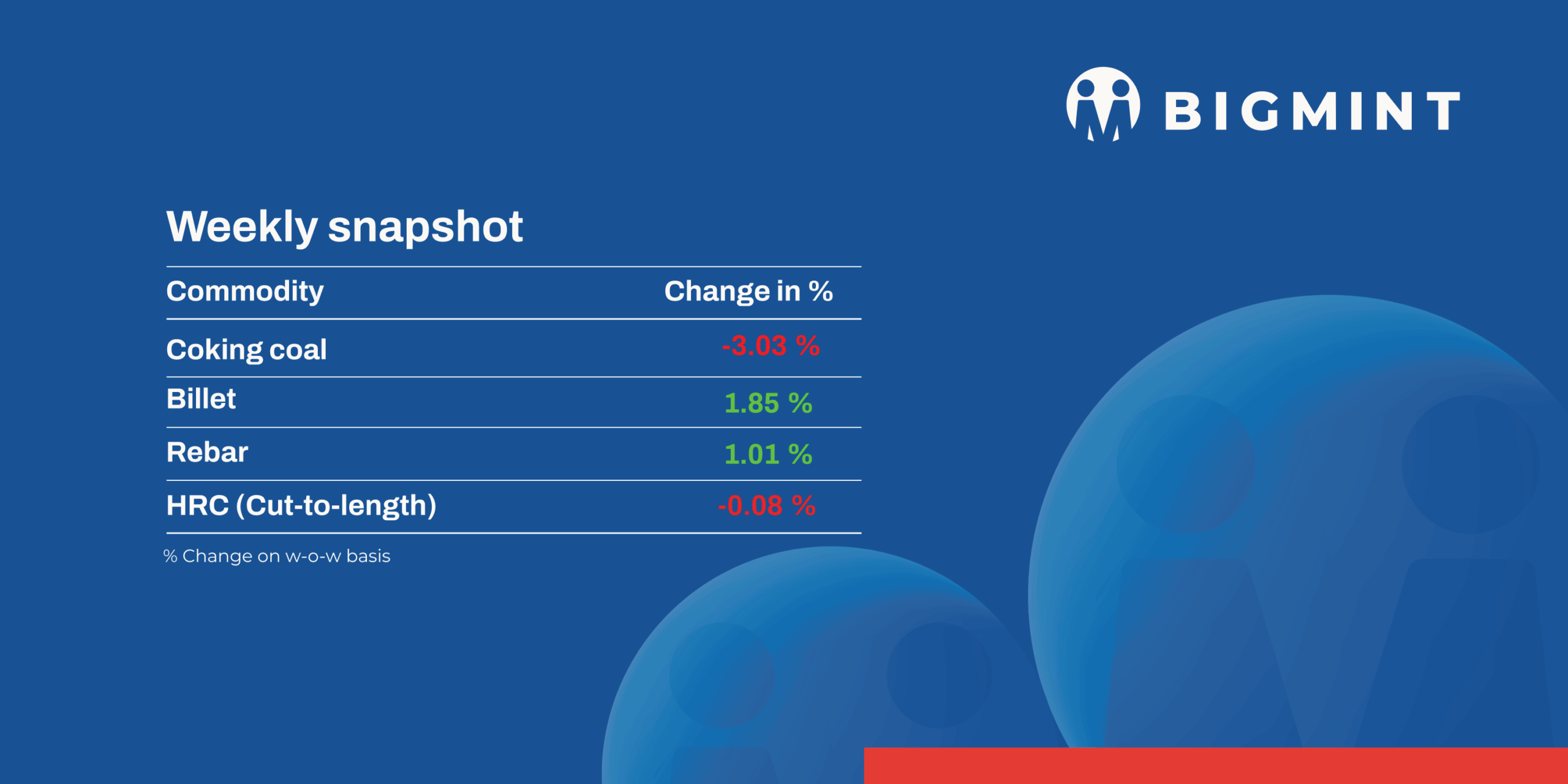
- Raw materials stay firm; semi-finished strengthens, scrap imports and ferro alloys remain subdued.
- Tighter supply and stronger buying lift rebar and pig iron prices across India.
Steel market sentiment strengthened on improved procurement and tightening supply fundamentals. Rebar and semi-finished steel posted gains, whereas flat steel, imported scrap, and ferro alloys continued to reflect cautious buying and mixed trends.
Iron ore and pellet
- OMC auctioned 0.883 mnt of iron ore lumps, with 0.727 mnt booked (82%), and 1.66 mnt of iron ore fines, with 1.524 mnt booked (92%), on 20 July. On a weighted average basis, bids for both lumps and fines remained stable m-o-m, with lumps attracting an average premium of INR 350/t and fines INR 100/t over the notified base prices.
- NMDC sold 27,500 t of iron ore at its Chhattisgarh auctions on 23 July. At Bacheli, the entire 21,500 t of DR CLO (Fe 67%) was booked at INR 6,570/t (FOR), a premium of INR 670/t over the base price, while 6,000 t of iron ore lumps (Fe 65.5%) were sold at the base price of INR 5,600/t. However, all 149,800 t of fines offered across Bacheli and Kirandul remained unsold.
- PELLEX, BigMint’s bi-weekly domestic pellet (Fe 63%) index for Raipur, rose by INR 550/t to INR 10,100/t ($105/t) DAP as local producers raised offers for the fourth time in July. The increase was driven by improved sentiment across the steel value chain, supported by stronger sponge iron and semi-finished steel prices, seasonal demand, and tightening pellet availability.
Coal
- South African thermal coal prices increased during the week, supported by higher replacement costs amid firmer global benchmark prices and geopolitical tensions. BigMint assessed RB2 ex-Paradip up INR 100/t w-o-w to INR 10,550/t, while RB3 rose INR 100/t to INR 9,000/t. At Vizag, RB2 increased INR 100/t to INR 10,400/t and RB3 climbed INR 100/t to INR 8,900/t. However, weak sponge iron demand, comfortable domestic coal availability and a wide bid-offer gap kept import buying largely requirement-based.
- Domestic coal prices edged higher as steady demand and monsoon-related supply constraints tightened availability. BigMint assessed 5,000 GCV coal at INR 5,600/t exw Bilaspur and 4,500 GCV coal at INR 4,300/t, both up INR 50/t w-o-w. Meanwhile, 38% FC washed coal (5,000 GCV) FOR Raipur increased INR 200/t to INR 6,550/t, supported by lower mine dispatches and limited ROM coal availability. Despite firmer prices, buyers continued purchasing cautiously amid subdued steel and sponge iron demand.
- India’s met coke market remained stable despite softer international sentiment and lower raw material costs. BigMint assessed Indonesian BF-grade metallurgical coke (65/63 CSR) down $6/t w-o-w to $312/t CFR India. However, domestic BF-grade prices were unchanged at INR 35,150/t ex-Jajpur and INR 34,000/t ex-Gandhidham, while foundry-grade coke held at INR 36,400/t ex-Rajkot. Continued uncertainty over the anti-dumping duty extension, weak steel demand and muted spot trading kept both buyers and sellers on the sidelines.
- BigMint’s premium hard coking coal (PHCC) index declined $7/t w-o-w to $243/t CNF Paradip, approaching a four-month low amid sluggish buying activity and abundant unsold cargoes. Australian FOB indications softened to around $220-222/t, while India’s June coking coal imports fell 25% m-o-m to 5.6 mnt. Weak domestic steel demand, softer HRC prices and cautious Chinese buying continued to pressure sentiment, with market participants expecting further downside in the near term.
Ferrous Scrap
- Imported ferrous scrap market remained subdued during the week as weak steel demand, ample domestic scrap availability, and poor import viability continued to curb buying interest. Mills restricted imports to immediate requirements, while the monsoon season, a weaker rupee, and geopolitical uncertainties weighed on sentiment. Higher crude oil prices also lifted US container freight to $1,300-1,400, providing limited support to import offers.
- UK-origin shredded scrap was offered at $390-395/t CFR, US-origin shredded at $395-400/t CFR, UK-origin HMS at $335-340/t CFR against buyer bids of $325-330/t CFR, while Australia-origin HMS was heard around $320/t CFR Chennai and shredded scrap at $360-365/t CFR. Market participants expect imports to remain sluggish unless finished steel demand improves.
- Trading activity remained limited, with only around 2,000-3,000 t of containerised scrap booked during the week. Transactions included Africa-origin HMS 80:20 at $330/t CFR Mundra, UK-origin plate iron at $320/t CFR Vizag, Malaysia-origin turnings at $305/t CFR Chennai, and Europe-origin turnings at $300/t CFR Chennai.
Ferro alloys
- Silico Manganese:Indian silico manganese (60-14) prices continue to decline by INR 375/t ($4/t) w-o-w to INR 73,700-74,400/t ($766-773/t) across key markets.Prices remained under pressure amid weak domestic and export demand, need-based buying, ample spot availability, and persistent oversupply, pushing prices to a two-month low.
- Meanwhile, HC 65-16 silico manganese export prices edged down by $7/t to $907/t FOB Vizag/Haldia.
- Ferro Manganese:Indian ferro manganese (70%) prices remained largely steady with slight decline w-o-w by INR 100/t ($1/t) to INR 78,200/t ($813/t) in Raipur and by INR 200/t ($2/t) to INR 78,000/t ($810/t) in Durgapur. Prices eased marginally as steel mills restricted purchases to immediate requirements, while comfortable inventories and subdued export demand weighed on sentiment.
- Meanwhile, export prices for the 75% grade also dipped by $2/t w-o-w to $918/t FOB Vizag/Haldia.
- Ferro Silicon:India ferro silicon (Si 70%) prices remained unchanged w-o-w at INR 88,500/t ($920/t) ex-works Guwahati, while Bhutan prices dropped by INR 1,400/t ($15/t) to INR 87,700/t ($911/t).The market remained largely stable during the week, supported by balanced demand-supply fundamentals. Most producers in Bhutan and Northeast India were occupied with previously booked orders or had limited spot availability, keeping fresh supplies constrained.
- Ferro Chrome:Indian high-carbon ferro chrome (HC 60%, Si: 4%) prices dipped by INR 1,000/t ($10/t) w-o-w to INR 121,500/t ($1,262/t) exw-Jajpur. Prices fell following softer bids at the latest chrome ore auction of the Odisha Mining Corporation (OMC) and the ferro chrome auction of Vedanta-FACOR.
- At OMC’s chrome ore auction held on 20 July, 60,500 t were booked out of 104,800 t offered, with bids declining marginally by 0.05-3% (INR 11-611/t) from the previous auction. Most grades attracted bids at the base price, while only a few secured premiums of 1-2% (INR 300-600/t), reflecting restrained buying interest.
Semi finished
- India’s semi-finished steel market extends gains on stronger domestic demand during the week ended 25 July. According to BigMint’s assessment, pan India billet prices increased by INR 100-1,500/t ($1-15/t) w-o-w across major producing clusters as improved procurement from central, eastern and southern India help lifted spot prices.
- Among the key regions, Chennai was the only market to record a correction, with billet prices declining by INR 250/t ($2.5/t) w-o-w. The fall was attributed to need-based procurement and relatively weaker finished steel demand, which limited fresh billet buying despite recovery across other regions.
- The sponge iron market recorded a sharp increase during the week. Prices across major producing regions increased by INR 100-1,500/t w-o-w, supported by a significant rise in bookings, tight spot availability and higher raw material costs. Trading volumes also exceeded those recorded in the previous week, indicating a notable improvement in market participation.
- The strongest gains were reported from Raipur, Raigarh and Jharsuguda, where robust buying interest and limited spot availability enabled producers to increase offers. Rising pellet prices and tighter raw material availability further strengthened sponge iron prices, prompting several buyers to secure material through forward bookings.
India’s direct reduced iron (DRI) export segment remained under pressure due to subdued buying interest from neighbouring countries. Exporters continued to lower offers to improve competitiveness. Pellet-based sponge iron export offers to Nepal declined by $2/t w-o-w to $260/t CPT Raxaul, while CDRI/mix sponge iron offers fell by $6/t to $284/t CPT Raxaul. Export offers to Bangladesh remained unchanged at $300/t CPT Benapole, reflecting cautious overseas demand. -
Pig iron: Strong domestic buying, tighter metallics availability, sponge iron and scrap shortages, and a INR 350/t rise in pellet prices supported higher auction realizations.
- SAIL-BSP (21 Jul): Sold 4,940 t at INR 38,000/t exw, up INR 1,500/t from 22 Jun (1,950 t @ INR 36,500/t exw).
- NMDC Nagarnar (22 Jul): Sold 4,000 t at INR 37,300/t exw, up INR 800/t from the 9 Jul auction.
Finished long steel
- IF-rebar:IF-route rebar prices witnessed a predominantly positive trend across major regions during the week. Buying activity remained moderate in the early part of the week; however, enquiries and order bookings improved in the latter half. In the western region, mills raised prices after price levels had reached their recent lows in the previous week, supported by moderate order bookings and efforts to restore margins. With an improvement in order bookings, several mills further revised their offers upward by a small margin. However, heavy rainfall during the week continued to disrupt construction activity, keeping overall demand limited. Meanwhile, firm raw material prices and tight availability continued to support rebar prices. Mill inventories remained at around 10-15 days, while order booking visibility stayed limited to 3-5 days, reflecting continued need-based procurement.
-
IF-route rebar prices are expected to remain marginally volatile in the coming days. Mills focus on dispatching previously booked material. Demand is expected to stay largely need-based amid ongoing monsoon-related disruptions.
-
On a week-on-week basis, rebar prices increased in the range of INR 100-1,300/t across key regions, except in the Jalna and Durgapur market where the prices fell by INR 200/t and INR 300/t respectively, according to BigMint’s assessment.
-
Trade reference prices of Fe 500 grade rebars manufactured via the IF route (10-25 mm size) were assessed at INR 39,900-40,300/t exw Raipur and INR 43,200-43,800/t exw Jalna.
-
Trade reference prices of heavy structural steel for the base size 150 mm channel stood at INR 43,200-43,500/t exw Raipur.
-
Trade reference prices of wire rod stood at INR 42,300-42,800/t exw Raipur.
- BF-rebar:Moderate demand and expected August supply tightening lifted rebar prices, while stable raw materials and planned mill shutdowns strengthened market sentiment.
- BF-route rebar: ↑ INR 800/t w-o-w to INR 48,600/t exy-Mumbai.
- Project prices: INR 46,000-47,000/t landed.
- BF-IF spread narrowed to INR 4,500/t in Mumbai.
Flat steel
- BigMint’s bi-weekly benchmark assessment for HRC (IS2062, Grade E250, 2.5-8 mm/CTL) in Mumbai remained stable w-o-w at INR 57,800/t ($599/t) as on 24 July from the previous assessment.
Likewise, the benchmark assessment for CRC (IS513, Grade O, 0.9 mm/CTL) declined w-o-w from INR 65,000/t($673/t) to INR 64,900 ($672/t) as of 24 July. - India’s trade level HRC market saw liquidity constraints emerge as a key factor limiting activity, as tight working capital availability kept many traders and service centres from making bulk purchases. Supply itself is not under strain; however, the trade cycle has lengthened, causing goods to clear more slowly and inventory to build up with dealers.
OEM demand offered only limited support, and overall market sentiment stayed cautious. - Import volumes: India’s bulk HRC imports stood at 152,538 t as of 17 July and with an additional 127,027 tonnes to be recorded by the end of August
- Export volumes: India’s bulk HRC exports stood at 198,712 t as of 17 July, with an additional 186,516 expected to be added by end-July.
- Indian HRC export activity showed mixed regional trends during the assessment week ended 21 July. Buying interest in the EU strengthened as greater clarity on the revised country-wise quota framework encouraged buyers to return and secure available allocations. In contrast, logistical disruptions around the Strait of Hormuz continued to weigh on Middle East trade flows, while weak downstream demand kept buying interest subdued in Vietnam.

Leave a Reply