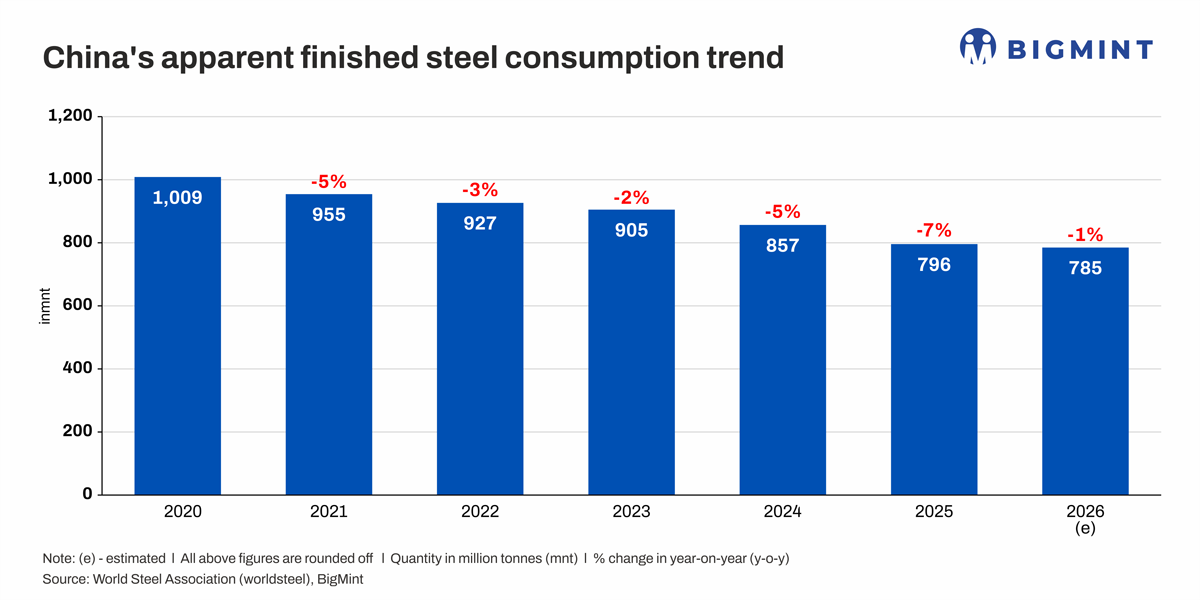
- China’s steel consumption has dropped 17% since 2021 due to real estate crisis
- Machinery, new-age manufacturing, green energy emerge as key pillars of demand
Data Deep Dive: Will steel consumption in China, the world’s second-largest economy, weaken further in 2026? Has steel consumption in China entered a phase of structural decline despite the significant growth in high-tech industries and manufacturing?
Data from China’s National Bureau of Statistics (NBS) show that steel consumption has dropped around 17% from close to 1 billion tonnes (bnt) in 2021 to 830 mnt in 2025. This is largely due to the real estate crisis. While growth in steel demand from manufacturing and exports has been unable to wholly offset the impact of the real estate downturn, most estimates show that consumption will remain largely rangebound in 2026 or may decline only marginally.
This is because of greater momentum in manufacturing demand and a very slight improvement in the construction sector vis-a-vis 2025.
China witnessed exponential growth in infrastructure development and construction since the start of the century coinciding with rapid urbanisation. Growth in manufacturing and exports, too, propelled the Chinese economy, and all these factors created huge demand for steel, with production increasing by an astonishing 700% to over 1 bnt in 2024 from less than 130 mnt in 2000.

However, after decades of rapid infrastructure development, China’s urbanisation and infra growth cycle seems to have run its course. The previous model was based on investment in basic industries. Now that investment is declining and consumption is growing at a relatively slow pace, and so it is getting increasingly difficult to achieve planned GDP growth.
Structural decline in real estate sector
The real estate sector, once the largest downstream consumer of steel, has entered a period of deep adjustment. Data show that the combined share of building construction and infrastructure has declined from 55% of total steel consumption in 2010 to 41% in 2023.
Since the commencement of the 14th Five-Year Plan period (2021-2025), the proportion of steel consumed by the real estate sector relative to total steel consumption has declined significantly from approximately 32% in 2021 to around 23% in 2025. Impacted by market adjustments, the average annual steel consumption in the real estate sector during the 14th Five-Year Plan period fell by approximately 13% compared to the 13th Plan period.
China’s official statistics for January to June 2026 show that real estate development investment fell 18% y-o-y. During the same period, sales by floor area fell 10.8% y-o-y. New construction starts were down around 23%. Buyer confidence is at a low and the market has entered a period of deep structural adjustment.
Sectoral demand trends in manufacturing
Likewise, the transition from a manufacturing-reliant economic growth model to a services-driven one has impacted basic steel demand. The share of manufacturing to GDP has declined from over 30% in the early-2000s to less than 25% in 2025. The services sector, on the other hand, has raised its share in total GDP from around 22% in the 1980s to around 57% currently.
However, this only tells half the story. Within manufacturing, the momentum has definitively shifted from traditional heavy industries such as steel and cement to new-age industries such as NEVs, renewable energy equipment, high-tech industrial machinery, shipbuilding, etc. In terms of steel, the focus has shifted from capacity to quality, cutting-edge customised products for new-age downstream sectors.
As per CISA, the share of manufacturing compared with construction in total steel demand rose for the first time in 2025, a defining moment reflected the steel industry’s adaptation to shifting demand patterns and its efforts to drive product quality improvements and upgrades. For example, the share of machinery and general engineering products in total steel demand has increased from 20% in 2010 to 30% in 2023 and is growing rapidly.
In 2025 China’s steel consumption in the automotive sector edged up by 11% to around 65 mnt. Total auto production increased by over 10%, NEV sales rose by 20% thereby supporting demand for electrical steel and high-end rolled products.
Similarly, the green energy infrastructure consumed greater volumes of steel, Development of wind energy had a positive impact on steel consumption. Unlike solar power plants, which have low steel intensity, wind power plants use steel both for the production of turbines and for the construction of wind towers.
In 2024, China set a record by commissioning 80 GW of new wind plants. In 2025, it surpassed 100 GW of new annual installations, reaching a cumulative capacity of about 640 million kilowatts, and dominating global turbine manufacturing. Moreover, solar additions maintained high deployment volumes, incorporating significant distributed solar, requiring roughly 35 to 45 tonnes of steel per new megawatt of capacity.
Last year China’s production of ships reached 52 mnt, which was over 30% higher y-o-y. China maintained its position as the world leader in shipbuilding, capturing over 68% of new orders last year.
As per Chinese government data, within the industrial sector above a designated size in 2025, the value added of high-tech manufacturing grew by 9.4%, accounting for 17.1% of the total value added of industries. But steel demand from these new-age industries can’t match construction in scale; therefore, overall steel demand has declined.
Consumption outlook in 2026
Estimates are that new home sales will decline by 11-13% in 2026 and the construction sector will churn out much lower steel demand than before. Total land transactions in major cities is also declining progressively. The government’s efforts to stabilise the market and restore buyer confidence may result in a marginal improvement, although structural decline is evident. To control the problem of idle properties, the government may take up a portion of these properties under the affordable housing programme.
Changes in consumer trade-in programmes may have a significant impact on steel demand, especially in the automotive and consumer durables sectors. From January 1, 2026, the tax credit for purchasing a new NEV will be reduced by 50%. Regional subsidy programmes for trade-in schemes, which provide additional payments to car owners when they exchange their old car for a new one, are being tightened and even phased out. These will impact sales and demand for steel.
However, manufacturing momentum is progressing well. China’s shipbuilding completion volume reached 36.5 million deadweight tonnes (dwt) in H1CY’26, an increase of 51.2% y-o-y and accounting for 62.2% of the world total. New orders reached 121.06 million dwt, accounting for 82.3% of the world total.
The machinery sector is turning out to be a stable growth factor in steel demand. For instance, excavator sales reached 152,320 units in the first half of 2026, marking a strong year-on-year increase of 26.4% according to data from the China Construction Machinery Association.
However, auto sales fell by 4% y-o-y in H1CY’26 on high fuel costs, changes in trade-in policies and cautious consumer behaviour. The government’s efforts at enhancing consumer spending will determine the extent of discretionary spending amid an overall contraction in GDP growth at approximately 4.5% in 2026.
Therefore, in the backdrop of these conflicting trends operating on the market, BigMint expects China’s apparent finished steel consumption to decline by around 0.7-1.4% in 2026, remaining at around 785-790 mnt level.
Leave a Reply