- Sellers raise offers amid firmer LME, higher replacement costs
- Buyers continue need-based procurement, resist high offers
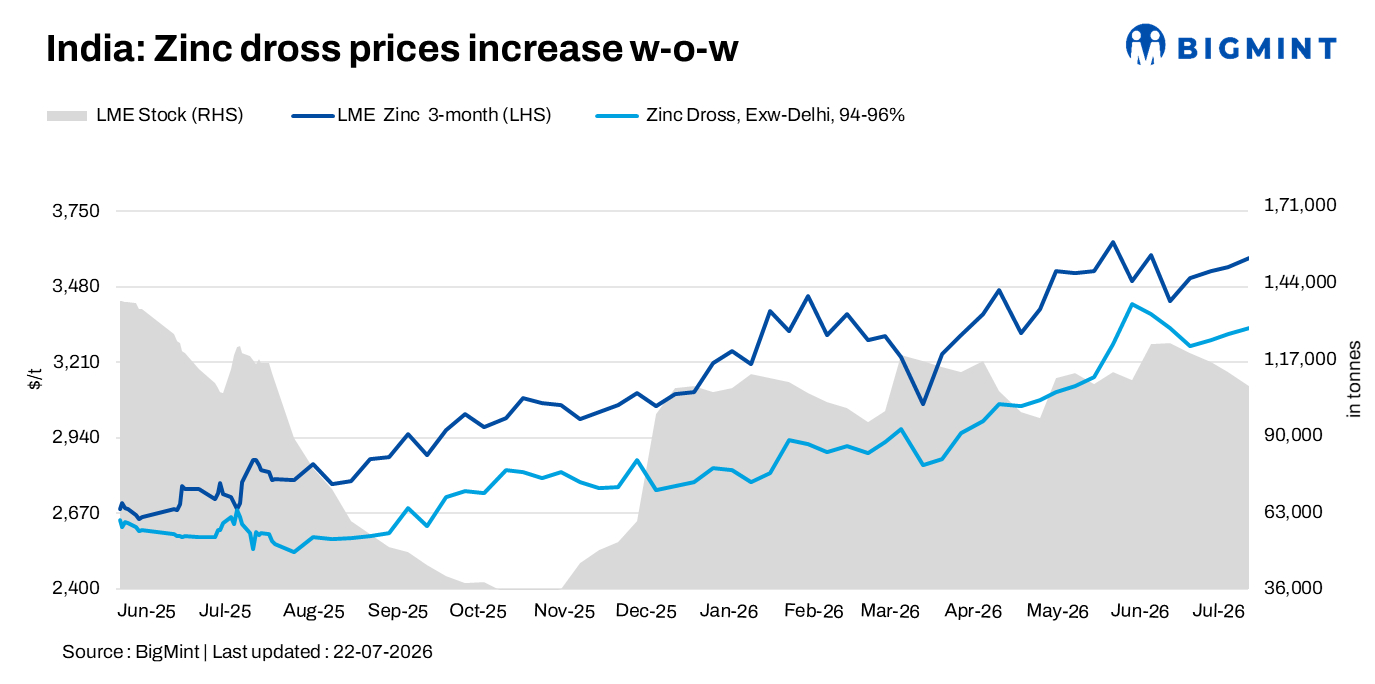
India’s zinc dross and zinc oxide prices extended their gains in the week ended 22 July 2026, supported by a sharp decline in LME zinc inventories and higher replacement costs for secondary material. Although the weekly average of three-month LME zinc prices declined slightly from the previous assessment period, prices recovered towards the end of the week, while falling exchange stocks strengthened the underlying market sentiment.
Benchmark three-month LME zinc prices averaged around $3,559/t during the assessment week ended 22 July, compared with approximately $3,573/t in the previous assessment period. However, prices recovered from $3,529/t on 17 July to $3,583/t on 22 July. Meanwhile, LME zinc inventories declined sharply to 107,650 t on 22 July from 112,450 t on 15 July, a drawdown of 4.27% w-o-w. The continued decline in exchange stocks supported replacement costs and kept sentiment across the zinc value chain firm.
Firmer international prices towards the end of the assessment week and lower exchange inventories translated into higher replacement costs for domestic secondary zinc products, encouraging suppliers to maintain higher offers. However, buyers remained selective, limiting purchases to immediate production requirements as elevated prices continued to meet resistance.
Zinc dross, oxide price movements
Domestic zinc dross prices increased by INR 2,000/t w-o-w to INR 320,000/t ex-Delhi from INR 318,000/t a week earlier.
Meanwhile, zinc oxide (99% Zn) prices rose by INR 1,000/t w-o-w to INR 308,800/t ex-Delhi, compared with INR 307,800/t in the previous assessment.
The increase in zinc dross and zinc oxide prices reflected higher replacement costs amid the firming international zinc market and continued declines in LME inventories. However, the relatively moderate price increases indicated that suppliers remained cautious about pushing offers sharply higher in the face of buying resistance.
Scrap segment trends
In the north Indian zinc scrap market, big Tukdi (97-98% Zn) was heard at around INR 310,000-311,000/t ex-Delhi, up from INR 308,000-309,000/t a week earlier. Meanwhile, mid-sized Tukdi (97-98% Zn) was assessed at INR 307,000-308,000/t, compared with INR 303,000-304,000/t in the previous assessment.
Market participants reported that scrap quotations moved higher alongside replacement costs, although buying interest remained measured. Suppliers were more comfortable maintaining higher offers following the decline in LME inventories and the recovery in benchmark zinc prices towards the end of the assessment period. Buyers, however, continued to negotiate actively for spot requirements rather than build significant inventories at elevated levels.
Market sentiment
Market sentiment remained cautiously firm during the assessment period. Traders said the sharp drawdown in LME zinc inventories and the recovery in international prices towards the end of the week had strengthened replacement economics, making it difficult for sellers to offer material at previous levels.
However, higher prices continued to widen the gap between buyer and seller expectations. Consumers remained selective, with procurement largely linked to immediate production requirements rather than inventory accumulation. While enquiries remained present, buyers showed resistance to accepting further sharp increases after the recent rise in secondary zinc prices.
Suppliers and traders largely aligned their offers with prevailing replacement values, limiting the scope for significant discounts. The availability of zinc-bearing scrap remained broadly adequate, preventing a major supply squeeze despite the stronger pricing environment.
As a result, the market remained fundamentally balanced, with recent price gains driven primarily by replacement-cost adjustments and lower exchange inventories rather than a significant improvement in underlying downstream demand.
Outlook
In the near term, zinc dross and zinc oxide prices are expected to remain supported by replacement costs and the continued decline in LME zinc inventories. The recent recovery in benchmark zinc prices could provide further support to domestic secondary zinc prices if sustained.
However, upside is likely to remain gradual as downstream consumers continue to follow order-linked procurement and resist building inventories at elevated price levels. Market participants will closely monitor whether the recent LME price recovery can be sustained and whether lower exchange stocks translate into stronger physical demand. Unless buying interest shifts towards inventory replenishment, further price gains in the domestic secondary zinc market may remain measured.

Leave a Reply