- Shanxi’s tougher mining rules may tighten China’s coal supply
- Weak spot demand continues to pressure thermal coal prices
Shanxi province, China’s leading coal-producing hub, published a draft regulation on 21 July proposing mine suspensions or even permanent closures for operators found to have engaged in specified illegal mining activities.
Released as a public consultation draft by the provincial government, the proposal is viewed as one of the most significant regulatory interventions in China’s coal sector this year.
The 17-point document targets the long-standing practice of maintaining dual sets of extraction maps — one falsified copy submitted to regulators during inspections, and another showing actual, undeclared operations. It also cracks down on the concealment of “hidden workfaces” — illegal mining zones omitted from official plans and regulatory filings. These areas, often lacking adequate ventilation, gas monitoring, and roof support, rank among the deadliest sources of mining accidents.
These illicit practices are particularly common in unregulated small-mine operations. Operators caught flouting the rules could face production suspensions for rectification, and may be subject to licence revocation and permanent mine closure should they fail to address the violations. Company legal representatives, de facto controllers, shadow managers, and mine directors also risk criminal prosecution. The consultation period ends on 28 July, with the regulation likely to take effect soon thereafter.
In addition, the regulation prohibits dispatched labour in underground operations, outlaws the subcontracting of core mining activities, and criminalises fraud involving surveillance data. Taken together, these provisions signal a structural tightening of Shanxi’s regulatory landscape, which market estimates suggest could curb effective capacity at smaller mines by 10-20%.
The draft comes in the wake of a fatal mine accident in Shanxi in late May. Investigators found the mine had been fined at least five times for concealing illegal working faces and had also unlawfully outsourced operations to unqualified contractors, whose staff had received minimal, if any, safety training.
Shanxi’s raw coal output tumbled 31.5% y-o-y in June, reaching 78.01 million tonnes (mnt), the lowest monthly level since 2019, the latest data from the National Bureau of Statistics showed, indicating a significant impact of safety inspections on the province’s coal supply.
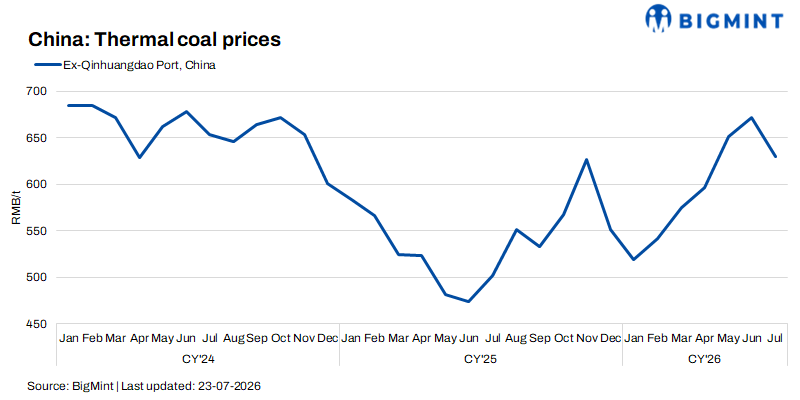
On Tuesday, however, the upward momentum in China’s domestic thermal coal market showed signs of moderating, with price gains at northern ports slowing to their smallest increase in the latest uptrend.
On Tuesday, Mysteel assessed 5,500 kcal/kg NAR thermal coal at northern ports at RMB 824/tonne ($121.7/t) FOB with VAT, up RMB 2/t from Monday. The 5,000 kcal/kg NAR grade rose RMB 2/t to RMB 734/t, and the 4,500 kcal/kg NAR grade edged up just RMB 1/t to RMB 642/t. Along the Yangtze River in East China, both 5,500 kcal/kg and 5,000 kcal/kg NAR grades held flat at RMB 890/t and RMB 795/t respectively.
The seven-session rally, which lifted benchmark 5,500 kcal/kg coal by about RMB 22/t from its 10 July low, is clearly losing steam. Offers for the grade were quoted at RMB 825-835/t FOB, inclusive of VAT, yesterday. Traders noted a growing urgency to liquidate positions, as port inventories continued to build and downstream buying remained thin.
As of Tuesday, the eight northern ports monitored by Mysteel held coal stocks totaling 29.06 mnt, down 0.7% d-o-d but still 7.4% higher than a week ago. The volume was also 14% higher than a year earlier.
Coastal utility data pointed to higher coal burn amid the ongoing heatwave, lending some support to market sentiment. Daily consumption at the six major coastal power groups stood at 874,900 t on 20 July, largely unchanged from the previous day, while inventories fell to 16.4 days of use, down from 19.7 days at the start of the month. Yet despite the inventory drawdown, most utilities have not noticeably stepped up spot procurement at northern ports.
Note: This article has been written in accordance with a content exchange agreement between Mysteel Global and BigMint.
Leave a Reply