- Global fines prices drop by $4/t w-o-w on ample supply
- Chinese mills prefer pellets amid weak steel margins
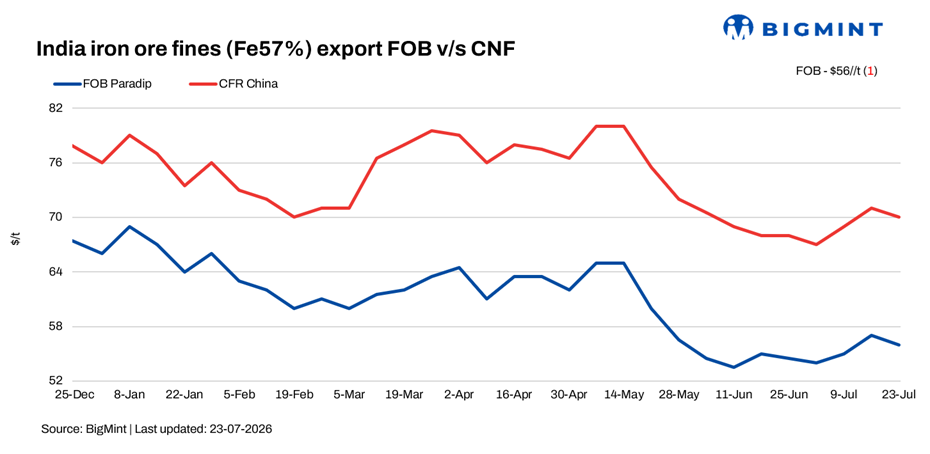
India’s low-grade iron ore fines export prices fell $1/t w-o-w during the latest assessment period, reflecting subdued buying interest from China and limited trading due to wide bid-offer disparities. The fall followed the downward movement in the global fines index, as Chinese steelmakers continued to exercise caution amid poor downstream steel demand and persistent pressure on steel margins.
Rationale
- One deal for Fe 57% was recorded during this publishing window and was taken under prices calculation. Therefore, T1 trade was given 50% weightage in the index calculation. For the detailed methodology, click here.
- BigMint received sixteen (16) indicative prices in the current publishing window, and eleven (11) were considered for price calculation as T2 inputs and given the rest 100% weightage.
Prices, deals
BigMint’s bi-weekly Indian low-grade iron ore fines (Fe 57%) export index decreased by $1/t w-o-w to $56/t FOB (equivalent to $70/t CFR China) east coast on Thursday, 23 July. A deal for around 55,000 t fines (Fe57%) was concluded from the east coast at $71-72/t CFR China during this publishing window.
Market scenario
Market participants linked the softer sentiment to recent developments involving China Mineral Resources Group (CMRG) and Fortescue Metals Group (FMG). According to industry sources, FMG is yet to receive approval for the dispatch of its new lower-grade material, adding uncertainty to the seaborne low-grade market.
No major export deals from India were reported during the current publishing window, as a significant gap between buyer expectations and seller offers kept trading activity muted. Indian exporters were largely seeking discounts of around 20-21% to the low-grade index, while overseas buyers continued to place counter bids at 24-25% discounts, leaving negotiations without conclusion.
An international trader said, “The export market remains under pressure due to weak demand from Chinese steel mills. Mills are increasingly preferring pellet cargoes from India and other origins because higher lump premiums and weak steel margins are making pellets a more cost-effective raw material.”
Meanwhile, the domestic market also remained sluggish. Market participants reported slower movement of low-grade iron ore following the recent DMG notification and dispatch restrictions affecting Odisha-based miners. Limited availability and logistical constraints have reduced trading activity across the region.
A trader based in eastern India commented, “Material movement has slowed considerably after the recent restrictions in Odisha. Although current export demand is weak, some suppliers are holding cargoes as they expect better prices once domestic sourcing improves and market sentiment stabilises.”
Sources indicated that only a handful of exporters were active, while most participants preferred to stay on the sidelines, awaiting improved bids from international buyers before concluding fresh deals.
Domestic vs export market
The price gap between export and domestic realisations was recorded at INR 300/t this week. Export realisations (Fe 57%) were at INR 3,000/t ($31/t) this week, while domestic realisations (Fe 57%) remained stable at w-o-w at INR 3,300/t ($34/t) exw.
Chinese iron ore fines prices fall w-o-w: The benchmark iron ore fines Fe 61% index dropped by $4/t w-o-w to $96/dmt CFR China on 22 July. Seaborne iron ore prices eased as weak spot buying and abundant medium-grade fines supply outweighed support from higher freight and energy costs.
DCE iron ore futures down w-o-w: Iron ore futures on the Dalian Commodity Exchange (DCE) for the September 2026 contract decreased by RMB 11/t ($2/t) w-o-w to RMB 747/t ($111/t) on 23 July.
Outlook
BigMint expects Indian low-grade iron ore export prices to remain largely stable in the near term. Trading activity is likely to stay subdued unless Chinese steel demand improves or buyers raise their bids.

Leave a Reply