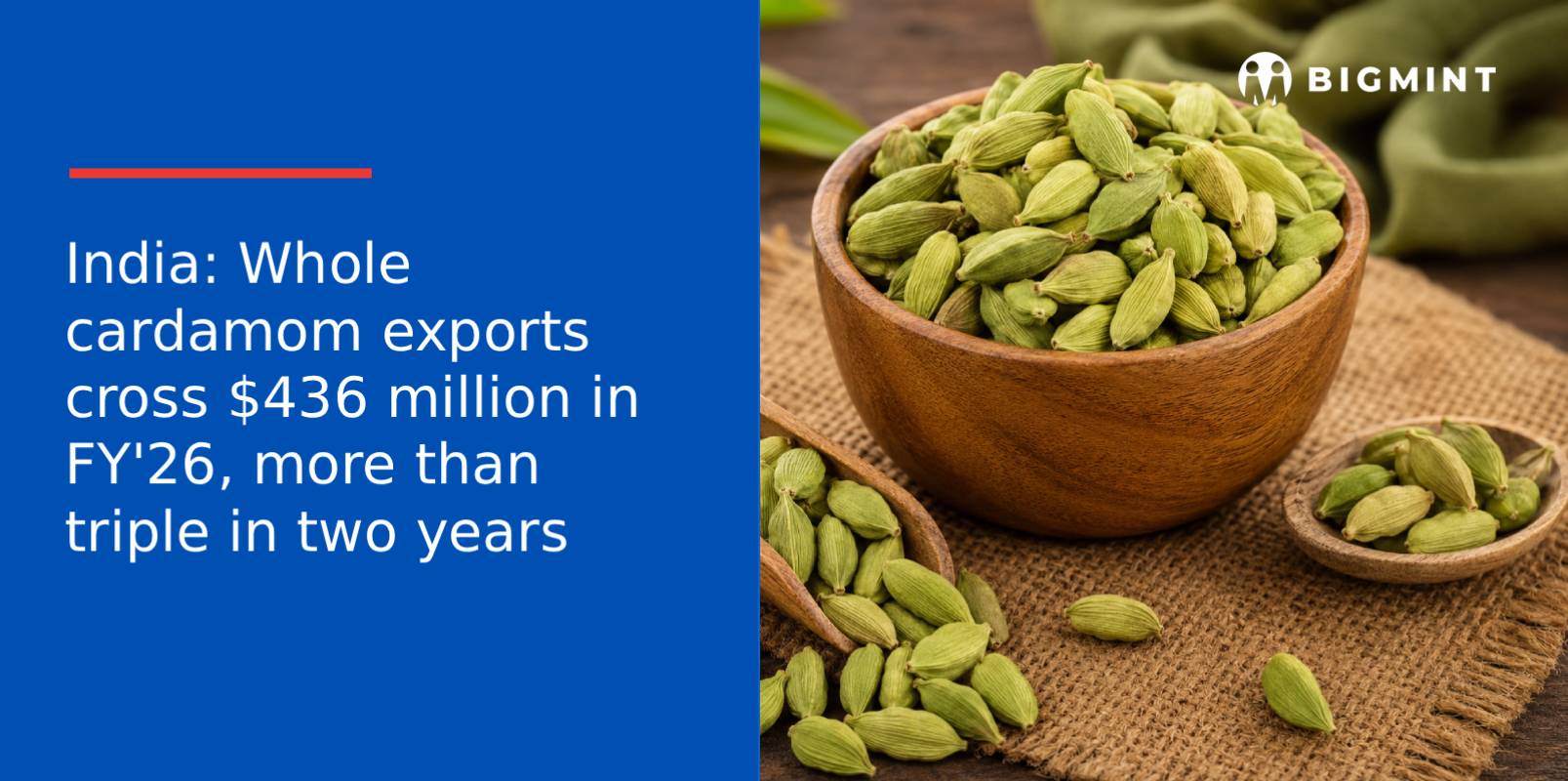
- Shipment volumes more than double over FY’26-24
- UAE, Saudi Arabia remain India’s largest markets
India’s whole cardamom exports climbed to $436.8 million in value terms in FY’26, more than tripling from $131.9 million in FY’24, while export volumes more than doubled during the same period, according to Commerce Ministry data. The growth was supported by rising global demand for premium-quality Indian cardamom and higher overseas preference for its aroma, quality, and purity.
Exports register strong value, volume growth
Export earnings increased to $436.8 million in FY’26, up from $201.2 million in FY’25 and $131.9 million in FY’24. In volume terms, shipments rose to 16,399 t in FY’26, compared with 7,674 t in the previous fiscal and 7,083 t in FY’24.
According to government officials, the strong performance reflects increasing international demand for premium spices, improved quality production, and growing preference among overseas buyers for Indian cardamom because of its aroma, quality and purity.
Middle East leads India’s export destinations
The UAE remained the largest importer of Indian whole cardamom, with imports valued at $135.22 million, followed by Saudi Arabia at $125.16 million. Other major destinations included Bangladesh ($47.71 million), Kuwait ($20 million), Iraq ($13.71 million) and Malaysia ($8.48 million). Indian whole cardamom was also exported to the Netherlands, Australia, Bahrain, Canada, China, Egypt, and Iran.
India cultivates two major varieties of cardamom. Small cardamom, grown across the southern Western Ghats, accounts for the majority of production, with Kerala contributing over 56-58% of the country’s total output, followed by Karnataka and Tamil Nadu. Large cardamom is primarily cultivated in the northeastern states of Sikkim and Arunachal Pradesh, where it is widely used in Ayurvedic medicines and spice blends.
Outlook
BigMint expects India’s whole cardamom exports to remain supported by strong demand from key international markets, particularly the Middle East. Continued focus on quality production and sustained overseas demand are likely to support export growth in the coming seasons.
Leave a Reply