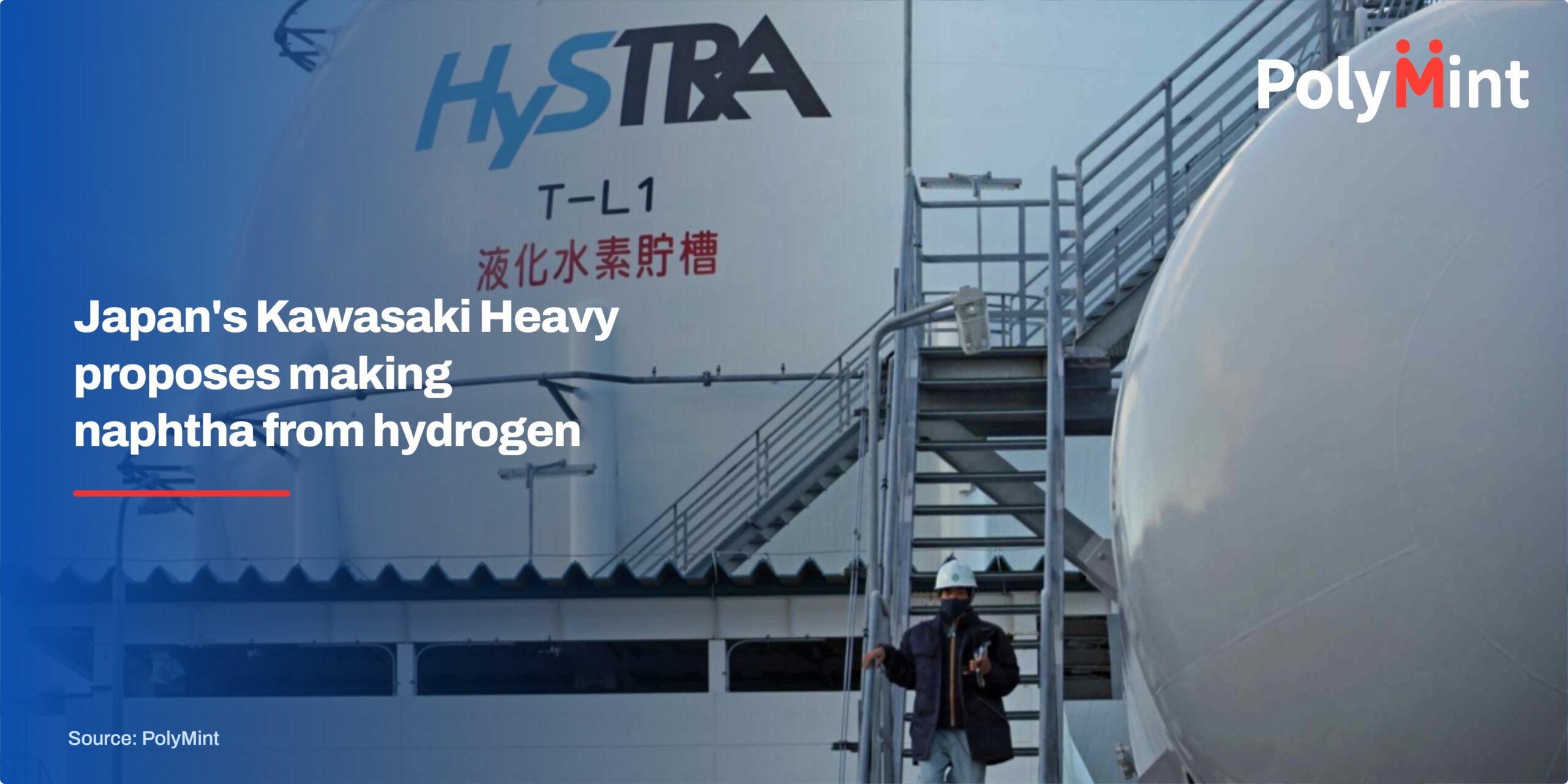
- Move follows supply concerns triggered by disruptions in Strait of Hormuz
- While technically feasible, high hydrogen production costs remain key hurdle
Japan’s Kawasaki Heavy Industries has unveiled a proposal to produce synthetic naphtha from hydrogen, signalling a potential long-term shift in how petrochemical feedstocks could be manufactured. The announcement comes amid supply concerns caused by disruptions in the Strait of Hormuz, which exposed Japan’s heavy dependence on imported crude oil and conventional naphtha.
Japan consumes approximately 20-22 million kilolitres of naphtha annually, with nearly 90% used as feedstock for the petrochemical industry. Naphtha remains the primary raw material for steam crackers, which produce ethylene, propylene, benzene, and mixed xylenes — the fundamental building blocks for plastics including polyethylene (PE), polypropylene (PP), polyvinyl chloride (PVC), polystyrene (PS), and polyethylene terephthalate (PET). Developing an alternative route to naphtha production could therefore have significant implications for feedstock security across the polymer value chain.
The company plans to leverage the Fischer-Tropsch (FT) synthesis process — a commercially proven technology that converts hydrogen and carbon monoxide into liquid hydrocarbons — to manufacture synthetic naphtha. Kawasaki Heavy has already demonstrated the technology at its gas-to-gasoline (GTG) facility in Turkmenistan and believes the same process can be adapted for naphtha production.
Although the technology is commercially proven, widespread adoption will depend on reducing hydrogen production costs, developing low-carbon hydrogen supply chains, and establishing supportive infrastructure and regulatory frameworks. If successfully commercialised, hydrogen-derived synthetic naphtha could emerge as an alternative feedstock for steam crackers, supporting the production of ethylene, propylene, and aromatics used in manufacturing polyethylene (PE), polypropylene (PP), polyvinyl chloride (PVC), polyethylene terephthalate (PET), and other petrochemicals.
How hydrogen can be converted into naphtha
The proposed technology is based on the Fischer-Tropsch (FT) synthesis process, a well-established technology originally developed in Germany during the 1920s. The process converts synthesis gas (syngas) — a mixture of hydrogen (H₂) and carbon monoxide (CO) — into liquid hydrocarbons.
Initially, hydrogen is produced through steam reforming of natural gas, generating hydrogen and carbon monoxide. This synthesis gas is then passed over iron or cobalt catalysts under elevated temperatures and pressures inside an FT reactor. During the reaction, hydrocarbon chains are formed, and by carefully controlling operating conditions, the resulting hydrocarbons can be tailored to fall within the 30-180°C boiling range, producing synthetic naphtha suitable for petrochemical applications.
Unlike conventional naphtha, which is obtained by refining crude oil, this route synthesizes naphtha directly from hydrogen and carbon monoxide without requiring crude oil as the primary feedstock.
Kawasaki Heavy has already proven the commercial viability of this technology through its 600,000-tonnes-per-year gas-to-gasoline (GTG) plant in Turkmenistan and is now proposing to adapt the same process for synthetic naphtha production.
Future low-carbon pathway
Over the longer term, the same process could transition to green hydrogen produced through water electrolysis powered by renewable electricity, or hydrogen generated using low-carbon nuclear power. Such a pathway could enable the production of low-carbon or near-zero-emission synthetic naphtha, supporting both feedstock diversification and decarbonization of the petrochemical industry.
Why naphtha matters to the polymer industry
Globally, around 70-75% of naphtha demand arises from the petrochemical sector, with the remainder used for gasoline blending and industrial applications. In Japan, the share is even higher, as naphtha serves primarily as the feedstock for steam crackers.
A typical steam cracker converts naphtha into:
 These intermediates are subsequently converted into major petrochemical products:
- Ethylene: High-Density Polyethylene (HDPE), Low-Density Polyethylene (LDPE), Linear Low-Density Polyethylene (LLDPE), Polyvinyl Chloride (PVC), and Monoethylene Glycol (MEG).
- Propylene: Polypropylene (PP)
- Benzene and paraxylene: PET, polyester, and styrenics
This illustrates why securing naphtha supply remains strategically important for downstream polymer production and the wider petrochemical value chain.
Strategic significance
Japan operates an integrated petrochemical industry with more than 6 mnt per year of ethylene production capacity, most of which relies on naphtha-fed steam crackers. Any disruption in naphtha availability directly affects cracker operating rates and downstream polymer production.
Unlike North America, where abundant shale gas has shifted ethylene production towards ethane feedstock, Japan continues to depend predominantly on naphtha. Consequently, geopolitical disruptions affecting crude oil and naphtha imports have a greater impact on Japanese petrochemical producers than on many competing regions.
Hydrogen-derived synthetic naphtha could eventually provide an alternative feedstock for steam crackers, supporting production of:
- Polyethylene (PE)
- Polypropylene (PP)
- Polyvinyl chloride (PVC)
- Polyethylene terephthalate (PET)
- Styrenics and engineering plastics
Beyond improving feedstock resilience, the technology could also contribute to long-term decarbonization if paired with low-carbon hydrogen production, reducing dependence on conventional fossil-derived feedstocks while strengthening Japan’s energy security.
Commercial challenges remain
Commercial competitiveness remains the primary obstacle.
According to Kawasaki Heavy, producing synthetic naphtha in Japan currently costs more than twice that of conventional production in the Middle East because of higher feedstock and energy costs. The company’s commercial GTG facility in Turkmenistan required an investment of approximately JPY 150 billion ($920-930 million), highlighting the significant capital required for large-scale deployment.
In addition, green hydrogen production remains several times more expensive than fossil-derived hydrogen. Commercial viability will therefore depend on substantial reductions in hydrogen costs, continued improvements in process efficiency, and supportive policy frameworks.
Japan aims to reduce hydrogen costs from approximately JPY 100/Nm³ today to JPY 30/Nm³ by 2030 and JPY 20/Nm³ by 2050, levels considered significantly closer to competitiveness with natural gas and capable of improving the economics of hydrogen-derived petrochemical feedstocks.
Outlook
Although commercialisation is expected to take several years, the proposal signals a strategic shift in petrochemical feedstock development. Rather than replacing conventional naphtha in the near term, hydrogen-derived synthetic naphtha could initially serve as a complementary feedstock, improving supply resilience during geopolitical disruptions.
As hydrogen costs decline and low-carbon energy infrastructure expands, synthetic naphtha could become an important component of future petrochemical production, supporting both feedstock diversification and decarbonisation. For the polymer industry, this represents the emergence of an alternative route to producing ethylene, propylene, and aromatics — the essential building blocks for virtually every major commodity plastic.
Leave a Reply