- Baowu focusing more on consolidation than mergers and restructuring
- Big steel players creating new avenues for exports, smaller mills struggle
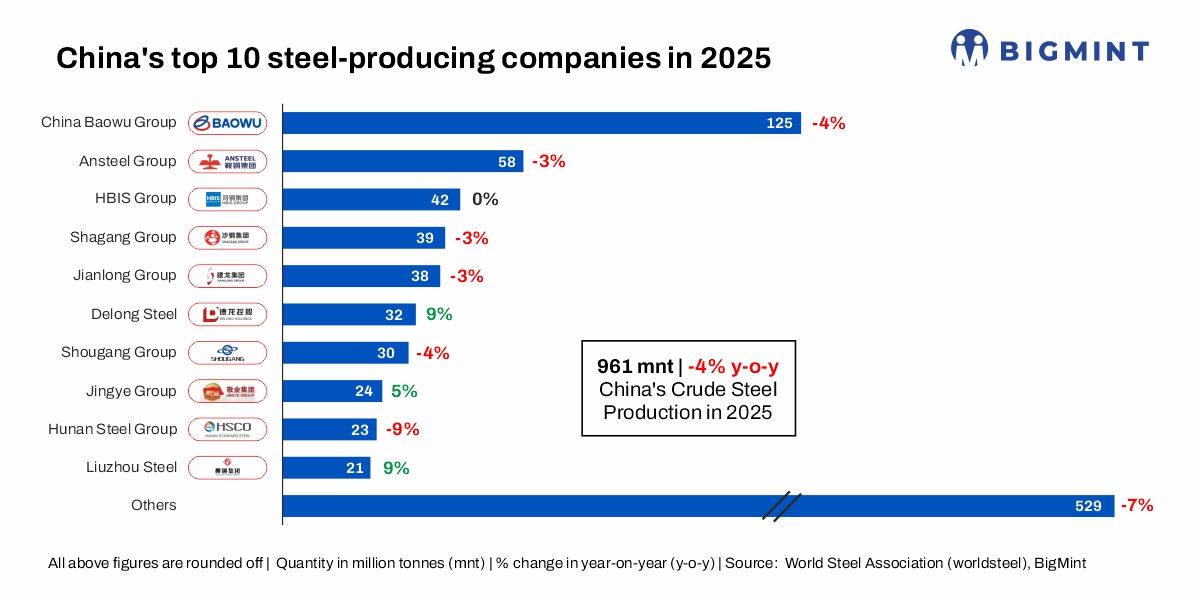
In 2025, the top 10 Chinese steel manufacturers are projected to hold a 45% share of domestic crude steel production, the highest level in 13 years. While the momentum for consolidation among major companies has subsided after a period of mergers, the decline among the top companies has been relatively small amidst a decrease in overall crude steel production, indicating a gradual increase in oligopoly.
Top companies raise market share
The 15th Five-Year Plan, which began this year, includes a section on promoting structural adjustments in industries such as steel, and strengthening and optimising production bases for high-quality steel materials. However, unlike the 14th Five-Year Plan, it does not specify numerical targets such as a 40% crude steel production share for the top five companies and a 60% share for the top 10 companies.
The crude steel production volume of the top 10 companies itself did not increase, falling to 432.26 mnt in 2025, a decrease of nearly 7 mnt from the previous year. However, overall crude steel production fell below 1 bnt for the first time in six years, reaching 960.81 mnt, and the decrease in the denominator allowed the top companies to increase their market share.
Among the top 10 companies, privately owned steel giants such as De Long Iron and Steel Group, which has operations in Indonesia, and Jingye Group saw increases compared to the previous year. On the other hand, state-owned giants, including the largest company, China Baowu Iron and Steel Group, saw decreases, reflecting the government’s request for production cuts.
The line-up of top companies has also shifted slightly, with Liuzhou Iron and Steel, based in the Zhuang Autonomous Region of Guangxi Province, ranking 10th for the first time with annual production exceeding 20 mnt. Its competitiveness has increased since it moved its blast furnaces and other upstream steelworks from Liuzhou City to Fangcheng Port on the coast, and increased production of high-grade steel materials such as heavy plates for shipbuilding and steel sheets for automobiles.
Shandong Iron and Steel Group, which once boasted a production volume of nearly 30 mnt, saw its output decline to 18.26 mnt. This marks the first time since the merger of Jinan Iron and Steel and Laiwu Iron and Steel to form the current group that it has failed to make it into the top 10.
Capacity replacement drive
The Chinese government implemented a revised version of the “Implementation Measures for Capacity Replacement in the Iron and Steel Industry” in April of this year. The conditions for capacity replacement have become stricter, with a new capacity limit of 1 for every 1.5 t of current capacity. Mergers and reorganisations will be given preferential treatment, with a new capacity limit of 1 for every 1.25 t of current capacity. The law also states that “production capacity can be exchanged between different corporate groups” for the next two years.
However, areas where new capacity can be built for air pollution control and other purposes are not necessarily areas of demand, and there is little movement to obtain preferential treatment through restructuring.
Baowu Iron and Steel, which became a 100-mnt producer after restructuring, seems to have stopped its restructuring efforts since acquiring Xinyu Iron and Steel, and is now prioritising internal consolidation within its larger group. It has begun to stably procure high-grade, price-competitive iron ore from the mine it developed in Simandou in Africa, and is emphasising “qualitative growth.”
Some believe that the intensifying “anti-corruption” campaign by the central government is making it difficult for companies within China’s steel industry to take risks and pursue consolidation.
The Chinese government introduced a licensing system for steel exports this year, strengthening its crackdown on illegal exports. However, the total volume of steel exports has not decreased, resulting in a situation where large mills can increase exports while smaller mills struggling to sell are more likely to be eliminated.
The new five-year plan also states that “regulations on safety, environmental protection, energy conservation, and quality will be strictly enforced, and market-driven mergers and restructuring will be promoted to steadily eliminate outdated and inefficient production capacity in an orderly manner.” As overall crude steel production continues to shrink, the market share of the top players is likely to increase.
This article is published as part of a content sharing agreement between BigMint and Japan Metal Daily
Leave a Reply