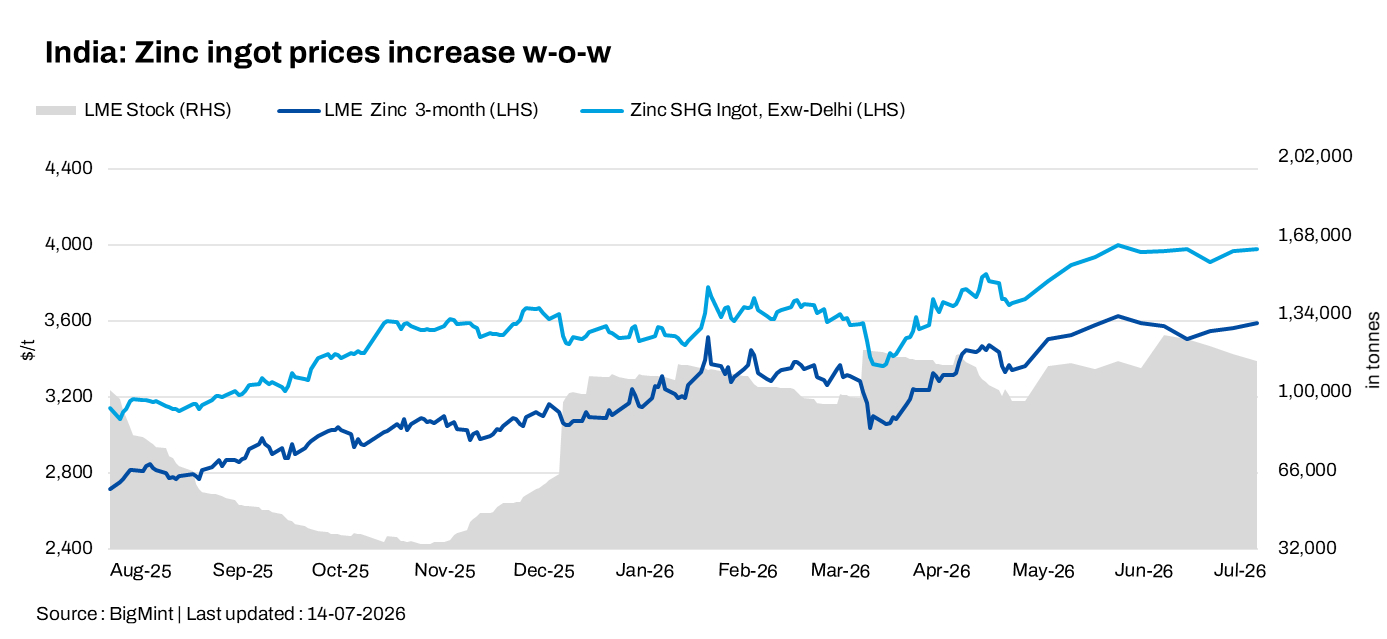
- Domestic zinc prices increase by INR 5,000/t w-o-w
- Port congestion, delayed transshipments keep imports constrained
India’s zinc ingot (99.995%) prices increased by INR 5,000/t w-o-w to INR 382,000/t ex-Delhi, according to BigMint’s latest assessment. The recovery was driven by Hindustan Zinc Ltd’s (HZL) latest benchmark price increase, supported by tightening global supply fundamentals and continued constraints on imported material availability. Despite firmer prices, downstream demand from galvanisers and alloy manufacturers remained largely need-based, with monsoon-related disruptions continuing to weigh on buying activity.
HZL revisions reinforce domestic sentiment
Domestic market sentiment strengthened after HZL increased zinc ingot prices by INR 5,900/t on 13 July compared with its previous revision announced on 10 July. Following the latest revision, the producer’s benchmark Special High Grade (SHG) zinc ingot prices rose to INR 385,600/t.
The sharp upward revision reinforced market confidence and aligned with strengthening domestic spot prices. Traders indicated that HZL’s benchmark continued to serve as the primary pricing reference across the market, even as spot transactions in some regions were concluded slightly above the producer’s benchmark amid tighter import availability and improving sentiment.
Meanwhile, global market fundamentals remained supportive. LME three-month zinc prices edged higher to $3,587/t on 14 July from $3,562/t a week earlier, while cash settlement prices increased to $3,589.5/t from $3,560/t over the same period. LME zinc inventories declined further to 113,450 t from 116,350 t, extending the ongoing drawdown in exchange stocks and reinforcing expectations of tighter global metal availability.
Import market supported by supply constraint, logistical delays
Activity in the imported zinc market remained moderate as constrained overseas supply and logistical disruptions continued to support offers despite subdued domestic buying.
South Korean import premiums were heard at around $265-270/t, while Australian-origin zinc ingots were offered at INR 391,000-392,000/t ex-Delhi. Korean-origin material was heard at around INR 381,000/t, remaining broadly competitive with domestic prices.
Market participants said fresh import arrivals remained limited, with only previously delayed transshipment cargoes gradually reaching the Indian market. Congestion at ports and extended transshipment timelines continued to disrupt supply chains, while maintenance activities and elevated production costs at key Asian facilities further curtailed export availability. The combination of logistical bottlenecks and restricted overseas supply has kept import availability tight, allowing domestic prices to strengthen despite largely need-based procurement.
Alloy and coated steel market
Downstream alloy prices strengthened in line with the recovery in zinc values. Zamak 3 was assessed at INR 390,000-391,000/t, while Zamak 5 stood at INR 398,000-399,000/t ex-works. Primary metal ingot (PMI) was assessed at INR 333,000-334,000/t. Demand from die-casting and engineering sectors remained moderate, with consumers continuing to procure primarily against confirmed orders.
In the coated steel segment, market sentiment remained subdued.
BigMint’s benchmark assessment for Mumbai GP coil (0.8mm/CTL, 120 GSM, IS 277) declined by INR 700/t w-o-w to INR 73,900/t ex-Mumbai, reflecting weak spot demand, comfortable inventories across the supply chain and sluggish material lifting despite lower mill offers.
Meanwhile, Mumbai PPGI (0.5mm/CTL, 90 GSM, IS 14246) remained stable w-o-w at INR 85,200/t, as limited transactions and balanced replacement costs prevented further price correction.
Similarly, Mumbai BGL (0.5mm/CTL, 1220mm, AZ150) remained largely unchanged w-o-w at INR 89,500/t, supported by stable replacement costs despite subdued booking activity.

Outlook
India’s zinc ingot market is expected to remain cautiously firm in the near term. HZL’s latest benchmark price increase, continued declines in LME inventories and constrained import arrivals are likely to provide underlying support to domestic prices. However, monsoon-related disruptions, comfortable spot availability and continued need-based procurement by galvanisers and alloy manufacturers are expected to limit sharper price gains. Market participants will closely monitor HZL’s future pricing strategy, the pace of import arrivals, port congestion, global inventory trends and the timing of a post-monsoon recovery in downstream demand for clearer market direction.

Leave a Reply