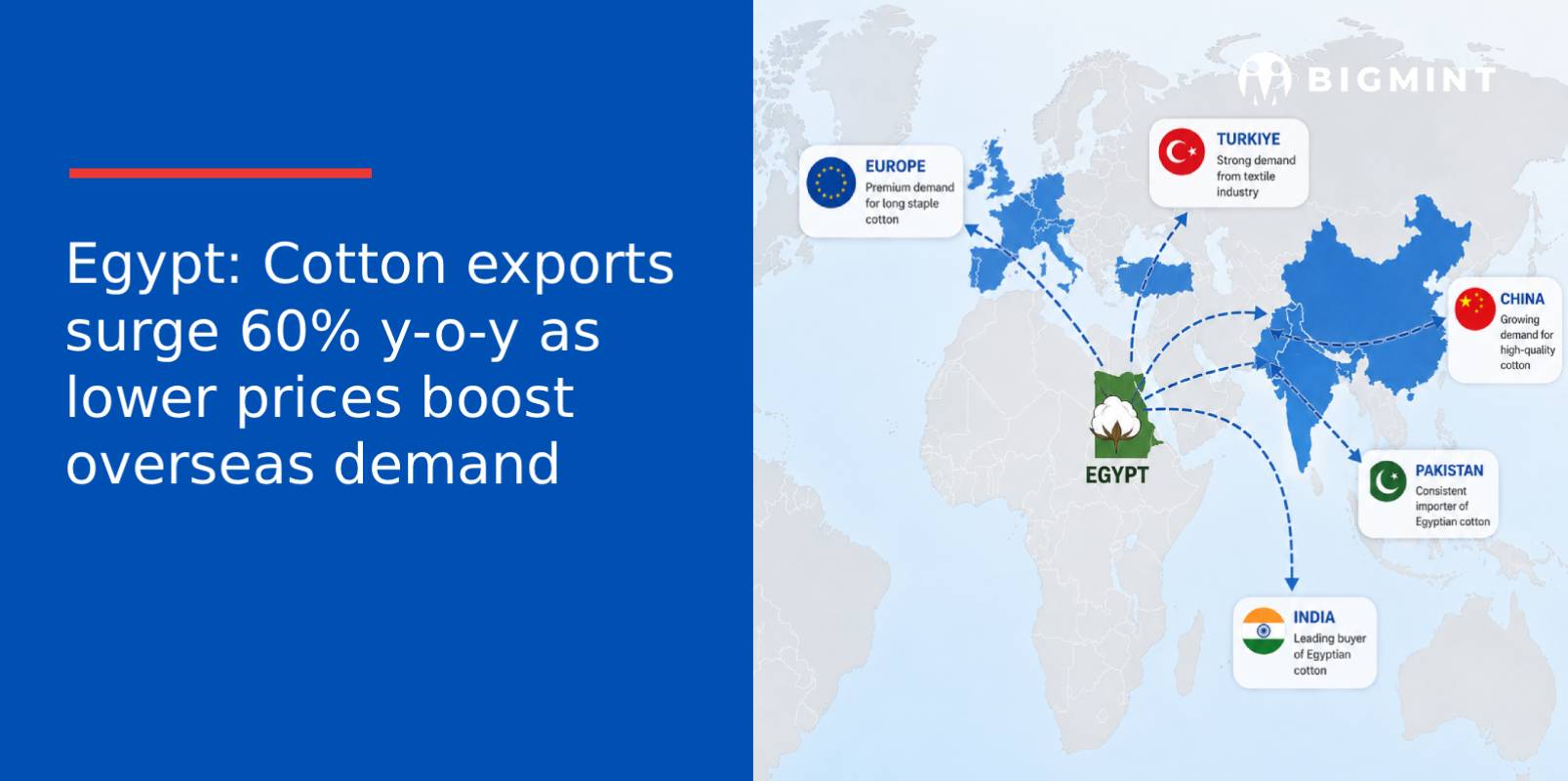
- Egypt’s cotton shipments rise to 57,234 t during Sep’25-Jul’26
- Competitive Giza cotton prices support demand from global spinning mills
Egypt’s cotton exports registered strong growth in the 2025-26 marketing season, supported by improved demand from international buyers amid competitive prices. According to the Alexandria Cotton Exporters Association, shipments increased by nearly 60% y-o-y to 57,234 tonnes (t) during 1 September 2025-4 July 2026, compared with 35,949 t in the corresponding period last season. Egypt’s cotton marketing season runs from September to August.
Asian and European buyers support trade
Demand from major textile manufacturing hubs, including India, Turkiye, China, Pakistan, and parts of Europe, continued to support Egyptian cotton trade. Market participants indicated that spinning mills increased procurement interest as the price correction improved the competitiveness of Egyptian long and extra-long staple cotton against other premium-origin fibres.
“Lower prices encouraged buyers to cover requirements, especially mills producing premium yarn where Egyptian cotton remains preferred due to its fibre strength and quality,” a market participant said.
Price correction improves competitiveness
Egyptian cotton prices witnessed a decline across key varieties, strengthening export enquiries. Giza 94 prices fell to around 142 cents/pound from 147 cents/pound in June, while Giza 95 softened to nearly 106 cents/pound from 107 cents/pound. Extra-long staple Giza 96 was assessed at around 180 cents/pound.
Industry sources noted that the price adjustment narrowed the gap with competing long-staple cotton origins, helping Egyptian exporters regain buyer interest amid cautious global textile demand.
Reduced acreage raises supply concerns
Despite robust exports, supply-side pressure remains a key concern. Egypt’s cotton cultivation area declined sharply to around 195,000 feddans compared with 311,000 feddans a year earlier, while seed cotton output is estimated at nearly 1.5 million kantars.
Outlook
Egyptian cotton exports are expected to remain steady in the near term, driven by demand from premium spinning markets and attractive prices. However, reduced planted area could tighten availability and support prices if overseas buying continues at the current pace
Leave a Reply