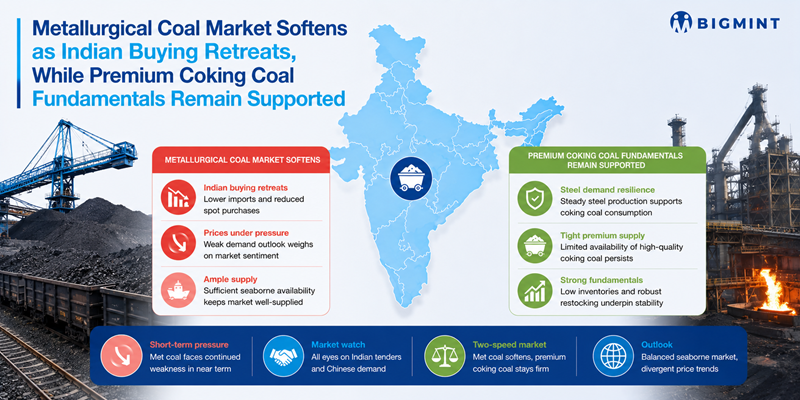
- Weak Indian demand kept spot coking coal buying subdued
- Tight Australian supply continued to support premium coking coal prices
The global metallurgical coal market entered a more cautious phase during the week ended 4 July as subdued steel demand, comfortable inventories and seasonal weakness in India curtailed spot buying. Although Australian premium hard coking coal (PHCC) prices eased modestly, the market stopped short of a broad correction as supply disruptions in Australia and China continued to support premium products. Meanwhile, uncertainty surrounding India’s anti-dumping duty (ADD) on imported metallurgical coke kept both buyers and sellers on the sidelines, reducing spot trading across the value chain.
BigMint’s Premium Hard Coking Coal (PHCC) Index declined by $4/t week-on-week to $263/t CNF Paradip, reflecting weaker bidding by Indian steelmakers rather than a deterioration in global supply fundamentals. Indian mills continued to limit purchases to immediate requirements amid falling domestic steel prices, healthy inventories and weak monsoon-season demand.
Premium Australian coking coal remains fundamentally supported
The weakness in Indian buying contrasted with relatively resilient FOB Australia prices.
Premium Australian cargoes continued to command healthy values as weather-related disruptions and temporary mining interruptions in China’s Shanxi province tightened the availability of premium hard coking coal. During the week, BHP concluded two August-loading transactions – 35,000 t of Caval Ridge at $243/t FOB Australia and 40,000 t of Peak Downs at $244/t FOB Australia – indicating that premium brands continue to attract buyers despite the softer overall market.
While benchmark assessments eased marginally, market participants noted that sellers have shown little willingness to significantly reduce offers because replacement supply remains limited. Premium low-volatility Australian coal therefore continues to trade within a relatively narrow range despite weaker downstream demand.
India remains largely absent from the seaborne market
India has emerged as the weakest major demand centre.
Steel producers are adequately covered for the near term and have largely stepped away from fresh import purchases. The arrival of the southwest monsoon has slowed construction activity, while declining finished steel prices have compressed mill margins, reducing appetite for expensive imported coking coal.
Several market participants reported that Indian buyers were unwilling to bid above $250-260/t CFR India, well below prevailing seller expectations. As a result, some Australian cargoes originally intended for India have reportedly been redirected towards China and other Asian destinations.
Rather than importing additional cargoes, several Indian traders have also begun offering previously purchased premium cargoes into the secondary market, illustrating the cautious procurement strategy currently prevailing across the country.
China presents a contrasting picture
China continues to offer a more balanced market.
Although seaborne buying activity remains subdued and traders report abundant port inventories, Chinese crude steel production remains relatively strong. Domestic cokeries have proposed a tenth round of coke price increases since early March, supported by continued profitability and tight availability of certain domestic premium coking coal grades.
Chinese steel mills are increasingly adjusting their coal blends rather than increasing imports. Instead of purchasing expensive seaborne premium hard coking coal, many mills are increasing the use of domestic fat coal and blended coals to achieve the desired coke strength after reaction (CSR), thereby reducing dependence on imported premium cargoes. This has limited fresh seaborne demand despite relatively healthy steel output.
Metallurgical coke market waits for policy clarity
India’s metallurgical coke market remained dominated by policy uncertainty.
The expiry of the provisional anti-dumping duty on imported low-ash coke, combined with the absence of a government notification regarding its extension or revision, has effectively frozen buying activity.
Eastern Indian BF-grade coke prices declined by around INR 500/t week-on-week to approximately INR 36,000/t ex-Jajpur, reflecting slow sales and limited spot transactions. Western India remained comparatively stable near INR 34,000/t ex-Gandhidham, while foundry coke prices held broadly unchanged around INR 36,400/t ex-Rajkot.
Interestingly, several southern Indian steelmakers reported shortages of domestic coke and indicated interest in imported material irrespective of the eventual anti-dumping duty. However, most participants continue to delay purchases until policy clarity emerges.
Indonesian coke softens as buyers resist higher offers
Imported Indonesian BF-grade coke also came under pressure.
FOB Indonesia assessments declined as suppliers lowered selling indications amid limited buying interest, while CFR India prices remained comparatively stable because buyers largely stayed away from the market.
Weak Indian demand, together with uncertainty surrounding the anti-dumping duty, prevented suppliers from successfully passing through higher raw material costs, despite firm Chinese domestic coke prices.
PCI market remains stable but lacks fresh momentum
The pulverised coal injection (PCI) market remained relatively stable during the week, although buying activity continued to be limited.
Weak steel margins across Asia reduced incentives for mills to aggressively optimise blast furnace productivity through higher PCI injection rates. Most steelmakers continued to operate with adequate inventories and limited purchases to contractual requirements.
The absence of significant spot activity suggests that PCI prices are likely to remain broadly range-bound until steel production improves or blast furnace utilisation increases meaningfully.
Freight provides little directional support
Freight movements offered few surprises.
Australian Panamax freight to India remained broadly stable around $18.9/t, supported by steady vessel availability and Australian export programmes. Stable freight rates meant that delivered coking coal costs were driven primarily by movements in FOB prices rather than shipping costs.
Outlook
The metallurgical coal complex is entering a period of consolidation rather than structural weakness.
Demand-side fundamentals remain subdued, particularly in India where monsoon-related slowdown, falling steel prices and comfortable inventories continue to suppress import activity. However, the supply side remains considerably tighter than in the thermal coal market.
Weather disruptions in Australia, production interruptions in parts of China and limited availability of premium low-volatility coal continue to underpin FOB values.
The next direction for the market will likely depend on three factors: the pace of recovery in Indian steel demand after the monsoon, China’s steel production and coke pricing strategy, and the Indian government’s decision on anti-dumping duties for imported metallurgical coke.
Until greater clarity emerges, buyers are expected to continue following a requirement-based procurement strategy, keeping spot trading volumes subdued while premium hard coking coal prices remain relatively well supported.

Leave a Reply